
The Art of the Gaze: Male Gaze in Famous Renaissance Paintings is a gallery of paintings from the Renaissance created within the 14th to 17th century. The works in this series focus on the ideology of the “male gaze”. The term “male gaze” has developed and evolved through forms of art, film, and other entertainment entities. The “male gaze” is a term coined by Laura Mulvey who wrote about this phenomena in her paper, “Visual Pleasure and Narrative Cinema” in 1973. This term encapsulates the way the media describes and depicts women through the perspective of a man. Although this term started to gain traction in 1973, the “male gaze” can be recorded in recent films all the way to 14th century Renaissance paintings. In the Strange Case of Dr. Jekyll and Mr. Hyde, Robert Stevenson paints a descriptive account of the characters in the story. These characters are mainly limited to men, but in the future adaptations of this story, women are introduced. The addition of these female figures in the film adaptations are primarily for “the male gaze”. They are used for visual pleasure that almost disrupts the plot. The following paintings during the Renaissance accurately depict the “male gaze” through the use of nudity, framing, lighting, and the underlying message it is trying to convey. This gallery aims to illustrate and analyze the “male gaze” in a different medium rather than film. Overall, this gallery’s goal is to allow the audience to reflect on their knowledge on the “male gaze” and what other forms of media that have witnessed this theory.
Botticelli, Sandro. The Birth of Venus. 1485.
The painting depicts Venus emerging from the sea. Venus is in the forefront of the image, in the background the ocean. On either side of Venus is said to be the winds bowing her to shore and a handmaiden covering her up. The colors are almost muted with tints of yellow, but Venus almost appears to be glowing. The image is framed to showcase Venus as the focal point of the painting. In terms of shot depiction, this painting would be a wide shot. This is to ensure the story of the painting is able to be received accurately. The use of light and staging of the images, brings the viewer;s attention to Venus. This depicts the use of “male gaze” because Venus is the Goddess of Love and Beauty and this is an image of her birth. Birth is a sacred and intimate moment and by capturing this scene, it has voyeuristic tendencies. In the primary text of the Strange Case of Dr. Jekyll and Mr. Hyde, there is an absence of many women characters. There are references to maids and other servants, in traditional roles. In The Birth of Venus, Venus is the Goddess of Love and Beauty which places her in a traditional role that women are projected to be in.
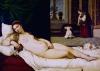
Vecelli, Tiziano. The Venus of Urbino. 1534
This painting is another depiction of the use of nudity to portray the image of innocence and purity in the lives of young women during the Renaissance Period. The woman is posed seductively among a draped bed as she is staring romantically at the viewer. The color and lighting on the woman is bright and produces images of innocence. There are other colors of red and deep golds that express the wealth the young woman must hold. The young woman also extends from one end of the canvas to the other in a leading line. This specific painting is the most prolifIc images of the “male gaze” in the Renaissance Period. Women in this age were seen as objects or “scenery” as we can see in this painting. In the adaptations of Dr. Jekyll and Mr. Hyde, the woman figures were also categorized as prizes to be won. As mentioned throughout the gallery, “Visual Pleasure and Narrative Cinema” expresses the use of “scopophilia”. In this painting, the woman is the main image that produces a seductive energy with leads to the voyeuristic feeling of looking at something you shouldn't be.
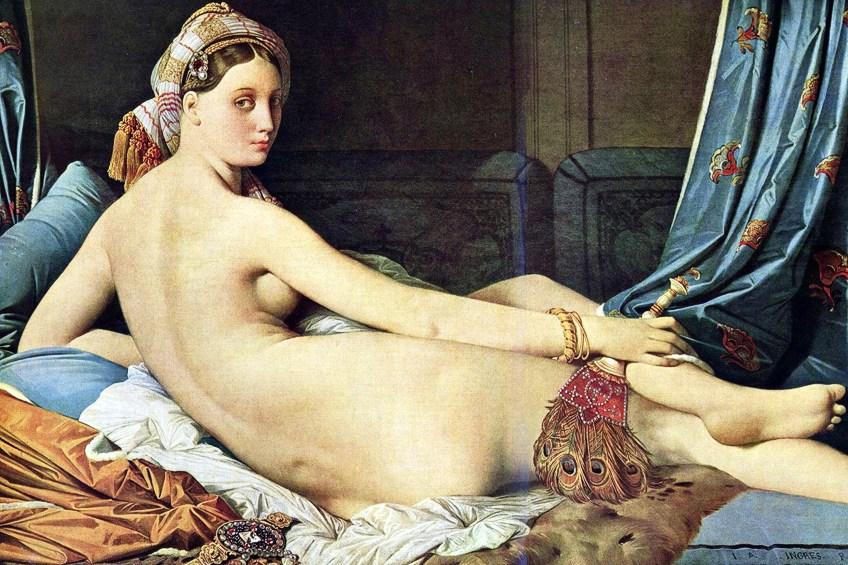
Dominique Ingres, Jean-Auguste. La Grande Odalisqueis.1814
The La Grande Odalisqueis is a painting of a young and confident woman in an “odalisque”. An odalisque was a term used for the living quarters for women and concubines, or mistresses during the 18th century. This was a very controversial piece for the time as it depicted a woman not only in the nude, but also with confident energy as she stared directly at the viewer. This painting was created to show how women were able to control their own bodies and own the skin they lived in, but it is just another example of the “male gaze” in Renaissance paintings. Instead of imagery of a woman in an active role of motherhood, working, or in a place of power, there are recurring images of women in the nude. A major theme in Laura Mulvey’s, “Visual Pleasure and Narrative Cinema” is “scopophilia”. This is a term that encompasses the love of looking (primarily things of sexual nature). In this painting, the woman takes up the entire canvas, there are no other images or objects that could overtake her figure. This produces a voyeuristic feeling of looking at something you shouldn't be.
Gentileschi, Artemisia. Susanna and the Elders. 1610
This painting depicts the image of a young woman perched on a step attempting to ward off older men. Susanna is nude, only one cloth around her leg. The lighting is bright on her pale skin as the elders around her are towering above her creating dark shadows and harsh lines. This painting uses extreme illustration to convey the feelings of disgust and fear in the face of Susanna. The story that emerges is one of a young girl that is trying to protect herself from the advances of older men. This perfectly outlines the term “male gaze”. As previously mentioned, the young girl is nude and her body is the focal point of the piece. The lighting and the colors on Susanna create the innocence and purity that was associated with women during the 16th century. In Laura Mulvey’s, “Visual Pleasure and Narrative Cinema”, the roles of men and women in film are categorized as passive and active relationships. This explains that women are the characters that do not take action within the plot, but allow the action to happen to them. The men in films are in control of the plot and in the active role of the relationship. In this painting we see how the young girl is trying to escape as the men are actively throwing themselves onto her.
Works Cited
Mulvey, Laura. “Visual Pleasure and Narrative Cinema.” 1975.
Stevenson, Robert Louis, 1850-1894. The Strange Case of Dr. Jekyll and Mr. Hyde. London :New English Library, 1974.
Botticelli, Sandro. The Birth of Venus. 1485
Dominique Ingres, Jean-Auguste. La Grande Odalisqueis.1814
Gentileschi, Artemisia. Susanna and the Elders. 1610
Vecelli, Tiziano. The Venus of Urbino. 1534