



The paper silhouette grew in popularity in 18th-century England. A skilled artist could produce an engaging silhouette in a very short period of time. Étienne de Silhouette, who enjoyed making paper creations now called "silhouettes," was a cheapskate, so the art form came to have connotations of cheapness. Nonetheless, the silhouette offered a relatively inexpensive alternative to other forms of portraiture including the portrait miniature, painting, drawing, or sculpture. Silhouettes were created well into the nineteenth century for members across the social classes, particularly for women. This case features a silhouette of both of Austen's parents displayed at the Jane Austen House Museum and "A Lively Mind: Jane Austen at 250" at the Pierpont Morgan Library, 2025. However, as the case progresses, we see how Reverend George Austen and Jane's brothers (with the exception of her less able bodied brother George) merit a portrait. In contrast, Mrs. Austen's silhouette--a cheaper alternative to portraiture--appears in this same family tree; Cassandra is not pictured, and Jane is represented via the circa 1810 sketch Cassandra made of her sister. The appearance of Austen--a canonical author whose fame continues to rise in academic and popular circles--remains fuzzy since neither her silhouette nor Cassandra's sketch offers a definitive portrait of this gifted writer known for her witty, romantic fiction.
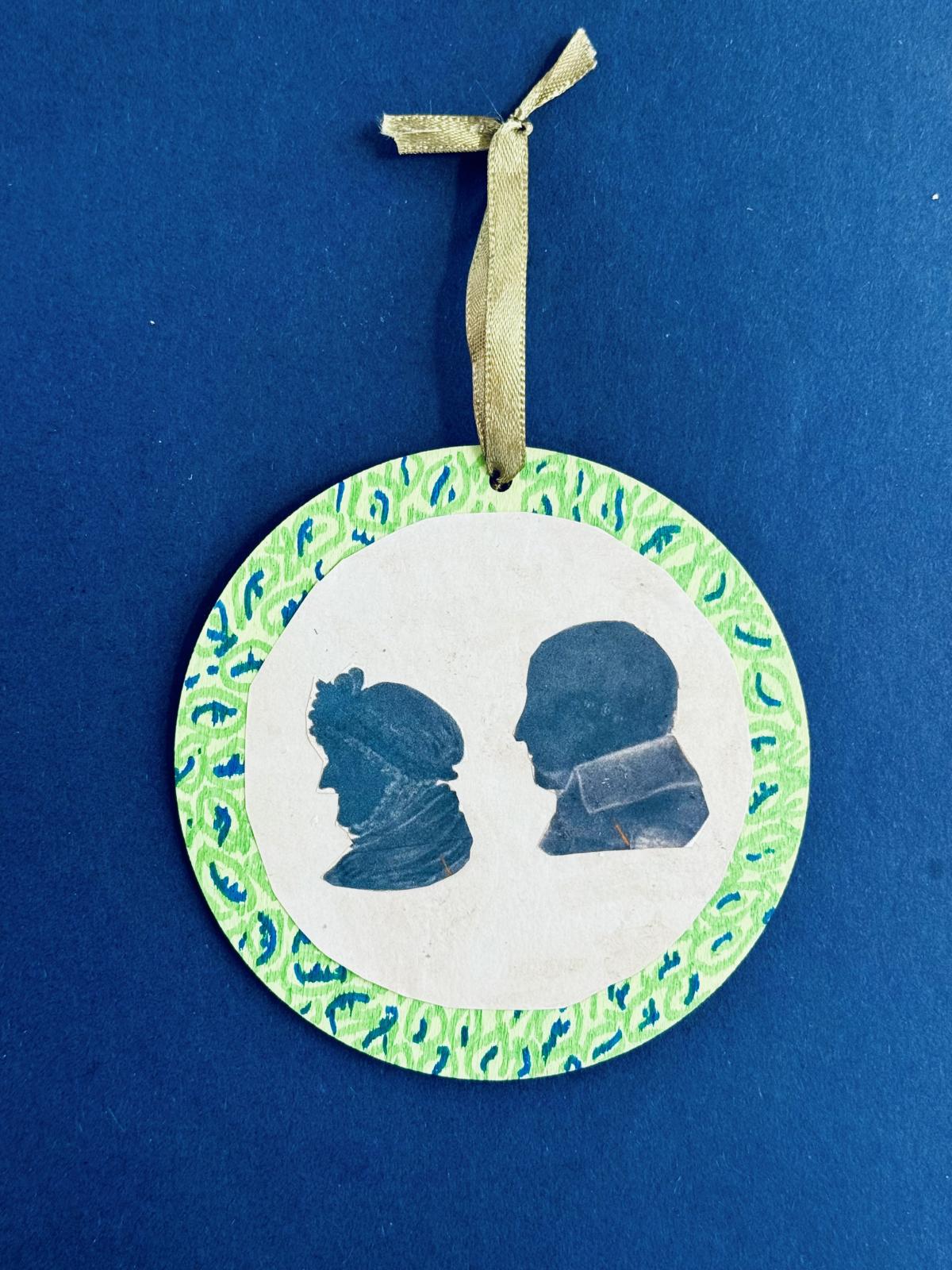
Recreation of Silhouettes of Jane Austen's Parents, Cassandra Leigh Austen and Reverend George Austen, by Catherine J. Golden, 2025. The silhouettes, based on those on display at both the Jane Austen House Museum and the Pierpont Morgan exhibit, show the the subject’s head and bust in profile. Mrs. Cassandra Leigh Austen appears to be wearing a cap, which was the important female head covering of the 18th century. For respectable genteel women such as Mrs. Austen, the cap was most likely made of linen or lace. The cap provided warmth and modesty as well as fashion; indeed, in this silhouette, Mrs. Austen's cap seems to sport a fashionable bow. The silhouette of Reverend George Austen shows him to have a regal nose, akin to that of his wife, and wears the clerical collar, designating his profession and genteel social status. The two silhouettes are placed on one canvas, painted pale green, framed with a leaf border that recalls the wallpaper on which the silhouettes were mounted at the Pierpont Morgan exhibition.
The Silhouette and the Critical Crafting Process, photograph by Catherine J. Golden, 2025. The process of creating a silhouette was very enjoyable since I have dabbled in this art form before. The inspiration for my double silhouette came from silhouettes on display at the Pierpont Morgan exhibition, "A Lively Mind: Jane Austen at 250.". I photographed the silhouettes and then printed them out. I tried cutting out the silhouettes and tracing them onto black paper. However, I realized that I would lose some of the details if I recreated the silhouette only in black, so I used the cut out of the photo. Although the Austens were framed separately in the display, I decided to put them in one frame. I also experimented with various colors for the background and settled on a green. As the picture shows, I experimented with an orange background to pick up the color in the framing of the original images, but I found green a better choice. I then used a dark green and blue marker to recreate the leaf patterned wallpaper used in the exhibition as a backdrop for the silhouettes (see the third image in this case). This leaf pattern serves as a border or frame for the double silhouette. The silhouette has a gold ribbon to be mounted on a wall.
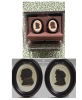
Photo of a pair of framed silhouettes of Austen’s parents, Reverend George Austen (1731-1805) and Mrs Cassandra (Leigh) Austen (1739-1827), Pierpont Morgan Library exhibition, "A Lively Mind: Jane Austen at 250," 2025 by Catherine J. Golden in a Collage with a Photo of the Silhouettes on Display at Jane Austen's House Museum, Chawton, UK. These silhouettes from the early 19th-century school show George and Cassandra (Leigh) Austen. Each is in a dark oval frame, measuring 8cm x 6.5cm. Of note, the silhouettes were arranged differently in the two locations as the collage shows. Whereas the Reverend George Austen is placed to the left and hence in front of his wife at the Jane Austen House Museum, Cassandra is placed to the left and hence in front of her husband in "A Lively Mind." For my recreation, I followed the lead of the Pierpont Morgan exhibition and placed Mrs. Austen in front of the reverend.
The Austen Family Tree, photo taken by Catherine Golden from The Austen Papers, 2025. The Austens had 8 children, six sons and two daughters. Of note in this family tree, Revered George Austen and 5 of Jane's six brothers appear in a portrait. Edward Austen Knight, the third brother who was adopted by wealthy childless cousins, appears in a fancy ruffled shirt and suit coat. His portrait is in color. The Reverend George Austen and James, the eldest son, appear in clerical dress as does Henry, Jane's favorite brother, who took orders after failed business adventures. Brother Frank and Charles wear naval uniforms; both Austen brothers had distinguished naval careers. The only brother not pictured is George, who was thought not to be able bodied. He remained close to the Austens but lived in the village of Steventon. The absence of his portrait speaks to the Regency view of disability much as the use of a silhouette for Mrs. Austen--as opposed to a portrait--reflects Regency views of gender. Although a silhouette of Cassandra does exist, it does not appear in this well-known family tree. Jane appears in the circa 1810 sketch made by Cassandra. The pencil and watercolor is very small, measuring 4 1/2 inches by 3 1/8 inches, which is smaller than a 3 by 5 inch photograph. The family tree thus offers insight into the role of gender and disability in the Regency period.
Silhouette from 1800-1815, hollow-cut, of Jane Austen, artist unknown, 4 in. x 3 1/8 in. (102 mm x 80 mm), Wikimedia. This silhouette thought to be of Jane Austen allows us to view Jane Austen's character, hairstyle and dress. It is influenced by Neoclassicism. Austen's hair is pulled into a bun, which, along with the chignon, was fashionable in her day. Austen wears a "chemise dress," an Empire style gown popular in the Regency era that flatters what we can glimpse of her figure. Moreover, the silhouette reveals Jane has a tranquil, pleasing countenance--she looks genteel. This silhouette, along with Cassandra's sketch of Austen on display at the National Portrait Gallery, are the only images we have of Austen while the male members of her family merit portraits. In Regency England, silhouette art emerges as gendered.