
William Holman Hunt is one of the "greatest single influence[s] in what is now coming to be known as the artistic Renaissance of the Victorian age," as he played a huge role in developing the Pre-Raphaelite movement in England. Or in other words, Hunt helped establish a new artistic movement to challenge the ideas and motivations of the Renaissance. When he was young, he participated as a student at the prestigious Royal Academy of Art in London where he perfected the skill of oil painting. He was taught alongside other famous artists including J.M.W Turner and William Blake. In 1848, he formed the Pre-Raphaelite Brotherhood, a select group of artists, and poets with similar interests. Presumably, the brotherhood was established to rebel against the standards taught within the Royal Academy. Essentially, they wanted to create a new standard for the art they were producing focused on a different type of morality. Therefore, within the brotherhood, there was a list of established standards. For example, some of the common themes of the art were to have genuine ideas, study nature, and exclude what is conventional. Some other members of the Brotherhood include Dante Rossetti and John Everet Millais.
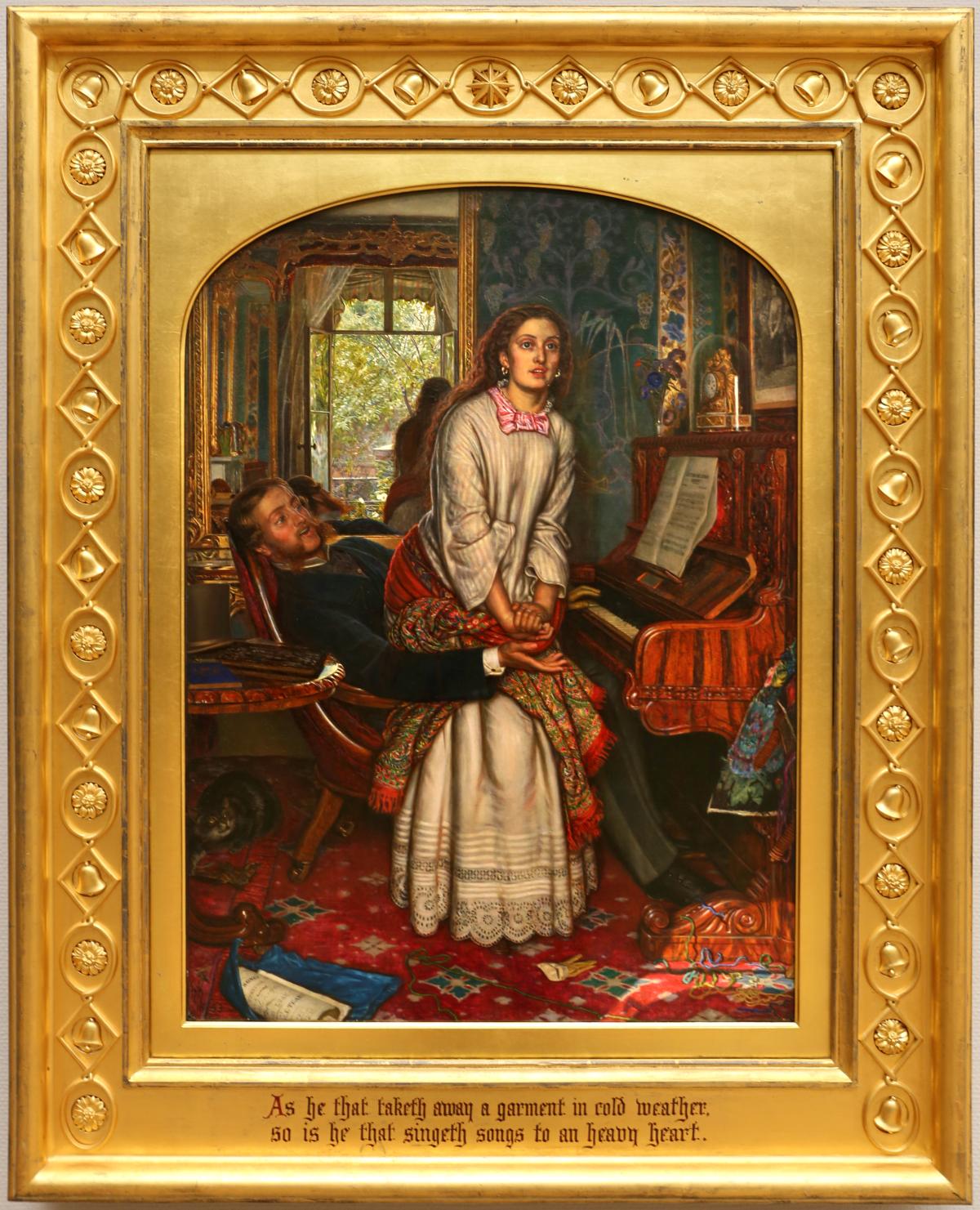
1853, oil-on-canvas, The Awakening Conscience was painted by William Holman Hunt. The painting currently resides in the Tate in Britain and was commissioned by Thomas Fairbairn The painting itself is considered a Pre-Raphaelite piece of work, and it upholds most of the standards selected by the brotherhood. Furthermore, in the 19th century, paintings that were deemed as Pre-Raphaelite often had internal elements such as brutal realism, which included the physiognomy of religious figures. Therefore, some of the common themes of their art included sexual morality, poverty, and other modern social problems. In the painting, Hunt depicts a young 'gentleman' with his mistress presumably living together out of wedlock. Furthermore, the woman in the painting doesn’t have a wedding ring. The real-life subject of the painting was the young 15-year-old Annie Miller. At the time, she was Hunt’s girlfriend. The painting is filled to the brim with symbolic imagery. One symbol within the painting shows the mistress as she has a spiritual revelation and is represented by the sunlit garden reflected into the mirror. Some interpretations view the mirror as the woman’s loss of innocence and that the light depicts possibly redemption. Such as, within the painting, the star is a likely symbol of spiritual revelation. Furthermore, this ties directly into the social problem novel we're discussing in class. This can tie into Jane Eyre as this is what Rochester initially wanted him and Jane to do, to live with each out of wedlock. The topics discussed by the pre-Raphaelite brotherhood are common themes in our course curriculum as well. For example, North and South discuss modern social problems such as poverty. I would argue that North and South is a great example of the brutal realism that the pre-Raphaelite brotherhood was interested in.
Works Cited
“William Holman-Hunt.” American Art News, vol. 8, no. 35, The Frick Collection, 1910, pp. 4–4, http://www.jstor.org/stable/25590613.
(William Michael Rossetti, ed., Dante Gabriel Rossetti: His Family-Letters, with a Memoir, London 1895, I, p.135)
Tate. “'The Awakening Conscience', William Holman Hunt, 1853.” Tate, 1 Jan. 1970, www.tate.org.uk/art/artworks/hunt-the-awakening-conscience-t02075.
Tate. “Why Were the Pre-Raphaelites so Shocking? – Essay.” Tate, www.tate.org.uk/art/art-terms/p/pre-raphaelite/why-were-pre-raphaelites…;
Tate. “William Holman Hunt 1827–1910.” Tate, www.tate.org.uk/art/artists/william-holman-hunt-287.