
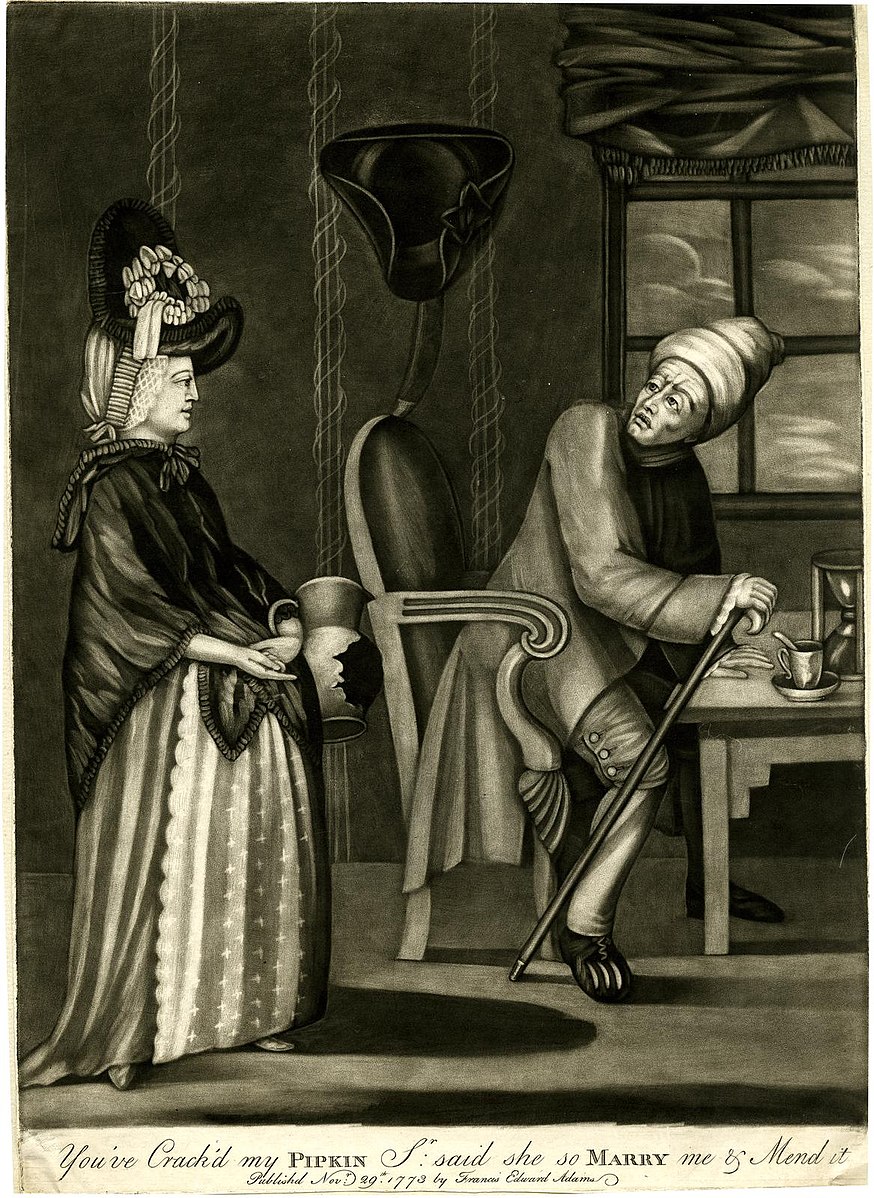
Imbedded in the Poor Laws of the 18th century, which dictated how the poor were to be treated, were bastardy laws. These were designed to both punish women for having children out of wedlock, and determine the treatment and life of children born outside of marriage. According to the early laws designed to deal with illegitimate children, it was the unwedded mother-to-be’s responsibility to declare her pregnancy and the father of the child so that he may be held financially responsible. A father’s legal obligation did not guarantee his financial support, however. In the event that the father did not or could not provide for the child’s well-being (which was often the case), and assuming the father didn’t leave town in order to escape his responsibility, he would be arrested and the task of giving financial support would fall on the parish until the father could continue payments. These bastardy laws decreed that a child of illegitimate birth would inherit its mother’s lot in life. This led to many children growing up and working in the workhouses. These laws come into play at the very start of Dickens’ Oliver Twist, when Oliver’s mother dies with “no wedding-ring” (Chapter I), leaving the parish to assume Oliver is illegitimate and, thus, must go to the workhouse once he is of age.
Works Cited
Adams, Francis E. You've Crack'd my Pipkin Sr: said she so Marry me & Mend it. 1773. https://commons.wikimedia.org/wiki/File:You%27ve_Crack%27d_my_Pipkin_Sr-_said_she_so_Marry_me_%26_Mend_it_(BM_2010,7081.385).jpg. Accessed 17 Feb 2021.
.jpg)
Dickens, Charles. “Chapter I.” Oliver Twist, Project Gutenberg, 2020. http://www.gutenberg.org/files/730/730-h/730-h.htm. Accessed 17 Feb 2021.
Higginbotham, Peter. Bastardy, http://www.workhouses.org.uk/poorlaws/oldpoorlaw.shtml#Bastardy. Accessed 17 Feb 2021.
Roberts, Stuart. “Supporting London's Bastard Children.” University of Cambridge, 26 July 2018, www.cam.ac.uk/unmarried_mothers. Accessed 17 Feb 2021.