
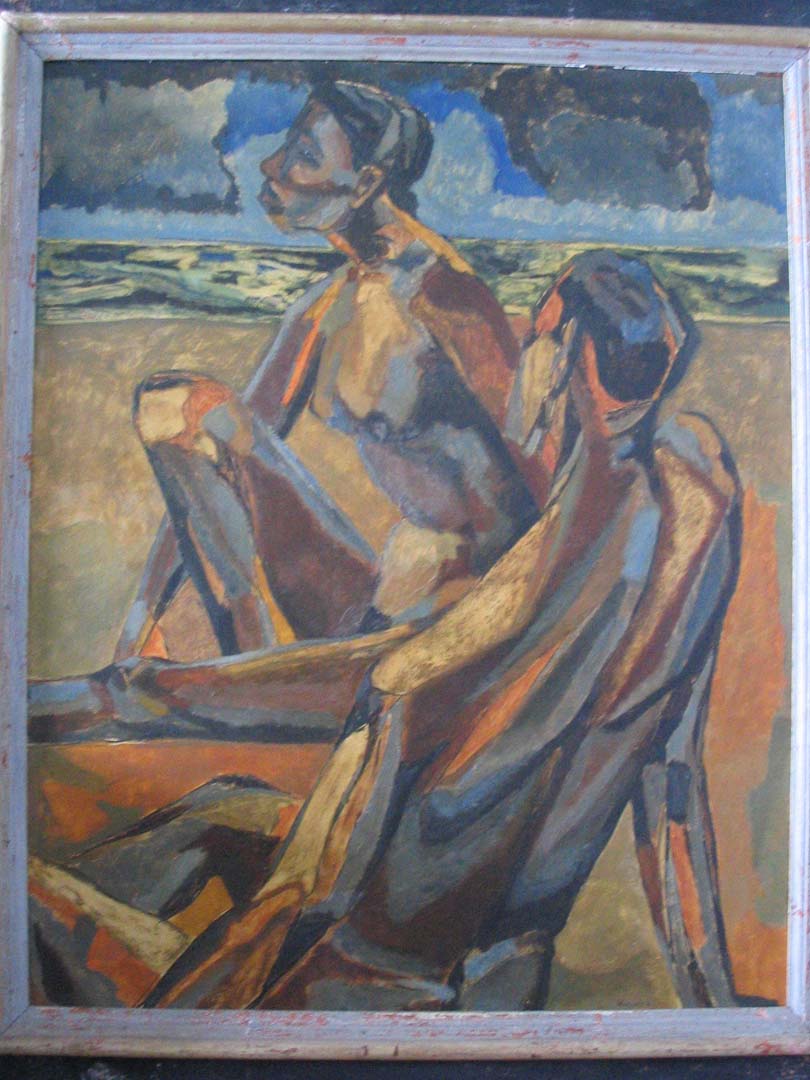
Philip Pearlstein wrote an article called, "Why I Paint the Way I Do" to the New York Times in 1971 which he compares himself to being a realist in a world of surrealists and expressionists. In Two Nudes on a Beach, some elements of surrealism remain as it was painted in 1949, but overall, this painting represents the turning point of Pearlstein's artistic style. The faces are surrealist interpretations and so are the bodies. The beginning of Pearlstein's focus on the nude body, as it presents itself, is seen here. The popular cultural aspects during the height of surrealism are better understood in this article. Pearlstein, a pioneer of Realism, details the struggles of finding his artistic style.
To combat the violence of abstract expressionism, whether it be on canvas or by the hand of the artist, Pearlstein discovers objectivity and a new sense of realism within his artwork. Pearlstein writes, “ Suddenly I aspired to be nonexpressive, to remove my own gesture, handwriting, fancy brushwork from the process of painting” (Pearlstein). In Two Nudes on a Beach, the violence of the brushstroke is found within the landscape and the angles of the models on the beach. In more of his later works, the violence previously mentioned is replaced with softness and attention to skin details that expressionism and surrealism often overlook. By painting objectively, Pearlstein was fully able to appreciate and understand his models, talent, and other artistic capabilities.
Pearlstein, Philip. “Two Nudes on a Beach (Melanctha).” Philip Pearlstein, 17 July 2019, 1949. https://philippearlstein.com/work/early-work/1949-two-nudes-on-a-beach-melanctha-college-after-war/Links to an external site. Accessed 18 Mar 2023.
Pearlstein, Philip. “Why I Paint the Way I Do; Why I Paint the Way I Do.” The New York Times, The New York Times, 22 Aug. 1971, https://timesmachine.nytimes.com/timesmachine/1971/08/22/90687723.html?pageNumber=149Links to an external site. Accessed 18 Mar 2023.
INTERPRETATION:
Considering the background info involving the three events defined, Philip Pearlstein’s influence on the surrounding art community of the 20th century remains impactful. In Two Nudes on a Beach and the rendition, the expression elements are seen as a shadow of Pearlstein’s artistic beginnings, next to his future wife and closest friend. The expressionistic brushstrokes are exaggerated displaying the artistic trends of the 1940s. We can fully appreciate Pearlstein’s realist artworks by understanding his past as an expressionist. Compared to his realism pieces, Two Nudes on a Beach seems uncomfortable with a certain air of conformity, perhaps boring. The original is dark, dreary almost, with the absence of light despite being known for his ability to convey light. The faces of the figures are dramatic with sharp brushstrokes and dark contours, Pearlstein’s relatability is lost here but gained in his future artworks. Pearlstein was able to be influenced by and remain friends with Warhol, a notable expressionist at times while cementing his unique art style. Pearlstein’s ability to transcend past critics, trends, and other influences at the time to develop his style. At the time of his passing in 2022, Pearlstein’s art was graphic but not explicit. His ability to depict light, nudity but not nude, and the natural lines/curves of the body continues to inspire the art community. Although Pearlstein’s relatability could be mistaken as a weakness, it is one of his greatest strengths. Through his nude portraits, the viewer, like us, can see ourselves and our bodies within the paintings.