

Display Explanation:
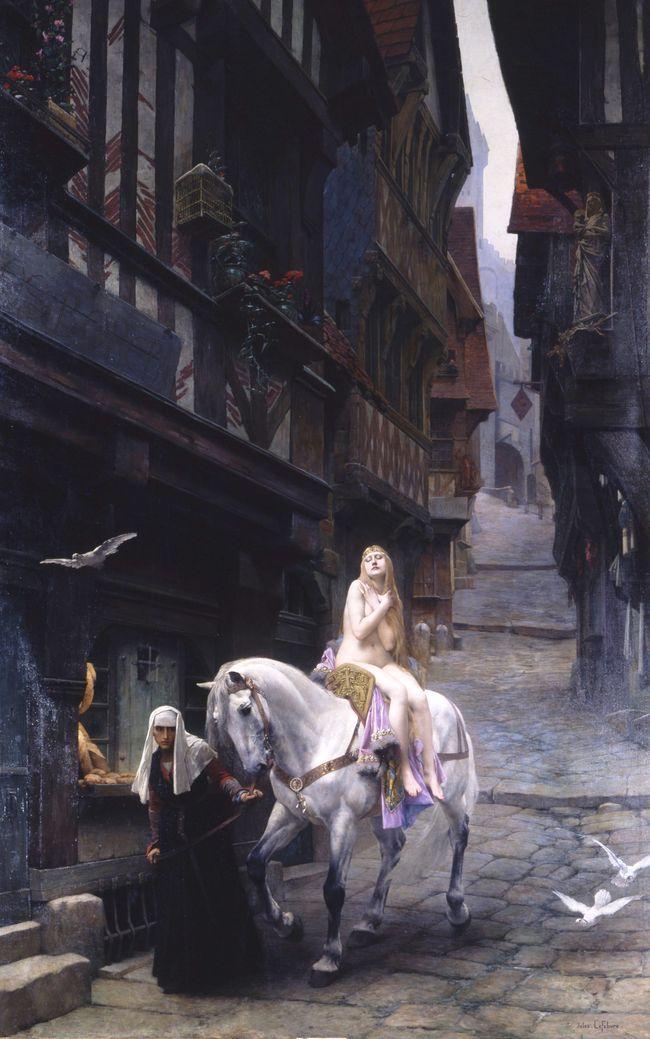
Each painting displayed will have separate rooms and a hallway entering each room to elicit the tone of the paintings. Additionally, each painting will be temporarily borrowed from where they are currently being housed, presented as the original dimensions. The first painting shown, Lady Godiva painted by Jules Lefebvre, will be the original piece that is currently being exhibited in the Salon Carré, a room in the Louvre Palace in France. The original dimensions of 24.4 x 15.3 inches will be presented. The first hallway that is entered before the room where Lady Godiva’s painting is, will be a construction of the town pictured in the painting. The colors used to depict the town will be dark, as well as the ighting. As one walks through the hallway they are able to witness the dimension of the tall buildings. The buildings have sculptures, terraces, and plants decorating them. When the guest walks through the entirety of the hallway as if they are leaving the town, they will enter a bright room where Lady Godiva is presented on a vintage golden easel. A beautiful bright light casts on her while a smoke machine blows, looking like God is shining his light upon her. The walls are painted of pastel clouds, creating a graceful and fluffy atmosphere. The floor will be stone, creating the feeling that you are present with Lady Godiva as she is guided out of town. As you look above, the ceiling is covered in fluffy cotton, creating a bright cloudy sky. Hanging from the clouds are white felt birds. This room will exude ethereal feelings, almost heavenly-like.
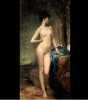
The only way through this installation is to continue through the next hallway. This tall and thin hallway is encompassed by various shades of blue satin tapestry. This blue tapestry is on the ground, walls, and ceiling. It signifies the water and most importantly, Chloé’s clothes coming off. This hallway will play sounds of soft and relaxed rippling water. At the end of the hallway, directly straight on, you see the 102.3 x 54.7 inches original portrait, Chloé painted by Jules Lefebvre, that is currently being kept at the Young and Jackson Hotel saloon bar. This portrait is big, which makes it the main focal point of the room, standing on the ground. The ground is lit by moving blue light and fog machines like you’re in the water near her. The walls are covered in exotic hanging plants like you are in a jungle. This room pulls in natural elements to elicit feelings of being in nature with Chloé, like you can feel her close by. On the wall to her right, where she is looking, there is a projection of Lady Godiva. Physically presenting Chloe observing Lady Godiva with deep interest.
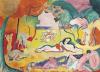
The projection of Lady Godiva on her horse leads the visitor to the final hallway. Almost like you are walking through the wardrobe to Narnia, various textured fabrics hang from the wall. The viewer almost sees nothing, like they are walking through the thick deep forest while listening to the pure sounds of nature. Once you exit the hallway into the next room, the visitor’s eye is likely to not stop with so much detail and color to experience. The painting Le bonheur de vivre by Henri Matisse, with original dimensions of 69.5 x 94.75 inches, is also presented on a vintage golden easel in the front half of the room. Guarded by various exotic plants, the floor is concealed with yellow satin fabric, while the ceiling is enclosed by several types of the vibrant colorful textured fabric to sculpt various kinds of forestry. These details illustrate the elements of the painting to bring them to life. The walls will have paintings of the people who belong in this land; men and women posing signifying the love of self, poses that represent diverse bodily movements, playing instruments, and lovingly embracing each other, with confidence, comfortability, and courage. Along with these men and women will be Lady Godiva and Chloé, who have found their final destination. Artists have come together to visually reenact the dance that is in the furthest part of the painting. These artists dance for hours for everyone to expand their minds to something they may have never seen. This portrayal is meant to challenge the viewer in ways to lead them to the discovery of true human connection.
Installation Note:
Lady Godiva. In exchange to drop the tax on her husband’s tenants, he dared her to ride a horse through town, naked. This adequately exemplifies the power dynamics, while highlighting sexuality, between men and women during the time of this painting in 1891. For a woman to hold any kind of power in a higher position, she had to exploit her body in some form. The legend of Lady Godiva states that she requested all town folk to stay indoors and block their windows. Lady Godiva was caring of others, so much so that she was willing to defy normalcy and present naked through the town she resided in. Presenting respect for herself and fellow residents by requiring privacy, she exhibits comfortability within her own skin. She doesn’t need approval or validation from others. I challenge to extend this tale by offering the visitor to imagine Lady Godiva escaping town, in protest for respect. Notice the birds, perhaps leading the trio to a final destination. Somewhere Lady Godiva truly belongs.
Chloé. A woman painted nude. Shaven, signifying youth. Historically, the woman pictured in this painting was vastly admired by others, especially men in the military. Her portrait was hung in a hotel bar, where men would come and enjoy her portrait’s beauty. Soldiers that visited the bar were so fascinated by her that they would write letters to her when they were away at war. These men remembered the painting, Chloé, and imagined their time with her when they were most isolated. This reaction to the painting exemplifies a man’s attraction to women. Not only is she beautiful, but she is also a figure of sexual gratification and passion. The power and influence she possesses are significant. Nudity was desired but also seen as taboo during this time, 1875, which can also be categorized as “a frenzy of religious protestation” (OnlyMelbourne). I would like to use this fuel of resistance, to help us imagine how and why this painted Chloé is where she appears to be: alone in the woods. May she be escaping the criticism to find the place and people she truly belongs to. The place where her soul aspires to reside. In the power she possesses, she follows her heart and intuition. She surrenders, to an inner knowing of where she needs to go. Suddenly, she notices Lady Godiva, led by a horse. She decides to follow them.
After a long excursion, the women painted in Lady Godiva and Chloé have made it home; the place their souls were striving to be. Where their souls will rest and belong. This final destination is where people who have sustained the restraints from their places of origin go, to be among people with free spirits. A place the people pictured in the painting have been longing for but didn’t quite know what it was… Until they found it; a land of cultural celebration, where souls were dispersed in different areas of the world to find their way back home. The place where all magical, curious, pure, and sexual desires are explored and fulfilled. Le Bonheur de vivre (The Joy of Life). The vivid color of this painting dramatically symbolizes the fluidity experienced between humans. A human soul who knows how to expand their hearts into the absolute true pleasures without shame: sex, dance, movement, unconditional love, truth, appreciation, authenticity, acceptance, and exoticism. A person who instead of conforming, they are courageous enough to explore the limits of their existence.
Citations:
Jules Lefebvre. Lady Godiva. 1891. https://en.wikipedia.org/wiki/File:Lady_godiva_full.jpg. Accessed 16 Feb. 2023.

Jules Lefebvre. Chloé. 1875. https://en.wikipedia.org/wiki/Chlo%C3%A9_(artwork)#/media/File:Chlo%C3%A9,_par_Jules_Joseph_Lefebvre.jpg. Accessed 16 Feb. 2023.
#/media/File:Chlo%C3%A9,_par_Jules_Joseph_Lefebvre.jpg)
Henri Matisse. Le Bonheur de vivre. 1905-1906. https://en.wikipedia.org/wiki/Le_bonheur_de_vivre. Accessed 16 Feb. 2023.
“Chloe: Jules-Joseph Lefebvre.” OnlyMelbourne, https://www.onlymelbourne.com.au/chloejules-joseph-lefebvre.
“Lady Godiva.” Wikipedia, Wikimedia Foundation, 30 Jan. 2023, https://en.wikipedia.org/wiki/Lady_Godiva.
“Lady Godiva.” Wikipedia, Wikimedia Foundation, 30 Jan. 2023, https://en.wikipedia.org/wiki/Lady_Godiva#:~:text=Today%2C%20she%20is%20mainly%20remembered,Leofric%2C%20imposed%20on%20his%20tenants.