
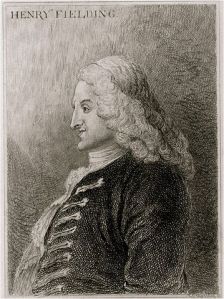
Prior to the early 18th century, England did not have any sort of professional police force. Criminals were mostly apprehended by private citizens who caught theives or murderers and the like, who were then turned over to parish constables or night watchmen to properly arrest the criminals. But in 1749, Henry Fielding established the "Bow Street Runners" who became responsible for catching and dealing with criminals. They were funded by the magistrates office and were able to bring more professionalism to the job of arresting criminals than private citizens who would often make mistaken or vindictive arrests. Sir John Fielding was able to help the force gain government recognition and financial help, under his leadership they were even able to create a criminal database to help officers in their investigations.
By Dicken's time the Bow Street Runners had become mostly incompetent and ill-equipped to deal with crime in a growing city. In Oliver Twist, Dicken's adds a bit of humorous social commentary about the Bow Street Runners. There is a scene in Oliver Twist where some noise is heard outside the Maylie's house and Brittles happily cries that "It's the runners!" and the doctor, Mr. Losberne, is quite upset by the knowledge, afraid that they will arrest Oliver. Mr. Losberne, Mrs. Maylie, and Rose all come up with a plan to fool the Bow Street Runners, Blathers and Duff, and the Constable and convince them all that Oliver was simply a victim and not the thief that had broken into the Maylie's.
Works Cited
Beattie, J.M. “The First English Detectives: The Bow Street Runners and the Policing of London 1750-1840.” Oxford University Press, 2012, https://journals.openedition.org/chs/1442. Accessed 11 Feb. 2021.
Image Source
Wild, Jonathon the Great. A sketch portrait of Henry Fielding – Novelist and Law Enforcement Magistrate, 1743. Wikimedia Commons, https://commons.wikimedia.org/wiki/File:Henry_Fielding_c_1743_etching_from_Jonathan_Wild_the_Great.jpg. Accessed 11 Feb 2021.
