
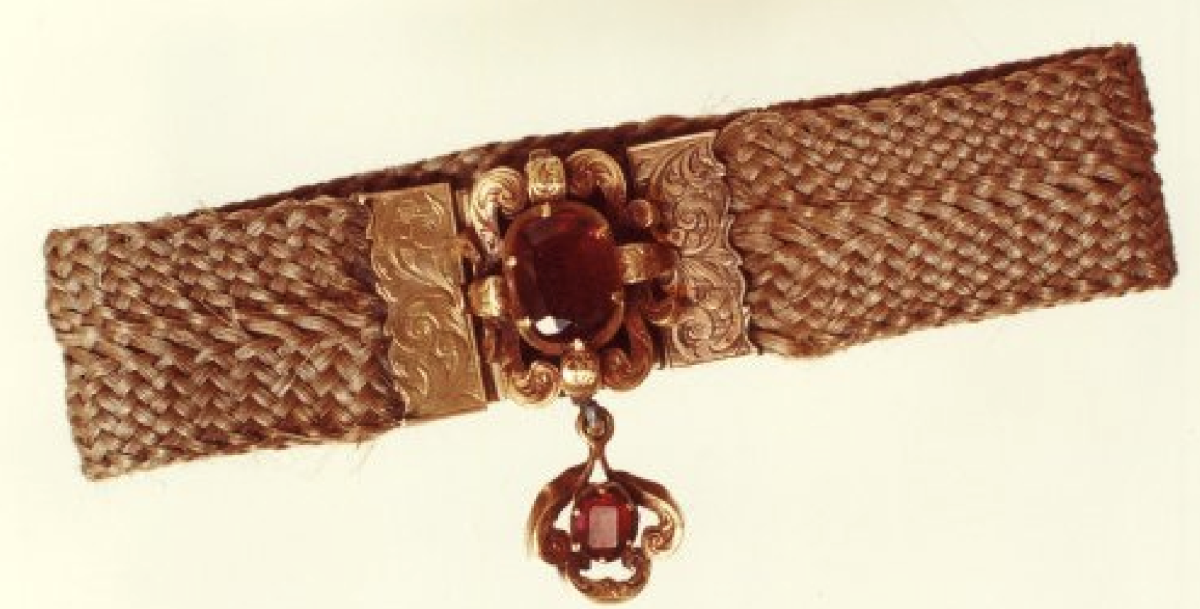




Mourning is a stage that goes beyond the actual death. Although the Brontë sisters, most notably Charlotte Brontë, had seen all of her beloved sisters and brother die, she was able to carry more than subjective recreations of those she was mourning. She held dear to her and wore everyday a woven bracelet that was made of both of her deceased younger sisters' hair (but notably not of Branwell's hair, due to his complicated and troubled relationship to his family members). Hair jewelry was extremely popular in the Victorian era due to the inaccesability of images of the deceased. In this way, lockets of one's hair were able to be taken post mortem and treasured as a relic. Charlotte was able to carry with her everyday the sentiment of her sisters being near. The hair bracelet is now kept in the Brontë Parsonage Museum along with the second image that containes hair from the Brontë family members. The second two images relate to Branwell Brontë and his mourning of both his physical self and of his failed potential and difficult life.
Chalotte Brontë's Hair Bracelet, the Brontë Parsonage Museum, Haworth, UK.
This bracelet is made of the hair of Charlotte Brontë's deceased sisters Emily and Anne. Emily and Anne both died in a similar time span, Anne dying in 1849 while Emily had passed away in 1848. Charlotte outlived her two sisters by 7 and 6 years respectively and was very impacted by the loss of her sisters. Growing up, the three surviving sisters had to deal with a large amount of loss in their life, and this tragedy forged a deep connection among them. Although this loss was great for Charlotte, she was able to find some comfort in the creation of her hair bracelt. Although to a 20th-century viewer this tradition might seem strange, in the Victorian era it was quite normalised. This was due to the inaccesability to portraits and paintings. Most middle-class Victorians would not have the means to have a portrait commissioned, and so the only memory they had was a snippet of a loved one's hair. For this reason relic culture began to amass popularity, and hair was kept post mortem in order to stay connected to the deceased.
A Collection of Hair of the Brontës, Bronte Parsonage Museum, Haworth, UK
Similarly to the previous image, hair was quite important to those living in the Victorian era and to most represented something more than the hair itself. It would embody the spirit of the person to which it was previously attached, an attachment which is then transferred to whoever now holds the hair. This image is a collection of the quite brittle and fragile hair of the Brontë sisters which was collected and preserved. It is quite notable that the sisters did not have red hair, which is a common misconception. Due to their Irish descent and older brother Branwell having red hair, many thougth that the sisters indeed were red headed themselves. These lockets of hair that represent the Brontë sisters at the time would have been quite powerful. Their message was transformed with age, and the hair samples now exist as a strangely unique, but personal part of one of the greatest literary dynasties.
Branwell Brontë, Self-Caricature of Branwell Dying, 1848, Brontë Parsonage Museum, Haworth, UK.
This image is quite interesting as it depicts Branwell Bronte on his deathbead. There appears a skeleton figure hovering over him with movement suggested towards Branwell. This would imply that death is coming for Branwell, and a bedridden Branwell is trying to defend himself but can do nothing to stop it. What is most notable about this drawing is that it is a self-caricature of himself, representing how he viewed himself or wanted to present himself to the world in his final moments. Branwell's crossbody position creates a sense of weakness in him. His body nearly parellels the fetal position, which shows how powerless he is in in this moment. He may be drawing the powerlessness he felt towards death. Expressing death as a figure moving towards him shows how little agency Branwell felt that he had when it came to his mortality. He was not ready for death, possibly due to his unfulfilled potential which haunted him through his entire life.
Branwell Brontë, The Brontë Sisters, 1834.
This is one of the most iconic paintings of the Brontë sisters. It was painted by Branwell Brontë himself and had originally contained all four of the surviving Brontë children. However, Branwell would eventually come to paint himself over and put a pillar over the entirety of himself. This decision is very representative of Branwell's life in general. He was a troublemaker who struggled with his own demons. He was quite problematic and had very toxic tendancies that he grew into early in life. He had exceptional talent during his youth but was never able to live up to it. His sisters quickly outgrew him in popularity, and he was left behind. These feelings of inadequacy may have caused Branwell to paint himself out of the painting. It is a poignant reference to how awry he went in life, and arguably he is mourning the loss of his talent. His aspirations of being a painter and poet quickly died as represented in his removal from the painting.