
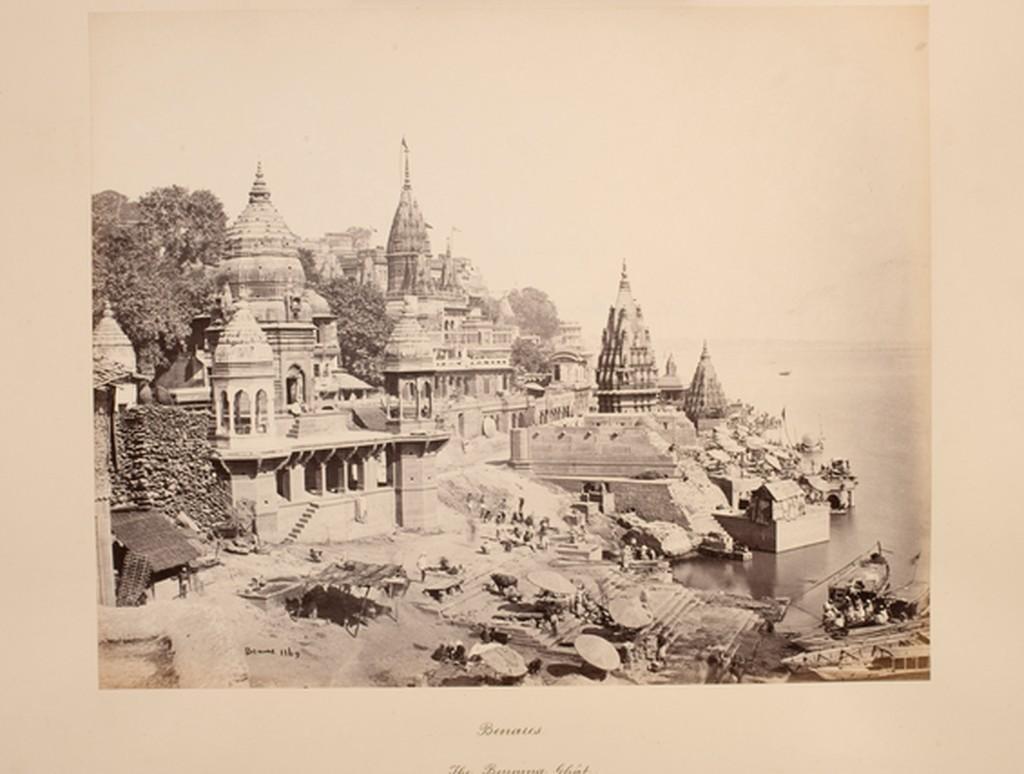
In the images: the city of Varanasi, or Benares, borders the Ganges River. On the west bank of the river, as it flows through the city, a series of steps, known as ghats, lead down to the water. Their uses are manifold, and often religious, as is the case with this particular set, known as the “Burning Ghat.” The latter two images are taken by a traveller, W. C. Fox, in 1918, who provided writted descriptions below each image.
Varanasi has long had religious significance within Hinduism, and is often the site of pilgrimage in preparation for death, whose crematory rites on the south-to-north-flowing Ganges are believed to aid in the transition and transformation from life to death to the next world. At this particular site, some believe, the souls of those burned here leave the cycle of death and rebirth and escape the suffering of reincarnation. Due to their auspicious power, two of the ghats, the two sites devoted to cremation, Harischandra and Manikarnika, see about 80 cremations a day, with bodies burned on open air pyres or in nearby crematoriums. Burnings will last for hours, and clouds of smoke constantly hang over the steps. Many travel to the city expressly to die there. The popularity and the religious valence of these ghats cause sickness and pollution to proliferate. It is also common for relatives of the deceased to make a pilgrimage with their ashes, to scatter them from the ghat into the Ganges.
Sources
Sørensen, Tim Flohr, and Mikkel Bille. “Flames of Transformation: The Role of Fire in Cremation Practices.” World Archaeology, vol. 40, no. 2, 2008, pp. 253–267. JSTOR, www.jstor.org/stable/40388210.
Gesler, Wilbert M., and Margaret Pierce. “Hindu Varanasi.” Geographical Review, vol. 90, no. 2, 2000, pp. 222–237. JSTOR, www.jstor.org/stable/216120.
Ingraham, Chris. “The Suddener World: Photography and Ineffable Rhetoric.” Philosophy & Rhetoric, vol. 50, no. 2, 2017, pp. 129–152. JSTOR, www.jstor.org/stable/10.5325/philrhet.50.2.0129.
Image Sources
Samuel Bourne (English, 1834-1912). Benares, The Burning Ghât. JSTOR, jstor.org/stable/10.2307/community.15018689.
Fox, C. W. “Images of India Dating circa 1916-18 Taken by W.C. Fox.” Albums, 1916–1919. Wiley Digital Archives: Royal Geographical Society (with IBG). http://WDAgo.com/s/3369e6c9