
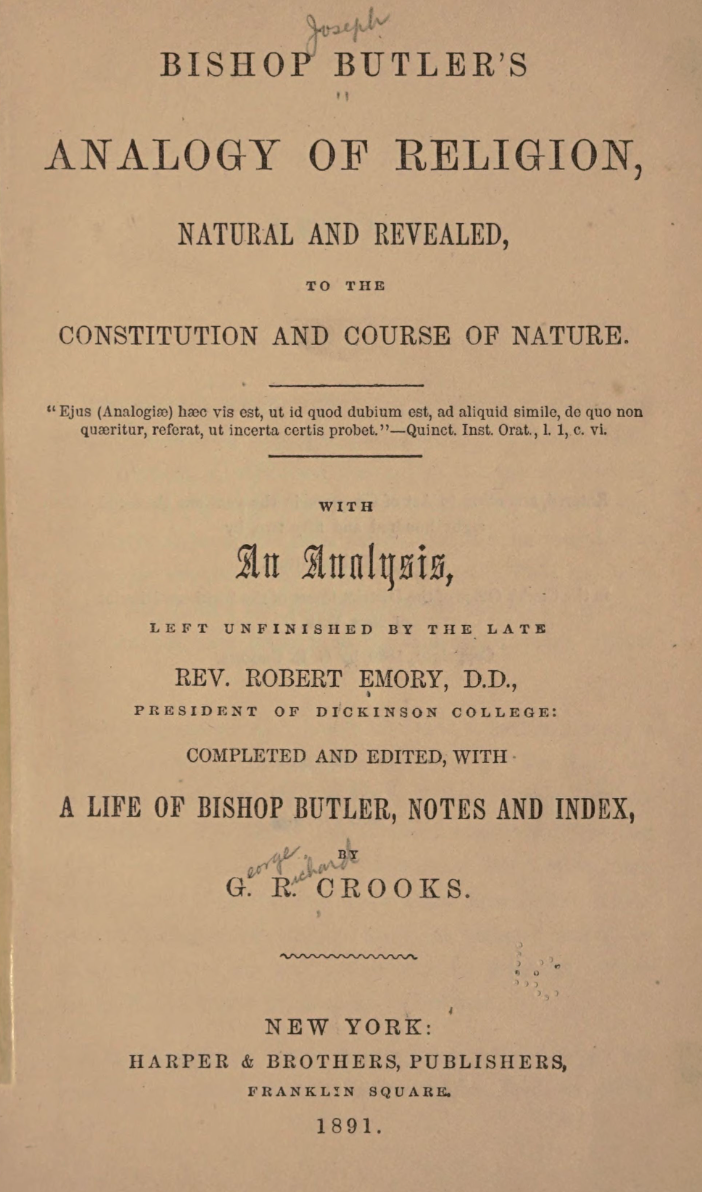

Joseph Butler (1692-1752) was an English Anglican theologian, bishop, and philosopher. He was known largely for his critique of Deism, a 17th and 18th century intellectual movement which accepted the belief of a supreme being who had created the universe but rejected belief of deities who interact with humankind, and was against organized religion. Butler advocated for traditional Anglican theology and argued against many philosophers of the time.
Butler’s most famous works was his 1736 Analogy of Religion, Natural and Revealed. The work was a reply to the deists and was seen by many to be the definitive work of its type. Butler argued using evidence and empiricist grounds in support of the Christian Bible. He rejected the deist belief that, while there was proof of an intelligent creator, there was no evidence of the miracles contained in the Bible, which seemed too improbable to exist. Butler used examples from nature to argue that the world was full of improbable mysteries, and therefore nature itself shared the same defects which the deists claimed of the Bible.
John Stuart Mill writes of Butler’s Analogy in relation to his father’s opinions on religion. Mill writes that the book proved to his father that, as difficult as the events in the Bible may be to believe, these same difficulties are present in the belief that the universe could have been made by a god. Mill continues, “He considered Butler’s argument as conclusive against the only opponents for whom it was intended. Those who admit an omnipotent...maker and ruler of such a world as this, can say little against Christianity but what can, with at least equal force, be retorted against themselves” (ch2). Eventually, his reaction to this work led him to determine that nothing can be known about the creation of the world. This response to Butler’s work-- that it is an effective critique against Deism but not against a lack of religion—is notable considering Mill’s relationship with religion.
Sources:
“Joseph Butler.” Encyclopædia Britannica, Encyclopædia Britannica, Inc., www.britannica.com/biography/Joseph-Butler#ref23113.
“Butler's Analogy.” Christian History Institute, christianhistoryinstitute.org/study/module/butler.
Garrett, Aaron. “Joseph Butler's Moral Philosophy.” Stanford Encyclopedia of Philosophy, Stanford University, 18 Feb. 2018, plato.stanford.edu/entries/butler-moral/#LifWorGenOve.
Fred Sanders on May 18, 2009. “Butler's Analogy.” The Scriptorium Daily, 10 Feb. 2021, scriptoriumdaily.com/butlers-analogy/.
“Joseph Butler.” Internet Encyclopedia of Philosophy, iep.utm.edu/butler/.