
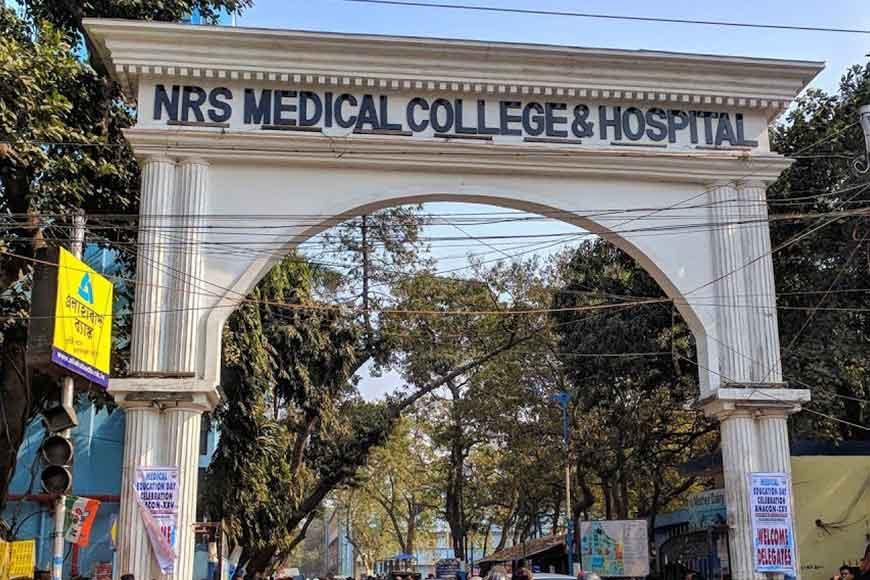


At the beginning of the 19th century, British soldiers in India (a private army of 260,000 in 1803 that belonged to the East India Company) were often stricken with Indian diseases. It was impossible to send a lot of European doctors, and Indian traditional medicine was not effective enough. Thus, training Indian doctors in sufficient numbers to practice European medicine seemed necessary. Concretely, the 1st Medical College of Asia was set up in 1835. With the growing social and political pressure during the first part of the 19th century, the Sepoy Mutiny, and the epidemics issues, the British government converted in 1864 the Sealdah Market Building into the Sealdah Municipal Hospital, and the Sealdah Medical School was set up in 1873, before being renamed the Campbell Medical School in 1884, which is actually the name used in Haimabati Sen’s autobiography. The interesting points about the history of this place are its links with the colonization of India, links we feel even in the name of the school, renamed after George Campbell (1824-1892), a Scottish Liberal Party politician who was Lieutenant-Governor of Bengal from 1871 to 1874, a career noticeably marked by the Pabna Disturbances. Besides, this place was important in Sen’s life because it is where she graduated. Later, in 1950, the College was renamed after the name of Sir Nilratan Sircar (1861-1943), an alumnus who was also a social activist, educationist, and freedom fighter. This last change of name is another illustration of the strong connections between the College and the history of colonization in India.
Source:
Nil Ratan Sircar Medical College and Hospital, Website, History / Heritage page: http://nrsmc.edu.in/pages/4.
About medical education in India:
Anshu. and A Supe. “Evolution of medical education in India: The impact of colonialism.” Journal of postgraduate medicine vol. 62,4 (2016): 255-259. doi:10.4103/0022-3859.191011.