
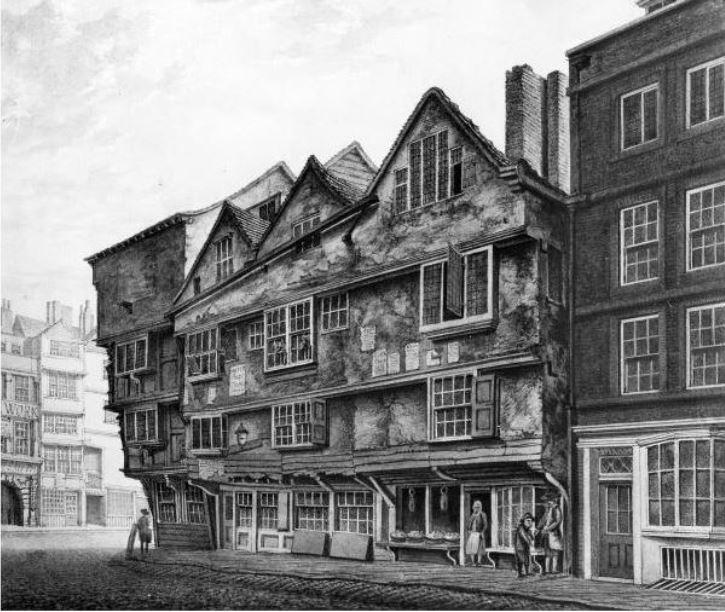
This image is of a building that represents the construction style of homes prior to the London fire. These homes were constructed with timber, plaster, waddle, daub, and lathe. In order for buildings to be more stable and be more likely to withstand disasters such as the previous fires, one can notice that the people of London began to construct buildings with stone, brick, and plaster. These end up being the majority of buildings that establish the setting in Bleak House. However, one can see that the older style still remained in some neighborhoods at the time. In one of the scenes of Bleak House Charles Dickens allows the audience to pick up on the atmospheric impact of these buildings as he included that it seemed as if the houses were “frowning” at some characters within the novel. This building also gives a good representation of the lifestyle and cost of living for almost a majority of the people of London. It was difficult enough for a lot of people to afford clothes at the time, so the expense of housing was a real challenge. People were forced to work with what they had instead of going for the new and expensive style of living. This also is a good representation of how difficult it was for some to escape poverty. People were divided and forced to live within their means. I believe that this image does a good job of connecting those points for understanding the mid and early 19th century.
“Old Houses and Shopfronts on Chancery Lane, London, 1798.” PBS Learning Media, KQED, ca.pbslearningmedia.org/resource/xjf437508eng/old-houses-and-shopfronts-on-chancery-lane-london-1798-xjf437508-eng/.
“The Proceedings of the Old Bailey.” London History - Currency, Coinage and the Cost of Living - Central Criminal Court, www.oldbaileyonline.org/static/Coinage.jsp.