
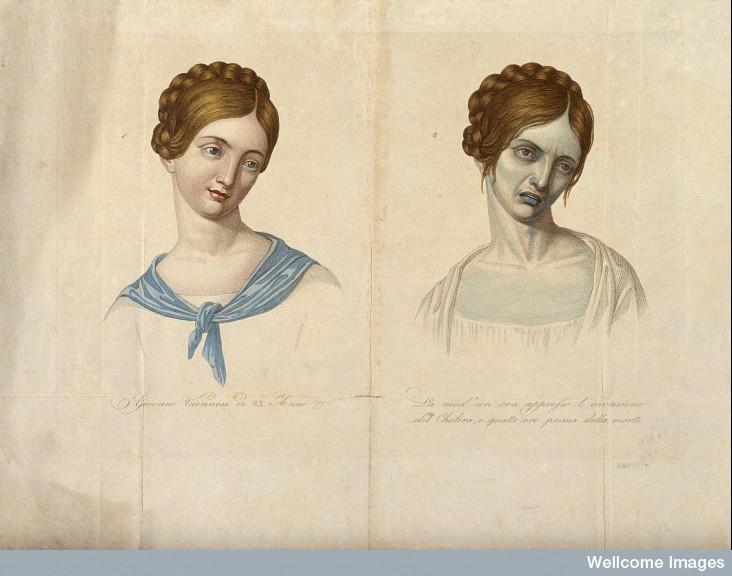
Cholera is a disease caused by the bacteria Vibrio cholerae that results in severe acute diarrhea. If left untreated, it can kill within hours. It can effectively be treated by rehydration with clean water. Cholera is spread through water or food that has been contaminated by infected fecal material.
While Cholera has been infecting humans in Asia since before 800 AD, it did not spread far beyond the Indian subcontinent until the 19th century. From 1816 to 1923, there were six cholera pandemics, each spanning from 7 years to 21 years. These pandemics which ravaged every place they touched were facilitated by trade and colonization. Three of these pandemics occurred during Sen’s lifetime, but cholera was also endemic to the Indian subcontinent, meaning that it never disappeared entirely. The sixth pandemic lasted from 1899 to 1923 was particularly lethal in India and spanned much of Sen’s medical career. There were violent outbreaks in India including in West Bengal throughout this pandemic which Sen likely helped to treat. In addition to being treated in her medical practice, Sen’s second son likely had Cholera, as described on page 213 of her memoir.
The bacterium that causes Cholera was discovered by Filippo Pacini in 1854 and Robert Koch in 1883 independently. The mode of transmission was discovered by John Snow in 1849. Common treatments throughout the 19th century included enemas, castor oil, calomel (a purgative), gastric washing, bloodletting, opium, brandy, and plugging up the anus to prevent fluid loss. None of these were at all effective. In the early 20th century at Calcutta Medical College, an effective treatment was found by Sir Leonard Rogers. It consisted of a replacement fluid that would be injected by IV in order to rehydrate patients. It reduced mortality by cholera to 20%, a of the previous mortality of 60%.
SOURCES
https://www.who.int/en/news-room/fact-sheets/detail/cholera
https://www.ncbi.nlm.nih.gov/pmc/articles/PMC2542143/pdf/bullwho00557-0108.pdf
https://shodhganga.inflibnet.ac.in/bitstream/10603/19328/7/07_chapter%203.pdf