
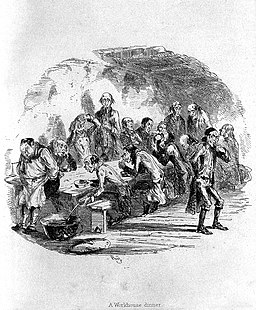
Throughout Oliver Twist, Charles Dickens' utter disgust for workhouses and the state they left children in can be seen, especially in the way Oliver spends his early years mistreated and living in horrible conditions. The most well-known example of this mistreatment in the text comes at the end of the second chapter when he and the other children are starving and he is pushed to request a second helping of dinner. For this apparently outrageous action, Oliver is trapped and isolated in a "dark and solitary room," caned in the freezing yard of the workhouse, and "socially flogged as a public warning and example" in the middle of the dining hall (Dickens 36-37).
As Dickens conveyed in his novel, Victorian workhouses were more like prisons than shelters or rehabilitation centers for the poor as they were perhaps originally intended to be. Workhouse "inmates" were forced to wear uniforms, separated from their families, forbidden from speaking to each other, regularly exposed to a wide variety of communicable diseases and generally unhygienic conditions, had little access to education, were barely fed enough to survive, and forced into dangerous jobs that stole long hours which often resulted in gruesome injuries or death (Scull, Brain). Some of these jobs including having inmates man long rows of factory machines, cook, clean, or engage in heavier manual labor like crushing bone or picking oakum (Brain). The Victorian poor also had little hope of escaping these situations due to the way society looked upon them. Victorians viewed the poor as "‘idlers’ or lazy people" and believed that, by entrapping them in a workhouse with conditions barely fit for human inhabitance, they could discourage poor people from "choosing" to be impoverished and thereby solve a major societal problem (Scull). Obviously, this was not an effective technique, but it very clearly demonstrates the importance of wealth and status in Victorian society and how easily a system can trap its inhabitants inside itself. A system that our very own Oliver Twist was born into.
Works Cited
Brain, Jessica. "The Victorian Workhouse." Historic UK, https://www.historic-uk.com/HistoryUK/HistoryofBritain/Victorian-Workhouse. Accessed 16th Feb. 2021.
Dickens, Charles. Oliver Twist. 1961. Signet Classics, 2005.
Scull, J. C. "The Workhouses: How the Poor Were Virtually Imprisoned in Victorian Era England." Medium, 9th Oct. 2020, https://medium.com/exploring-history/the-workhouses-how-the-poor-were-virtually-imprisoned-in-victorian-era-england-f25c9f608403.
Image Citation
Phiz. Poor People Having Dinner in a Workhouse. 1840. Wikimedia Commons, https://commons.wikimedia.org/wiki/File:Poor_people_having_dinner_in_a_workhouse,_1840_Wellcome_L0006801.jpg. Accessed 16th Feb. 2021.
