
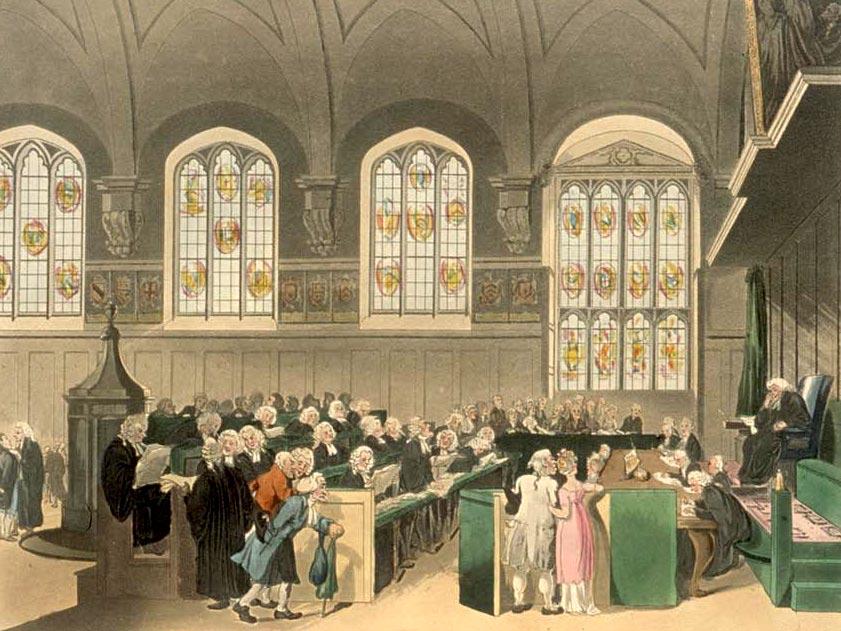
In the 15th century, the Court of Chancery started out as a court of equity to resolve cases that could not go through common law. To be put simply, it dealt with cases of little to moderate importance. Because of minimal control over the court, a case could drag on for decades after it's first been introduced. In Bleak House, prime examples include the infamous and mysterious Jardynce and Jardynce case, as well as Mr. Gridley falling victim to an unfairly settled case among thousands of others. Overall, the court was abusive in nature during the 19th century and could be seen as an example of why revelation ensued later on.
Image: Rowlandson, Thomas, and Augustus Charles Pugin. Court of Chancery. 1808.
Resources: Dickens, Charles. Bleak House. B. Tauchnitz, 1853.
“Chancery Division.” Encyclopædia Britannica, Encyclopædia Britannica, Inc., 19 Oct. 2018, www.britannica.com/topic/Chancery-Division.