
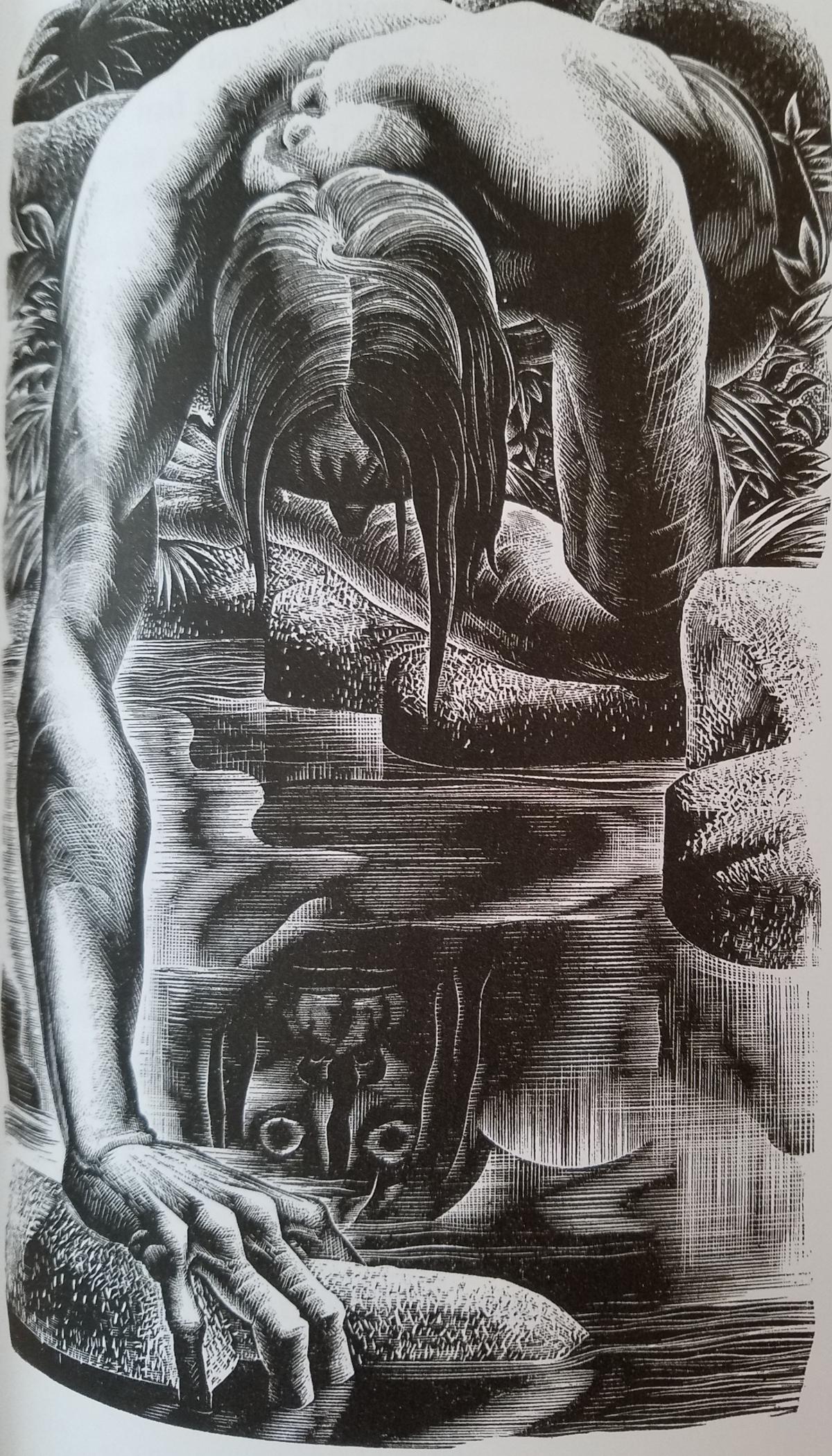
This illustration appears as a heading in Volume II Chapter 7, when the Creature has realized his appearance through viewing his reflection in the water. Leading up to this moment in the chapter, the Creature had discovered a satchel out in the woods that contains some clothing and books. The books catch the attention of the Creature and he begins to study them, eventually comparing his creation to the character Adam in the book Paradise Lost. They were both “created apparently united by no link to any other being in existence,” but Adam was created “from the hands of God” and was cared for by his Creator (Shelley 94). The Creature was neglected by Victor, who had “abandoned” him, and forced to learn the ways of the world on his own (Shelley 96). After reading the book, the Creature feels “wretched, helpless, and alone” (Shelley 94). His feelings of neglect are bolstered when the Creature discovers papers from Victor’s lab in the pocket of a coat that he stole, which describes his creation in great detail. The creature has been watching the DeLacy family through a hole in their wall, and he becomes hopeful that they will look past his “ personal deformity” and accept him for who he is (Shelley 95). This hope is snatched away however when he views his reflection in the water. After viewing his reflection, the Creature calls himself a “wretched outcast,” which deepens his fear of rejection.
Ward shows the Creature up close with his head facing down towards the water, where his reflection is visible. His one hand clutches a rock while his eyes are widened, almost as if he is in disgust. Ward is emphasizing the Creature’s physique and displays the neglect that he has faced. His arms are covered in scrapes and his back is mangled, exposing his spine. His hair is unkempt and falls around his face. The Creature’s claw-like fingers are a focal point of the image and display his inability to blend in with society because of his aptitude to cause damage without extensive efforts. The muscle in his arms and his sheer height advantage upon the average human are further examples of his strength and inhumanness. Ward ironically relates the features of the Creature to the natural elements surrounding him in nature. His spine mirrors the rocks that surround him on the embankment, and his hair exhibits lines similar to those of the water. However, “The Creature is born in a lab, and his creation is an industrial process,” and therefore, he can never assimilate with nature (Poole 59). The Creature’s unnaturalness is a stark contrast to the natural environment he is surrounded by. Adam and Eve were created by God in Paradise Lost as the first natural beings on Earth; however, Victor attempts to play God by creating the Creature unnaturally in a laboratory. This results in confusion and chaos when the Creature does not fit the mold of society’s natural standards of beauty. The viewer is able to sympathize with the Creature’s revelation of himself because the shock on his face portrays his feelings of displacement and abandonment.
The Creature exhibits a strong desire to reveal himself to the DeLacy family, but after seeing his appearance, his confidence is shattered and he once again becomes fearful of human interaction. He “endeavored to crush these fears” and reveal himself a few months later, and his confidence continues to grow as he watches the DeLacy family from the barn (Shelley 96). After many months of watching from the barn, the Creature believes that the members of the DeLacy family are “amiable and lovely creatures” who will sympathize with his feelings as they do with one another, and they will come to accept him despite his appearance (Shelley 96). He finally musters up the courage to approach the old man while Felix, Safie, and Agatha step out on a “long country walk” despite his ever-present fear of rejection (Shelley 97). However, when the three return, they are horrified and disgusted by the Creature’s appearance. “Agatha fainted; and Safie, unable to attend to her friend, rushed out of the cottage,” while Felix struck him with a stick (Shelley 99). Ward’s display of fear in the Creature’s eyes in the image foreshadows this moment in the novel when he is ultimately rejected by the people he feels the greatest connection to. Through the neglect that the Creature has faced, the reader is able to further empathize with him after seeing how the fear in his eyes, unfortunately, came true shortly after.
Works Cited
Poole, W. Scott. Monsters in America: Our Historical Obsession with the Hideous and the Haunting. Baylor UP, 2011.
Shelley, Mary. Frankenstein, or The Modern Prometheus. Oxford, 2018.