



‘Dining is the privilege of civilization. The rank which a people occupy … may be measured by their way of taking their meals’. Mrs Beeton’s Book of Household Management, 1861
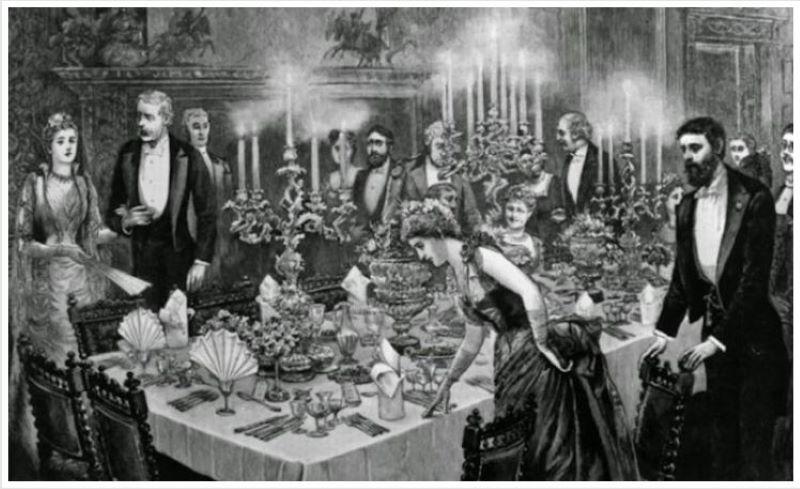
Taking this view to heart, the upper and middle classes in the 19th century sought to demonstrate their social standing and cultural values through the rituals of the dining room. A well-laid table was the sign of a well-ordered household. Entertaining guests required serving the correct food and following the correct etiquette. It also required the correct array and quality of cutlery. Outside the home, the development of the railways, hotels, steamships, gentlemen’s clubs and institutions in Britain and throughout the Empire also expanded the market for cutlery. Enterprising manufacturers met – and stimulated – the growing demand for these items.
This exhibition section presents Victorian cutlery as a prime example of how industry, technological innovation, mass-production, international trade and advertising aligned with class-led social aspirations and a growing consumer society.
Introduction image: Illustration of grand dinner party. n.d. Source: Grimsdyke Hotel, England website.
Dining à la Russe
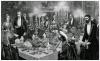
Why did upper and middle-class Victorians need so much cutlery? Entertaining large numbers of friends, family and business acquaintances to dinner was an important social marker. Indeed, Isabella Beeton (1836-65), the doyen of respectable household management, offered menu plans for eight to eighteen guests. The fashion for dining ‘à la Russe’ – where the courses were served one after another – was generally adopted by the 1870s. This required an assortment of cutlery at each place setting as well as serving utensils. For example, the popular etiquette guide Manners and Tone of Society or Solecisms to be Avoided (1879) instructed that each diner should have two large knives and a silver knife and fork for fish, a tablespoon for soup and three large forks, dessert spoons and small forks for the dessert course plus an extra knife and fork ‘as required’.
Image 1: Modified Dinner A La Russe, Set Out For Eight from Walsh, J. H., A manual of domestic economy suited to families spending from £150 to £1500 a year, including directions for the management of the nursery and sick room and the preparation and administration of domestic remedies, 1874. Smithsonian Libraries.
Electroplating
‘Electroplating was as revolutionary to the nineteenth century as the scientific discoveries of the electric telegraph, photography, and the railway’. [1]
Electroplating is an electro-chemical process. It is used to coat a base metal such as copper, brass, tin or zinc with a thin layer of precious metal, such as silver. George Richards Elkington (1801-1865) patented the first commercial electroplating process in 1840. His firm, Elkington & Co, in Birmingham, England led the electroplating industry. It soon spread to the traditional metalworks centre of Sheffield and then worldwide. Electroplated items were more hard-wearing and rust-resistant than silver. They were also quicker and cheaper to mass-produce. This meant that the rising middle-class, wishing to emulate the upper-class, could fill their homes with cutlery, tableware and ornaments, which looked like silver but were more affordable. [1] Brouilhet, Henri. 150 Ans d`Orfèvrerie: Christofle, Silversmith Since 1830, Chêne Hachette, 1981, p.89.
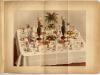
Image 2: Illustration of nickel-plating by dynamo-electricity. From Arnold Philip, The Electro-Plating and Electro-Refining of Metals, D. Van Nostrand Company, 1911.
Cutlery and the ivory trade
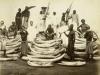
The 19th century colonisation of Africa led to a vastly increased demand for this luxury commodity. Huge quantities of ivory were imported - in some years the Sheffield cutlery firms alone used the tusks of over twenty thousand elephants. As demand grew, so did the price. In just four years, between 1879-83, the price of ivory doubled until it was fetching £1,000 per ton. Manufacturers turned to cheaper substitutes like celluloid, which was first used in the late 1860s. For those who could afford it, however, genuine ivory-handled cutlery was a must-have signifying purity, prosperity and ‘good taste’.
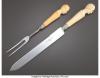
Image 3: Silver plate carving set, made by Joseph Rogers & Sons, Sheffield, England, c.1890. The carved ivory handles depict George Washington and Julius Caesar.
Image 4: The East African ivory trade c. 1880. Wikipedia.
Marketing cutlery
‘We live in an age of advertisement’. Lord Randolph Churchill
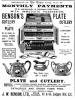
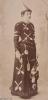
Cutlery manufacturers used a wide range of media to advertise their products. The removal of taxes on print advertising in 1855 and on paper in 1861 led to a huge increase in display advertisements in newspapers and magazines. This newspaper advert shows how cutlery canteens could be bought on credit. Manufacturers distributed illustrated catalogues of their ranges and cutlery was also displayed for sale in the new department stores, especially designed to attract female customers. In the 1870s and 1880s many American companies distributed collectable ‘cabinet cards’ with photographs of young women as ‘walking banners’ to advertise their wares, including cutlery.
Image 5: Display advertisement from Hearth and Home: An Illustrated Weekly Journal for Gentlewomen, 22 November 1900 © National Library of Scotland.
Image 6: 'Cabinet card' photograph of a ‘walking banner’ lady.
Caring for cutlery
‘Knives are now generally cleaned by means of Kent's machine, which gives very little trouble and is very effective’. Mrs Beeton’s Book of Household Management , 1861
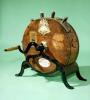
The first patent for this knife cleaning machine was awarded to George Kent in 1844, and improvements followed over the next fifty years. The operator inserted knives into the slots and poured emery powder into the drum's chute. The handle turned wooden discs inside with alternate rows of bristles and strips of leather, which rubbed against both sides of the knives. The machine was very popular because silver knives had to be cleaned and polished daily to keep them from rusting and becoming dull after exposure to acidic foods, and the task took far longer by hand. One education manual, however, warned against girls using the device because ‘the luxury will make them inflexible and indifferent as a housewife’. When stainless steel cutlery came into use in the 1910s/1920s the machine was made redundant - one of many kitchen gadgets to be relegated to the back of the kitchen cupboard by new technology.
Image 7: Kent’s knife sharpening and cleaning machine, c. 1905 © Board of Trustees of the Science Museum.
Novel 19th century cutlery
It has been estimated that cutlery manufacturers designed and marketed nearly two hundred different types of eating or serving implement. For each possible dining experience a specialised piece of cutlery was required – sardine servers, sugar sifters, afternoon spoons and pickle forks, to name just a few. This section presents some examples.
Absinthe spoon
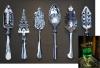
Absinthe spoons were designed to hold a sugar cube, through which water was dripped to counter the absinthe’s bitterness and lead to its louche (clouding). As a result, they were heavily reliant on the sugar-cubing process made commercially viable in 1875 by Henry Tate. Absinthe began as an artist’s drink, reflected in works by Edouard Manet (1858), Edgar Degas (1876) and the surrounding mythology of the ‘Green Fairy’. The intricate design of absinthe spoons likewise suggested artisanal craftsmanship. However, by the late-nineteenth century, demand for the drink by decadents in Europe and America gave rise to the mass-production of these spoons.
Image 8: Absinthe spoons came in a wide range of designs.
Moustache spoon
It became fashionable from the mid 19th century for men to grow luxuriant moustaches and beards. Progressives used it to affiliate themselves with earlier radicalism while conservatives imitated the heroically unshaven soldiers returning from the Crimean War (1854-56). Impoverished bohemians and explorers were unable to shave, meaning facial hair grew among them and their impersonators. The moustache spoon shows cutlery’s response to these changing fashions. Popular from the 1870s onwards, the invention allowed soup to be eaten without dirtying the moustache - a skill which, according to Manners for Men (1897), required ‘expertness and practice’.
Image 9: Silver moustache spoon, manufactured by John Round & Son Ltd, Sheffield, England, 1904 © Victoria and Albert Museum.
The fish knife
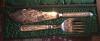
Epitomising gentility, the fish knife is an example of cutlery invented by manufacturers to sell to middle-class consumers. It first appeared at the start of the nineteenth century but gained in popularity from the 1850s onwards. Often elaborately designed, fish knives and forks were either silver or silver-plated; it was thought ordinary metal blades blackened when coming into contact with fish. The larger versions were used for fileting and serving while the smaller ones were for individual diners.
Image 10: Fish knife and fork in presentation box, manufactured by Lee & Wigfull, Sheffield.
Edward Lear's runcible spoon
'... they dined on mince and slices of quince, which they ate with a runcible spoon'. The Owl and the Pussycat, 1871
The English artist and writer Edward Lear (1812-88) is believed to have invented the ‘runcible spoon’ because he liked the sound of the word. He used it in several of his nonsense poems, including the famous The Owl and the Pussycat . Lear's verbal invention possibly reflects the proliferation of special types of cutlery for particular purposes: gravy, salt, mustard, hash and fruit spoons were all available in Victorian canteens of cutlery.
Image 11: Edward Lear’s drawing of the dolomphious duck catching spotted frogs for her dinner with a runcible spoon from Twenty-Six Nonsense Rhymes and Pictures.
Works used
Beachey, R. W. , ‘The East African Ivory Trade in the Nineteenth Century’, The Journal of African History, 8, 2 (1967)
Bevan, G Phillips, ed, British Manufacturing Industries, 2nd edn, ‘Cutlery’ by F. Callis , London: Edward Stanford, 1878
Church, Roy, ‘Advertising consumer goods in nineteeth-century Britain: reinterpretations’, Economic History Review, LIII, 4 (2000)
‘Elkington & Co., Birmingham manufacturers of electroplated metalwork’, Victorian Web http://www.victorianweb.org/art/design/metalwork/elkington.html [accessed 29 May 2020]
Gleason, Megan Elizabeth. From Vulgarity to the Current of Fashion: The Impact of Electroplating on Victorian Industry, Marketing and Design MPhil thesis, University of Glasgow, October 2001
Graham, K.. Gone to the shops : Shopping in Victorian England, Westport: Greenwood Publishing Group, 2008
Humble, Nicola, 'Domestic Arts' in The Cambridge Companion to Victorian Culture, Cambridge: CUP, 2010
Mars, Valerie, Ordering Dinner: Victorian Celebratory Domestic Dining in London, PhD thesis, University of Leicester, May 1997
Sussman, Herbert L. Victorian Technology: Invention, Innovation and the Rise of the Machine, Westport: Praeger, 2009
Symonds, James. Table Settings: The Material Culture and Social Context of Dining, AD 1700-1900, Oxford: Oxbow Books, 2014
Taylor, Sally-Ann, Tradition and Change: The Sheffield Cutlery Trades 1870-1914, PhD thesis, University of Sheffield, August 1988
Bevan, G Phillips, ed, British Manufacturing Industries, 2nd edn, ‘Cutlery’ by F. Callis (London: Edward Stanford,1878)
‘Elkington & Co., Birmingham manufacturers of electroplated metalwork’, Victorian Web, http://www.victorianweb.org/art/design/metalwork/elkington.html [accessed 29 May 2020]
Gleason, Megan Elizabeth. From Vulgarity to the Current of Fashion: The Impact of Electroplating on Victorian Industry, Marketing and Design MPhil thesis, University of Glasgow, October 2001
Humble, Nicola, 'Domestic Arts' in The Cambridge Companion to Victorian Culture, CUP, 2010
Mars, Valerie, Ordering Dinner: Victorian Celebratory Domestic Dining in London, PhD thesis, University of Leicester, May 1997
Sussman, Herbert L. Victorian Technology: Invention, Innovation and the Rise of the Machine, Praeger 2009
Symonds, James. Table Settings: The Material Culture and Social Context of Dining, AD 1700-1900, Oxbow Books, 2014
Taylor, Sally-Ann, Tradition and Change: The Sheffield Cutlery Trades 1870-1914, PhD thesis, University of Sheffield, August 1988