
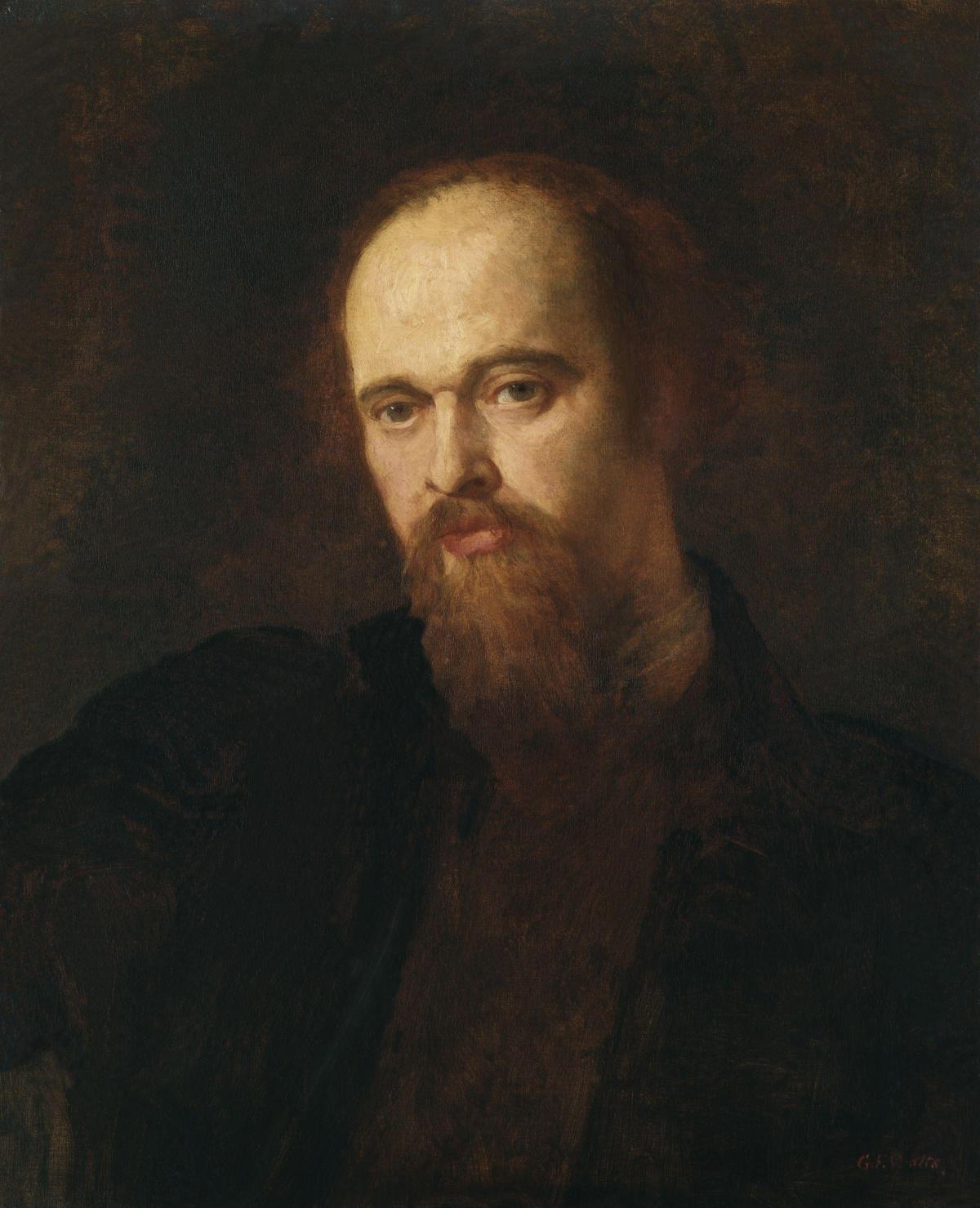

Dante Gabriel Rossetti was born on May 12, 1828 in London to parents Francis Polidori and Gabriel Rossetti (de la Sizeranne 157, Ash 8). Despite his later success as an artist, poet, and a vital member of the Pre-Raphaelite Brotherhood, Rossetti was not a successful student in school. He attended King’s College School, Sass’s, and the Antique School of the Royal Academy, but he dropped out of each school before graduation (Ash 8-9). Rossetti learned valuable skills throughout his time in school, but because he never finished any of his programs, he was unsure of what path-- poetry or painting-- to pursue. Despite his uncertainty, his parents were supportive of either of his artistic ambitions, which is likely because his father was an Italian poet (Ash 8, de la Sizeranne 157).
In a quest to establish his future career, Rossetti consulted with other artists at the time for advice. One of these individuals was Ford Madox Brown (Ash 9). Brown was not a famous artist at the time, but Rossetti was drawn to his work. Brown took in Rossetti and agreed to teach him free of charge (de la Sizeranne 157). Even though Rossetti did not have extensive formal training, Brown soon learned Rossetti had an abundance of natural talent, and he worked to help Rossetti further develop his skills. However, he wanted Rossetti to paint still-life works, but Rossetti was not interested in these types of paintings (de la Sizeranne 157, Ash 9). After learning under Brown for a period of time, Rossetti moved to work alongside William Holman Hunt. During this period, Rossetti, Brown, and Hunt had extensive conversations about their influences and inspirations and discovered they were like-minded in terms of their artistic styles and desires. These conversations eventually led to the foundation of the secret society Pre-Raphaelite Brotherhood in September of 1848 (Ash 9).
Though largely spearheaded by Rossetti, the three founding members of the Pre-Raphaelite Brotherhood, commonly referred to as the PRB, were Dante Gabriel Rossetti, William Holman Hunt, and Everett Millais. Though Brown was invited to join, he declined the offer (de la Sizeranne 157, Ash 10). The name Pre-Raphaelite reflects the style of art these artists hoped to create. As a whole, the Brotherhood aspired to have their art reflect the time before Raphael and the High Renaissance, more specifically, they wanted their work to have primitive qualities (Prettejohn 18-19). Thus, much of their artwork included late medieval qualities, religious ties, literary connections, and influences from historical events (Giebelhausen and Prettejohn 63, 65). While it had its ups and downs, the Pre-Raphaelite Brotherhood ultimately disassembled in the mid 1850s. The artists stopped labeling their artwork with the initials PRB, and the artistic focus of the artists’ paintings strayed from the Brotherhood’s original ideals (Ash 10-12).
As a part of the Pre-Raphaelite Brotherhood, Rossetti's first contribution was The Girlhood of Mary Virgin, which was shown at the Free Exhibition in 1849 (Prettejohn 17, de la Sizeranne 157). This painting was the first work of art that the PRB debuted, and it was characterized by the initials PRB in the corner (Ash 10). Besides being the first work of art in the PRB, The Girlhood of Mary Virgin was an important career accomplishment for the young artist. The painting sold at the exhibition for £80, and with this sale, Rossetti gained a reputation as an artist and also earned his first major income, which gave him considerably more freedom as an artist. With these newly-earned funds, Rossetti was able to travel to France and Belgium with fellow PRB member, Hunt (Ash 10, de la Sizeranne 157).

The Girlhood of Mary Virgin by Dante Gabriel Rossetti in 1849-49, via Tate.
In his artistic life, after The Girlhood of Mary Virgin and his second painting, Ecce Ancilla Domini, also known as The Annunciation, Rossetti’s and the PRB’s paintings, in general, contained less and less religious symbolism. Whereas Hunt and Millais developed their own unique styles, Rossetti began to heavily favor medieval-style paintings and turned to using watercolors instead of oil paints until the 1860s (Prettejohn 55). Another new project during this time was Rossetti’s idea for The Germ, a journal featuring both the literary and artistic creations of the PRB as well as examples of the Pre-Raphaelitism style. Due to a lack of interest and the large financial costs of such a publication, only four editions of The Germ were published (Ash 10-11, de la Sizeranne 160).
During this point in his life, during the late 1840s and early 1850s, Rossetti’s life began to change. In 1849, Rossetti met Elizabeth Sidall, who he later married in 1860, but their relationship was incredibly complicated. Sidall was a model in many of the PRB’s paintings, and exclusively became Rossetti’s model a few years after they met (Ash 11). Rossetti was sexually attracted to Sidall, but she wanted to remain pure until marriage. The fact that he could not have sexual relations with her was troubling to him and led him to sleep with other women, including William Hunt’s partner, Annie Miller (12). This caused significant issues in their friendship and was part of the reason why the PRB eventually disassembled.

Portrait of Elizabeth Sidall circa 1860 via Wikipedia
Even after their marriage, Rossetti’s life was quite turbulent. Sidall became quite ill and even though she became pregnant, the couple’s baby was stillborn. Sidall eventually died of an assumed drug overdose in 1862 (Ash 14).
In his later years as a widower, Rossetti completed many more works and found new influences and styles. In doing so, he continued to gain recognition as a successful artist. He eventually passed away in 1882. All together, Rossetti was a natural artist. Although he had little formal training, he learned from her peers, namely Brown, Hunt, and Millais and made a successful career for himself. Furthermore, while the Pre-Raphaelite Brotherhood may not have been a long-lasting organization, its influence on artists and artistic movements was undeniable.
Works Cited
Ash, Russell. Dante Gabriel Rossetti. Harry N. Abrams, 1995.
De la Sizeranne, Robert. The Pre-Raphaelites. Translated by Andrew Byrd, Parkstone International, 2014.
Giebelhausen, Michaela, and Elizabeth Prettejohn. “The Religious and Intellectual Background.” The Cambridge Companion to the Pre-Raphaelites, Cambridge University Press, 2012, pp. 62–75.
Prettejohn, Elizabeth. The Art of the Pre-Raphaelites. Princeton University Press, 2000.