
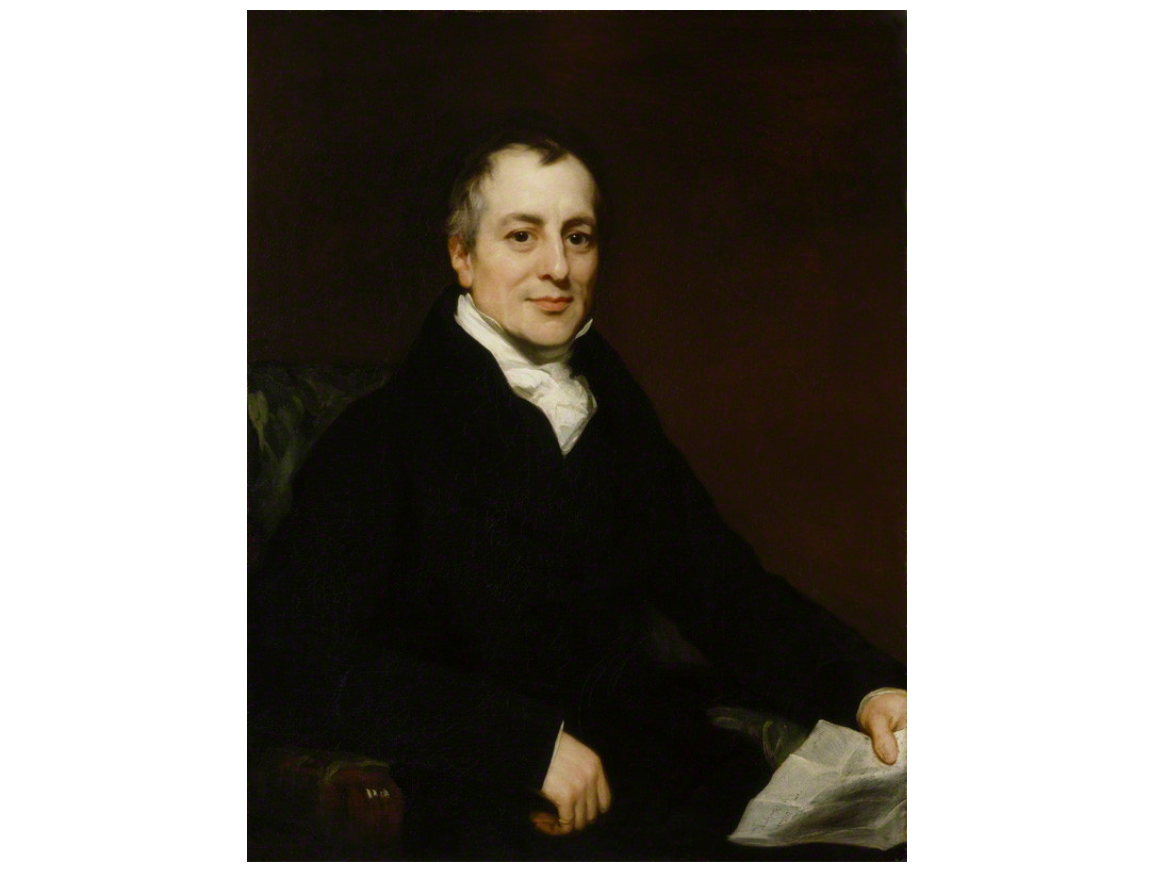
Often cited among Smith, Malthus, and other classical economists, David Ricardo (1772-1823) was a British political economist, and a politician. Born in a family of Sephardic Jews, emigrated from the Netherlands, he began business when he was fourteen, at the London Stock Exchange with his father. In 1799 he discovered Adam Smith’s Nature and Causes of the Wealth of Nations, that drove him to study more and more economics. The High Price of Bullion, a Proof of the Depreciation of Bank Notes, his first book, was published in 1810, and demonstrated the link between the volume of bank notes and the level of prices. Ricardo made friends among James Mill, Jeremy Bentham and Thomas Malthus, who influenced his work in general. With the Corn Laws debate in 1815, he strongly advocated for free trade. He developed the well-known theory of comparative advantages: trade among countries is influenced by relative costs of production. Thus, he rectified Adam Smith's concept of absolute advantages. He continued its engagement for free trade until the House of Commons, in which he purchased a seat in 1819 (a widespread practice at that time).
He is cited in J. S. Mill’s Autobiography as one of his main references. Indeed, Ricardo remains today an important thinker of liberalism. Moreover, his life and work illustrate that there were great interactions at that time among the liberal economists and philosophers, and the study of their interactions is essential to understand their individual works. It is an element we also find in Mill’s Autobiography. As Ricardo, Mill read a lot and spoke a lot with other liberal thinkers of his time. These interactions are real conversations, but also letters, and more globally readings of each other’s books. It creates a significant intertextuality in the books of J. S. Mill, Ricardo, etc.
Sources: