
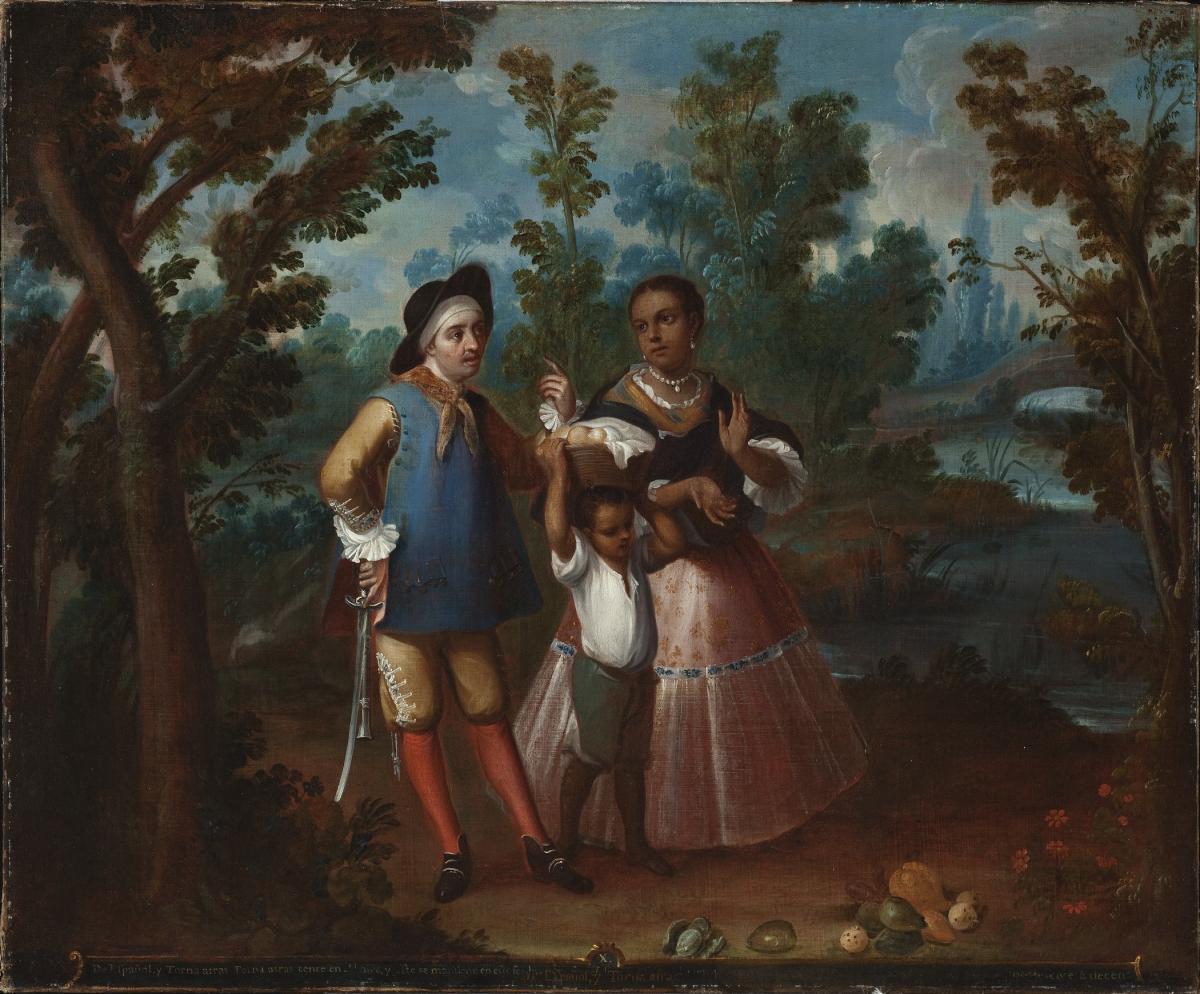

The Casta paintings were created for a numerous set of purposes; however, one commonly tends to dominate the others, and that is the division of social groups within the Latin American society based on skin color. In order to understand the purpose of these paintings, it is important to break down the image. On the left, there is a man (Spaniard), who is shown to be wearing common Spaniard clothing. Both the man and the woman show a hint of wealth as the woman is wearing jewelry and what appears to be a nice dress. Not all women in the paintings wear as nice of a dress as the one shown in this image. On the contrary, the child in the middle one can see doesn’t appear to be wearing any shoes. What this might mean is left up to more symbolic interpretation. While other paintings capture a theme of brutality or the work-life in Latin America, this painting is placed in a nice natural setting. The only thing that might be unpleasant or work-related is the boy that is carrying the filled basket above his head. On the ground, there appears to be Spanish fruit scattered, but what this means is hard to determine. This is partially what makes these paintings so interesting.
Juan Patricio Morlete Ruiz. Latin American Art, 1. De espanol y torna atras, tente en el aire. Art of the Americas, San Francisco, California, United States. c. 1760 (Copyright Public Domain)