
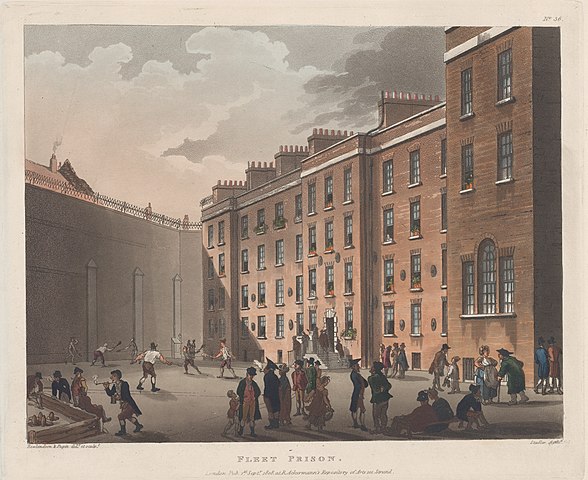
Being unable to pay off your debt was rampant during the 1800s, along with many other forms of crime. Although unlike some other crimes of the time, debt affected more than just the lower class, middle-class working men were often imprisoned for owing money. In response to this, some separate prisons were built specifically to hold debtors, such as the Fleet Prison in London. These prisons would hold the debtors until they paid off their dues or if they managed to settle something with their collectors. Before 1815 the debtors had to even pay their keep at the prisons after a certain amount of years. Since these prisoners could be held indefinitely their family were able to visit whenever they pleased. In 1824, Charles Dickens’ father was imprisoned for a debt he couldn’t pay which forced 12-year-old Charles to work ten-hour shifts at a shoe polish factory. Dickens’ terrible experience in the factory led him to write his first novel, Oliver Twist. One of the main reasons for writing Oliver Twist was to shed light on the child labor laws and workhouses that were popular at the time. Oliver experiences similar mistreatment while in the workhouse system at the beginning of the book such as insufficient food and long hours.
Works Cited:
Blakemore, Erin. “How Charles Dickens Helped the English Get Fresh Air.” History.com, A&E Television Networks, 20 Nov. 2017, www.history.com/news/how-charles-dickens-helped-the-english-get-fresh-a…;
Gooii. Debtors - Victorian Crime and Punishment from E2BN, vcp.e2bn.org/justice/page11365-debtors.html.
“Victorian Era England Debt Prisons History & Living Conditions.” Victorian Era, victorian-era.org/debt-prisons-of-victorian-era-england.html.
Image Citation:
By Thomas Rowlandson, Auguste Charles Pugin, Rudolph Ackermann - link to The Met record, Public Domain, https://commons.wikimedia.org/w/index.php?curid=94577143