
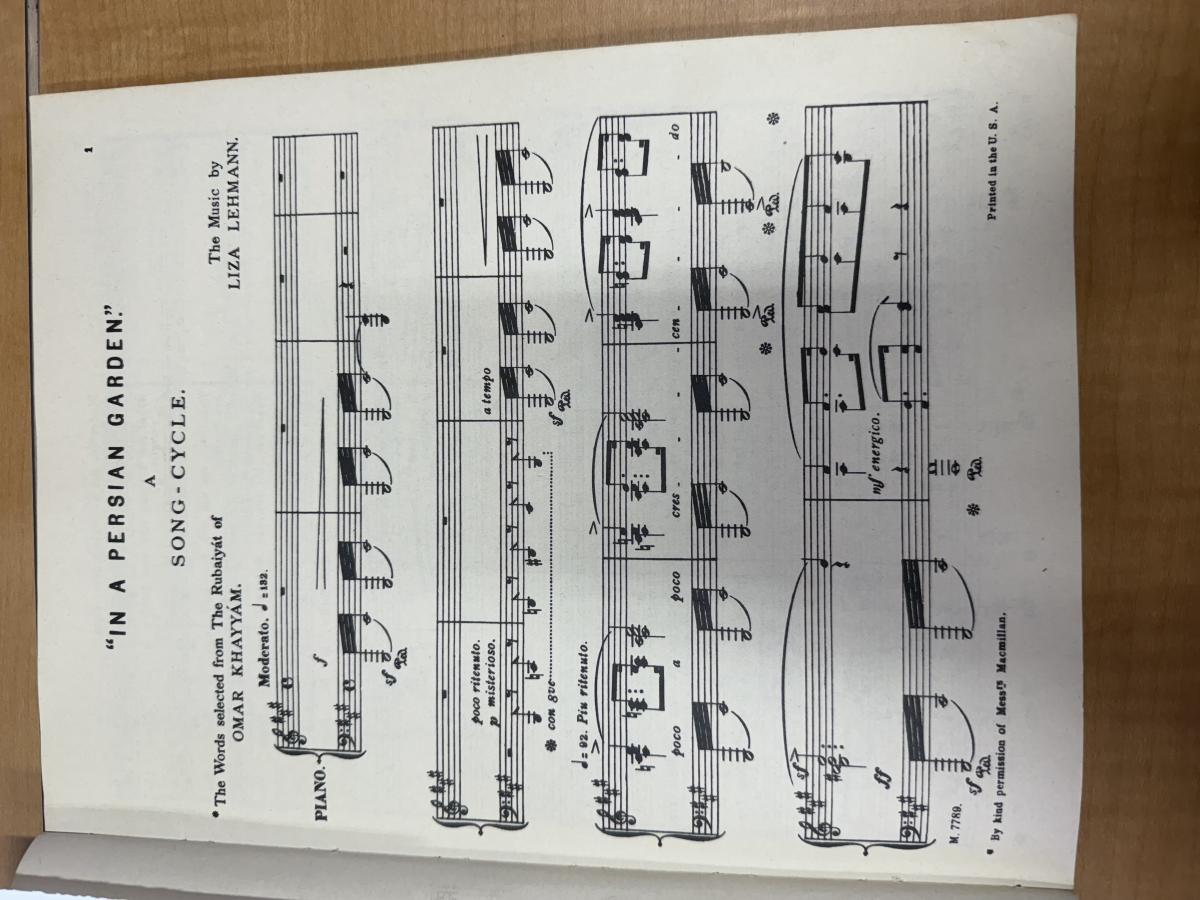

“In a Persian Garden: A Song Cycle for Four Solo Voices (Soprano, Contralto, Tenor, and Bass)” is an edition of the Rubáiyát of Omar Khayyàm that is composed by Liza Lehmann. (1862-1918) The score uses the Rubáiyát translation by Edward Fitzgerald, drawing form both the first and fifth editions of Fitzgerald’s translations.
The score was published by Metzler & Co in London and G. Schirmer in New York. It was copyrighted in 1896. The score is in English. The score is 76 pages long. This edition is part of the Dr. Sigurd H. Peterson Memorial Collection at Oregon State University. At the time, the price of score was $3.50 in the U.S.A. The cover of the edition includes a yellow and blue design of pillars and a decorative arch with flowers. The design is copyrighted in 1898 by G. Schirmer. Edward B. Edwards (1873-1948) is listed as the designer. Edwards was known for his skill in graphic arts and is best known for his calligraphic magazine covers designed in the style of Celtic, Byzantine, Gothic, Renaissance, and Egyptian styles.
This edition has three special elements that set it apart from other editions. The first element is this edition of the Rubáiyát of Omar Khayyám is a song cycle and score for four solo voices. The four parts of the score are for a soprano, contralto, tenor, and bass voice. This edition also includes a pianoforte accompaniment part. It contains 22 songs, and composer time period and piece style are considered Romantic. It is dedicated “To My Husband”.
The second special element from this edition is the unique, and sometimes confusing, use of multiple of Fitzgerald’s translation. The lyric for score comes from both the First and Fifth Edition of Edward Fitzgerald’s translation of the Rubáiyát of Omar Khayyàm. In some cases, the lyrical stanza is not a direct translation of either. The majority of the stanzas come from the Fifth Edition, unless otherwise marked. The stanzas used for the score are not concurrent. The solos and their corresponding stanzas are listed at the end of this gallery.
The third special element of this edition is that it also includes a small leaflet program. The front cover of the program includes the title, description, and composer. The program comes from a performance of the piece, listed as “Before the Women’s Club” in Madison, Wisconsin on December 15, 1905. The performance was given by Miss Genevieve Church Smith (Soprano), Mr. Elias A. Bredin (Tenor), Mrs. Frances R. Hiestand (Contralto), and Mr. Alexis Baas (Bass). It also includes a handwritten note that the performance was “Accompanied by Miss Alice Reg[illegible]”. The program contains the lyrics to the piece.
Quartette (Soprano, Contralto, Tenor, Bass): Stanza I
Solo Tenor: Stanza II
Recitative (Bass): Stanza IV (The same as Stanza IV from the First Edition)
Solo Tenor: Stanza V
Quartette (Soprano, Contralto, Tenor, Bass): Stanza VII
Solo Bass: Stanza VIII
Contralto (Recitative): Stanza XXXIX (This stanza is not a direct translation. See: Ah, And)
Contralto Solo: Stanza XIX and Stanza XX
Duet (Soprano and Tenor): Stanza XII
Bass Solo: Stanza XXVII- The “About it and about” in the third line of this stanza is not in the score, instead written as a pause before continuing.
Stanza XXVIII- First Edition
Stanza XXV- First Edition
Bass (Recitative): Stanza XXIV- First two lines only
Contralto Solo: Stanza XLVII- First two lines only
Soprano (Recitative) Stanza XLIV. This stanza is not a direct translation (See: Why, But)
Soprano Solo: Stanza LXVI
Stanza LXVII
Tenor Solo: Stanza LXXII- First Edition
Contralto Solo: Stanza XVI and/or Stanza XIV. The Stanza is the same in the Fifth and First Edition, respectively
Stanza XVII
The end of the solo contains the line “Waste not your hour!”, from Stanza LIV
Soprano Solo: Stanza IX
Quartette (Soprano, Contralto, Tenor, Bass): Stanza XVIII
Stanza XXI- First Edition
Stanza LXIV
Tenor (Recitative) Stanza XXXVII- First Edition (First two lines only)
Stanza LIV (First two lines only)
The third stanza in this recitative is not a direct translation from either edition, and is seemingly a combination of Stanza LXXIII of the First Edition and Stanza XCIX of the Fifth Edition
Soprano Solo: Stanza LXXIV- First Edition (Not a direct translation)
Tenor Solo: Stanza LXXV- First Edition
Bass Solo: Stanza XL
Stanza XLIII
Quartette: Stanza LXXIII- First Edition
Reference Used for Editions: Project Gutenberg. Rubaiyat of Omar Khayyam, by Omar Khayyam. https://www.gutenberg.org/files/246/246-h/246-h.htm.