
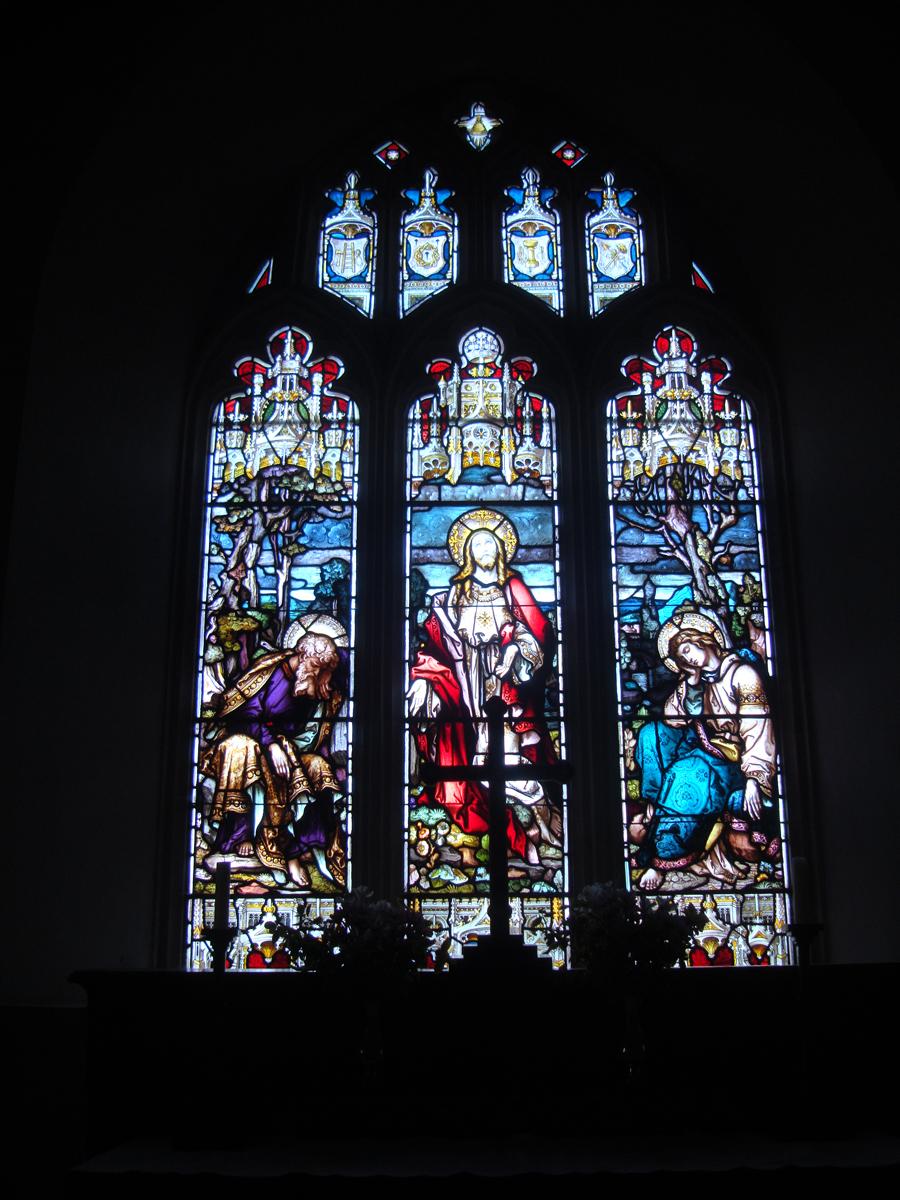
Image: "Stained Glass Window at St. Nicholas Church in Steventon, Hampshire" taken by Brenda Cox.
Great Britain is no stranger to religious reformation - in the centuries leading up to the lifetime of Jane Austen, the Church of England had seen a variety of religious influence. The stained glass window pieces, as well as other art and architecture, reflect the changes made to the religious followings of England.
When Henry VIII separated from the Pope, and more broadly Catholicism, in the 16th century, England endured religious uncertainty for a multitude of eras. Henry VIII established this separation after being denied an annulment from his wife, Catherine of Aragon, by the Catholic Church, and decided to announce himself as the head of the Church of England via the Act of Succession and Act of Supremacy. This reigned until Henry VIII's death, where Protestant ideals began to rise within the Church of England due to Edward VI's rule over England. Edward VI's reign was short-lived, and his half-sister Mary (who succeeded the throne) began persecuting Protestants and embraced traditional Roman-Catholicism (Church of England, History.com). Once Elizabeth I finally took the throne, she reinstated the Church of England and led a Protestant reform that kept symbols and meanings of Catholicism. With the Protestant Reformations came Anglicanism, a sector of Protestantism that many English people embraced, with Jane Austen being one of them.
Within the Anglican church, art, architecture, and liturgy are some of the most important and compelling components of their faith. Though they do not have an official creed (though some scholars argue that the "Thirty-Nine Articles" may be a creed), they follow many of the standards of Roman-Catholicism and Protestantism with more liberation in their practices and interpretations than those who are simply Roman-Catholic or Protestant. One of the most aweful and complex versions of showing their belief was through stained glass windows, which, like England's religious insecurity throughout the 17th, 18th, and 19th centuries, faced a variety of reformations and restorations in terms of how they are made.
The stained glass window seen above is from St. Nicholas Church of Steventon, Hampshire, the church where Jane Austen spent time in her childhood. Her father was a rectory there, meaning that there was a house provided nearby that was for the family. Her family would have often gazed at stained glass windows to intensify their connection with God, Christ, and their faith. The church had restorations done to it in the later 19th century, where the windows that Austen would have seen were taken out and replaced with depictions of Christ and doctors. Though these windows were not seen by Austen herself, they exhibit the religious importance that the ones she witnessed would have as well, allowing church-attendees to be visually connected with the Scriptures.
The history of building stained glass windows begins with the monk Theophilus around 1100 A.D. with his publication On Divers Arts, where he details how to be a craftsman according to 12th-century technology. The Met Museum dictates the process of creating stained glass windows on their website, stating that the main ingredients are sand and wood ash, or potash; "The mixture is melted into liquid which, when cooled, becomes glass. To color the glass, certain powdered metals are added to the mixture while the glass is still molten. Molten glass can be blown into a sausage shape, then slit on the side before being flattened into a sheet; it can also be spun with a pontil iron into a round sheet (crown)" (metmuseum.org). The makers then cut the pieces of glass according to shape needed for the image that is desired. Any shadows or shading necessary were created with black paint.
The Gothic age produced the majority of the stained glass windows that people see in cathedrals, churches, and other buildings. Those creating stained glass windows in the Gothic Age relied on a variety of colors, shapes, and patterns to create a bright and colorful environment. The authors of "A Brief History of Stained Glass" from the Ecclesiastical and Heritage World (UK) describe it as "Medieval man experienced a window more than he read it." Towards the height of Gothic high art, creators became more interested in the images being depicted. It is around the middle of the 15th century that we begin to see the shift towards images in stained glass windows, which would have been the type of window that Jane Austen witnessed throughout her life.
The stained glass windows within religious structures indicate that there was value and importance in these images within Anglican England. The experience of visualizing the scripture gave churchgoers a feeling of closeness with the written word of God, as it enhanced the imagination and in-turn the believability of the scriptures amongst the population.
Works Cited
“A Brief History of Stained Glass.” Ecclesiastical and Heritage World, www.ecclesiasticalandheritageworld.co.uk/news/877-a-brief-history-of-st…. Accessed 8 Oct. 2024.
Cox, Brenda. Stained Glass Window in St. Nicholas Church of Steventon, Hampshire. 5 June 2013. Jane Austen’s World, https://janeaustensworld.com/tag/st-nicholas-church/. Accessed 8 Oct. 2024.
Department of Medieval Art and The Cloisters. “Stained Glass in Medieval Europe - The Metropolitan Museum of Art: Heilbrunn Timeline of Art History.” The Met’s Heilbrunn Timeline of Art History, 1 Jan. 2001, www.metmuseum.org/toah/hd/glas/hd_glas.htm.
History Editors. “Church of England ‑ Anglican Church.” History.Com, A&E Television Networks, 13 Feb. 2018, www.history.com/topics/european-history/church-of-england.