
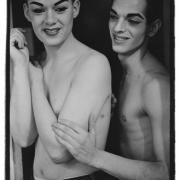
This timeline provides a sociohistorical context for Diane Arbus's 1962 Two Female Impersonators, N.Y.C.
Timeline
Table of Events
| Date | Event | Created by |
|---|---|---|
| Autumn 1959 to 26 Jul 1971 | The relationship between Diane and Marvin Israel
Marvin Israel was an American artist and photographer that worked in New York. He worked with Diane closely helping her further develop her career as a photographer. Though both Diane and Marvin were married outside of their relationship, they started dating in late 1959. This relationship would continue until she passed, throughout her marriage and her divorce. While Diane’s husband, Allan Arbus, was very supportive of Diane’s career, Marvin pushed Diane to become an independent photographer and work on her portfolio, not for commercial photography. This relationship with Marvin was very beneficial to Diane’s career as he influenced and pushed Diane to take on a creative aspect of photography, which led her to take part in focusing on photographing the outskirts of society. Even more so, Marvin convinced Diane to put out her first portfolio, a box of ten photographs featuring drag queens, identical twins, dwarfs, and many more. These images guided her to be connected with other famous photographers of New York and even get her first portfolio published in the Smithsonian American Art Museum. Working alongside Marvin Israel and being involved with him romantically impacted the direction of Diane’s career immensely, from a simple commercial photographer to an established innovative photographer before she took her own life in 1971.
|
Jakirah Johnson |
| 1962 to 1995 | Tavern Guild San Francisco, CA 1962Tavern Guild was the first gay business association to operate openly in the US. This association provided safe venues for the gay community of San Fransisco. This business association, consequently, influenced the production of gay venues all over the country. Though this was a group that solely consisted of bar owners that mainly focused on the distribution of alcohol, it created secured spaces for those of the LGBTQ community of San Francisco. There were not many venues, bars, or environments of this sort up and running for the gay community during that period, so this business acts as a big turning point for gay rights as it branded the mall together under an official group. There were places for performers, like theaters, that also assured their safety and comfortability to do their job for crowds filled with people of their kind. In connection to Diane Arbus’ photo, while she worked in New York with a marginalized group, this achievement across the country showcases the significance of normalizing belittled groups, especially the gay community, on a national level. Though still being labeled as ‘freak shows’, drag performers could now fulfill their enactments in homely atmospheres living both their realities as an entertainer and a member of society. Furthermore, a simple association operating may seem simple but brand bars that were run, operated, and occupied by LBGTQ members were a rarity in itself.
|
Jakirah Johnson |
| Aug 1963 | Bayard Rustin March on Washington August 1963Bayard Rustin was one of the most influential individuals during the civil rights movement but often is overlooked because he was a gay man. During the summer of 1963, working alongside Dr. Martin Luther King Jr. in Montgomery, Alabama, Rustin officially became accepted as a gay activist in the US after years of being arrested for moral charges. Concerning the image for the docent assignment, this triumph for the LGBTQ community paved the way for many other gay males who now felt comfortable expressing themselves. In addition, it shows the other side of the fight for gay rights with others outside of white gay men. As a gay, black man in the public eye, this helps bring awareness to the climate of the US surrounding gay culture and the importance of representation during the 1960s. There were not many openly gay black men during that time, only openly white gay men. So, Bayard Rustin provides a representation of gay culture for people of color. Though Diane Arbus did not specifically focus her work on gay culture, as she worked with all marginalized groups, this image specifically aims to normalize drag and feminine men. Moreover, the significance of gay culture coming to the forefront of America allowed for open expression and acceptance, especially for drag queens and entertainers.
Docent Story The reason that I offered that background concerning those three events is that it helps me to explain what Two Female Impersonators Backstage, N.Y.C.1962 was doing socially/culturally, and/or politically when Diane Arbus created it. The three historical backgrounds – Bayard Rustin's contribution to the March on Washington, the establishment of the Tavern Guild, and Arbus' romantic relationship with Marvin Israel – all help understand the climate of the U.S. during the 1960s. It is vital to understand the nature of society during Diane's life and around the time this image was created to further make sense of why Two Female Impersonators Backstage was taken. Understanding that the country already had existing turmoil in gay culture, as seen through Bayard Rustin’s experience and the significance of the Tavern Guild association, contributes to the overall reasoning and message behind Diane's purpose in focusing this image on drag queens of New York City. Marvin Israel was one of the biggest influences on her photographic career, and in part, is the reason behind her desire to focus her career on marginalized groups of society. Focusing on these groups was essential to Diane because she aimed to help normalize these groups of people that were often overlooked and neglected. After all, they do not fit into the norms of society. Diane did not only focus on gay culture, despite this photo in connection with it. She also focused on other groups like exotic dancers, those that participated in circus acts like individuals that suffered from dwarfism, and even nudists. Furthermore, her work helped provide representation for all of these groups. With these three events and hallmarks in mind, you can now comprehend Diane Arbus thinking and purpose in publishing Two Female Impersonators Backstage.
Work Cited “The Tavern Guild and Imperial Court · Polk Street History Project by Joey Plaster · Outhistory: It's About Time.” Outhistory.org. https://outhistory.org/exhibits/show/polk-street/gay-economic-engine/tavern-guild-imperial-court. Accessed 23 March 2022. Rexer, Lyle. “Through Her Lens Darkly: Diane Arbus's Life Was as Raw as Her Work.” The New York Times, The New York Times, 1 July 2016, https://www.nytimes.com/2016/07/03/books/review/diane-arbus-biography-by-arthur-lubow.html. Accessed 23 March 2022. Magazine, Smithsonian. “A Window into the World of Diane Arbus.” Smithsonian.com, Smithsonian Institution, 24 Apr. 2018, https://www.smithsonianmag.com/smithsonian-institution/window-world-diane-arbus-180968861/. Accessed 23 March 2022. Gates, Henry Louis. “Bayard Rustin, the Gay Civil Rights Leader Who Organized the March on Washington.” PBS, Public Broadcasting Service, 19 Sept. 2013, Accessed 23 March 2022.
Corley, Cheryl. “Bayard Rustin: The Man Who Organized the March on Washington.” NPR, NPR, 15 Aug. 2013, Accessed 23 March 2022. |
Jakirah Johnson |