
The Rubáiyát of Bridge by Carolyn Wells is a small, illustrated parody of the Rubáiyát of Omar Khayyám, rewritten with a focus on the card game bridge. Carolyn Wells was an American author and poet, best known for her work in mystery, children’s literature, and humor. Wells began her writing career with light verse and parodies, and she gained early popularity for her clever and humorous poetry. The Rubáiyát of Bridge was published in April 1909 by Harper & Brothers. Harper & Brothers was founded in 1817 and became one of the main publishing companies in the United States during the 19th century.
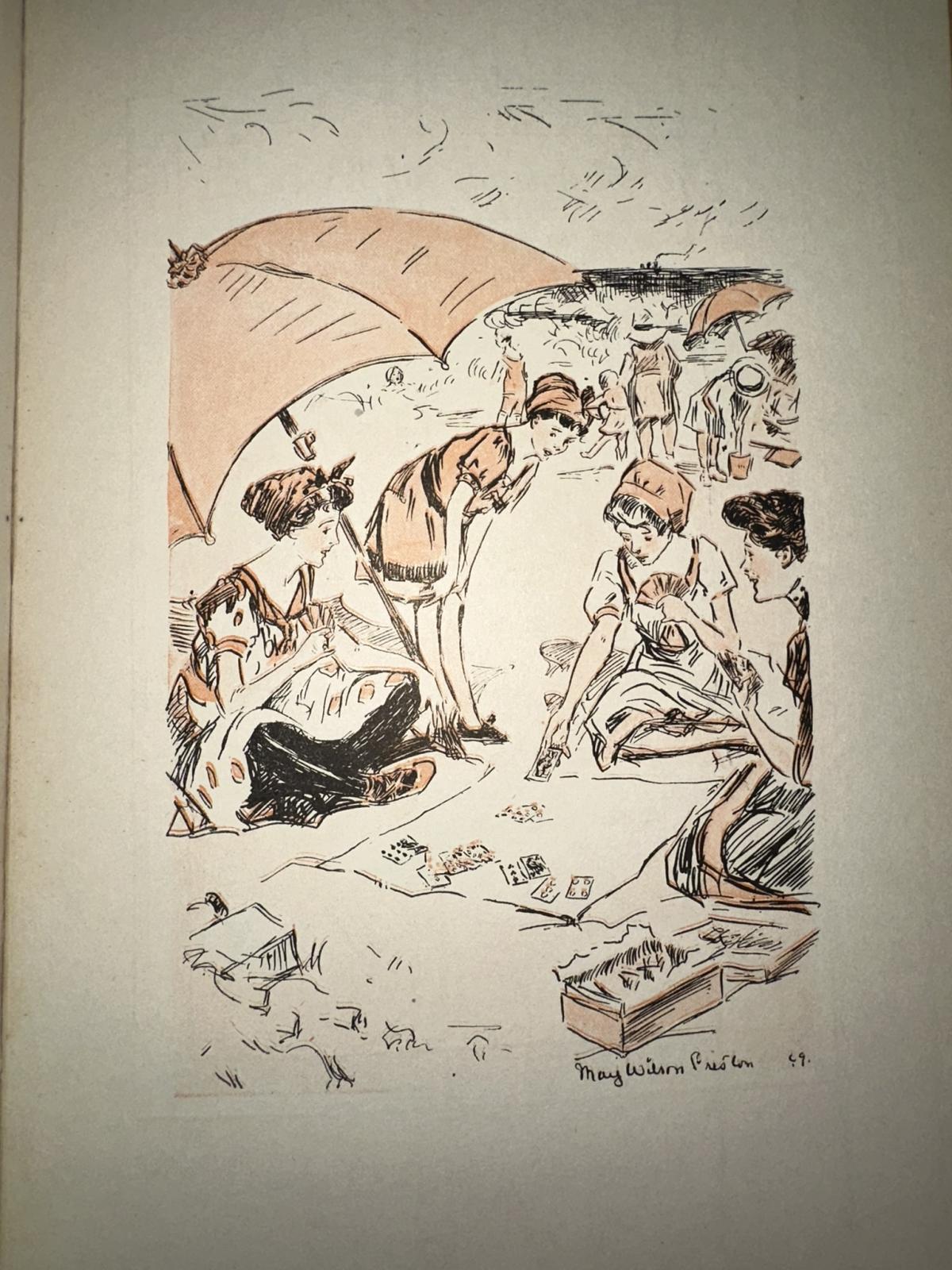
The illustrations were created by May Wilson Preston, a successful artist who became the first woman illustrator admitted to the Society of Illustrators. May Wilson Preston later illustrated for a magazine owned by Harper & Brothers Publishing, which is when she began illustrating for Harper & Brothers. Her illustrations are primarily composed of black-and-white line work, accented with splashes of light orange that draw the viewer's attention to key elements. These scenes depict men and women gathered around a table playing bridge. However, the settings vary—sometimes taking place outdoors in natural surroundings, and other times inside a parlor. The book’s cover features the same illustrative style, showing a young woman. This woman appears throughout the story in the illustrations.
What makes this edition of The Rubáiyát of Bridge really stand out is how every single stanza is paired with an illustration, which adds a fun and artistic layer to the reading experience. What’s even more interesting is that most of the illustrations include the same woman who’s on the cover, giving the whole book a kind of visual storyline or theme. We can track the women throughout almost the entirety of the illustrations. We see her first on the cover (Figure 1) interacting with her butler. We then see her again in the first illustration (Figure 5) playing bridge with a group of women. The fact that we can track this woman through the illustrations is an interesting element of this book.
Another interesting element of this edition is how, on the first blank page, there’s a signature that reads “Betty Bile,” which suggests that this particular copy probably belonged to her. This personal touch to this edition demonstrates how it holds its sentimental value and how it holds traces of the people who owned it previously.
The final interesting element of this edition is that there’s an emblem that looks a bit like a coat of arms—it features the head of a king wearing a crown and rendered in a style reminiscent of classic playing cards. Below him is a shield that incorporates the four suits of a deck above a shield with all four playing card suits (hearts, diamonds, clubs, and spades). Underneath it, there’s a scroll with the phrase “All’s Lost Save Honors.” According to The Italian Wars, "All is Lost Save Honour" this phrase comes from a wargaming guide focusing on the campaigns of the Italian Wars between the Habsburgs and the Valois. Although this phrase is from a wargaming guide, it is also still in reference to bridge. In bridge, an honor is a high card. Generally, we consider honors to be Aces, Kings, Queens, and Jacks. The fact that this phrase is reused in a way to speak about bridge is similar to how this edition uses the very popular, at this time, Rubáiyát of Omar Khayyám and parodies it. It uses the common phrase and relates it back to the game of bridge.
Sources:
“Europa Simulazioni.” Italianwars.net, 2025, italianwars.net/NewSite/all_is_lost_save_honour.html.