
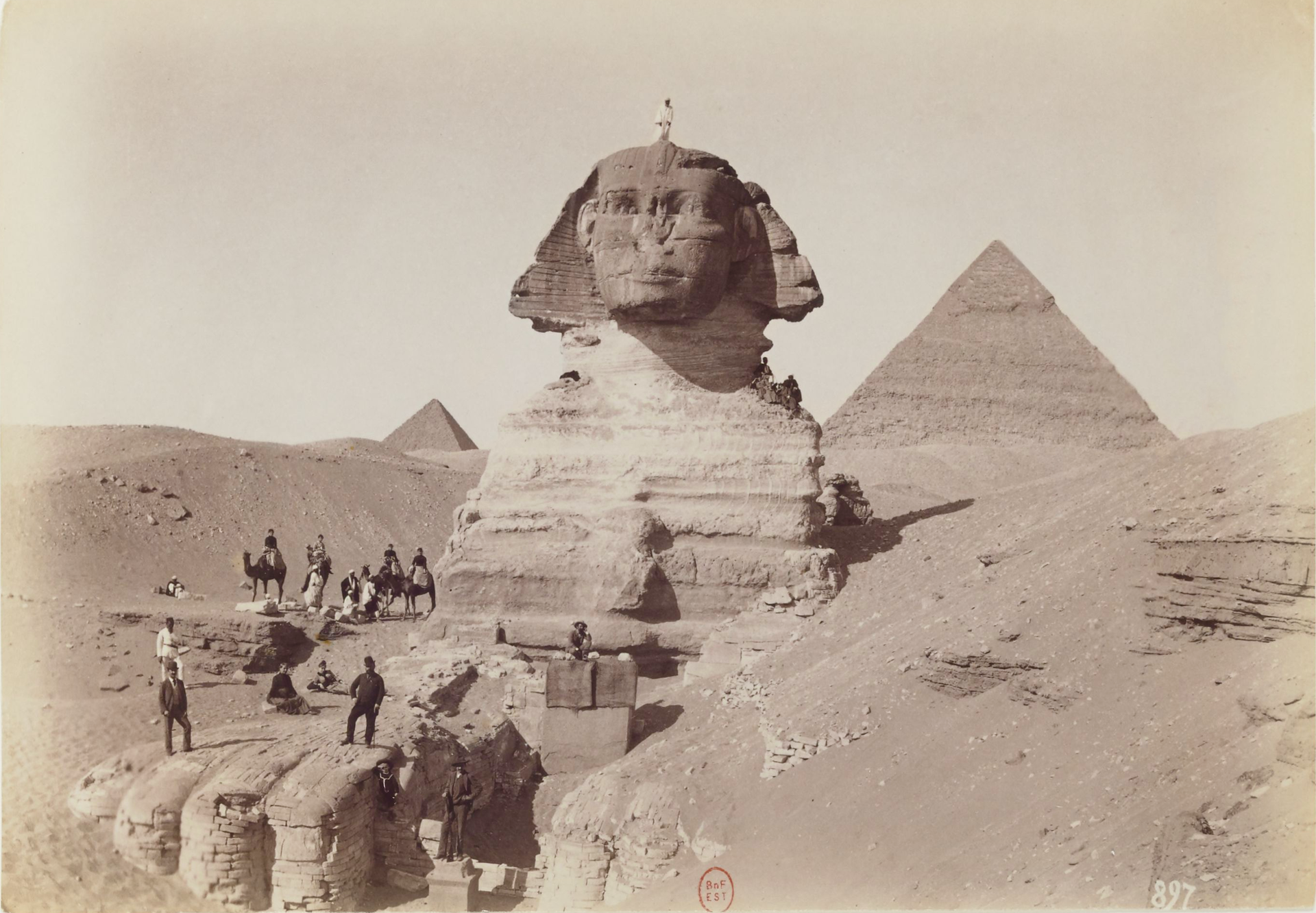
The discovery of the pyramids at Giza and the Sphinx have fascinated citizens of the world for thousands of years. Since Napoleon’s invasion of Egypt in 1798, much of Europe had made it a priority to discover as much of the artifacts as possible. Little of the pyramids construction and origin remain a mystery. During the reign of Queen Victoria there were several archeological expeditions led in Egypt to further explore the ruins of the pyramids as well as the Sphinx.
The Great Sphinx of Giza is a statue made of limestone, carved from the bedrock approximately 66ft tall by 240 ft long. It is thought to be designed and constructed by the Egyptians during the reign of pharaoh Khafre (circa 2558-2532 BC).
The Sphinx itself is a mythical creature originated by the ancient Greeks. The Sphinx had the head of a human, a falcon, cat or sheep and the body of a lion with the wings of an eagle. In Greek mythology the human head is often that of a woman, who was said to be cruel and would devour those who could not answer her riddles. The Sphinx in Egypt is shown as a man and often regarded as less evil than his Greek female counterpart but is still revered as a symbol of strength and power.
There’s a very good bet that H.G. Wells joined in the fascination over Egypt and its mystical culture. There is much to be said about Egyptian discoveries making headlines in England at the time. Archaeologist Andrew MacCallum published a letter documenting his discovery of a secret rock chamber in the Temple of Aboo Simbeil in March of 1874. The Time Machine was published in 1895.
“Imagine what wonders lie there in the sand. From this humble desk I read the discoveries of men far greater than myself. Men who longed for adventure and sought to uncover the mysteries of the ancient world. It seems quite like the makings of something from an alien world. How could mortal men transport those stones and carve such delicate features into rock? What secrets are buried underneath? The papers tell of treasure, of gold, tombs filled with mummified remains. How queer. I’ve compiled enough notes in my journals. Gathered the necessary resources. No longer shall I sit in listless misery watching the wonders of the desert be uncovered by others. Martha knows my intention though she cannot understand why I must feel the sand beneath my very feet, develop callouses from digging with my own shovel. Perhaps I will be the next King of England with all of the glorious treasure I’m bound to find!”
Works Cited
Wikipedia contributors. "Sphinx." Wikipedia, The Free Encyclopedia. Wikipedia, The Free Encyclopedia, 28 Nov. 2020. Web. 29 Nov. 2020.
Wikipedia contributors. "Great Sphinx of Giza." Wikipedia, The Free Encyclopedia. Wikipedia, The Free Encyclopedia, 29 Nov. 2020. Web. 29 Nov. 2020.
Kenna Hawes. “Oscar Wilde’s “The Sphinx” and Victorian Egyptomania.” Victorian Web. 11 Sept 2003. Web. 29 Nov. 2020