
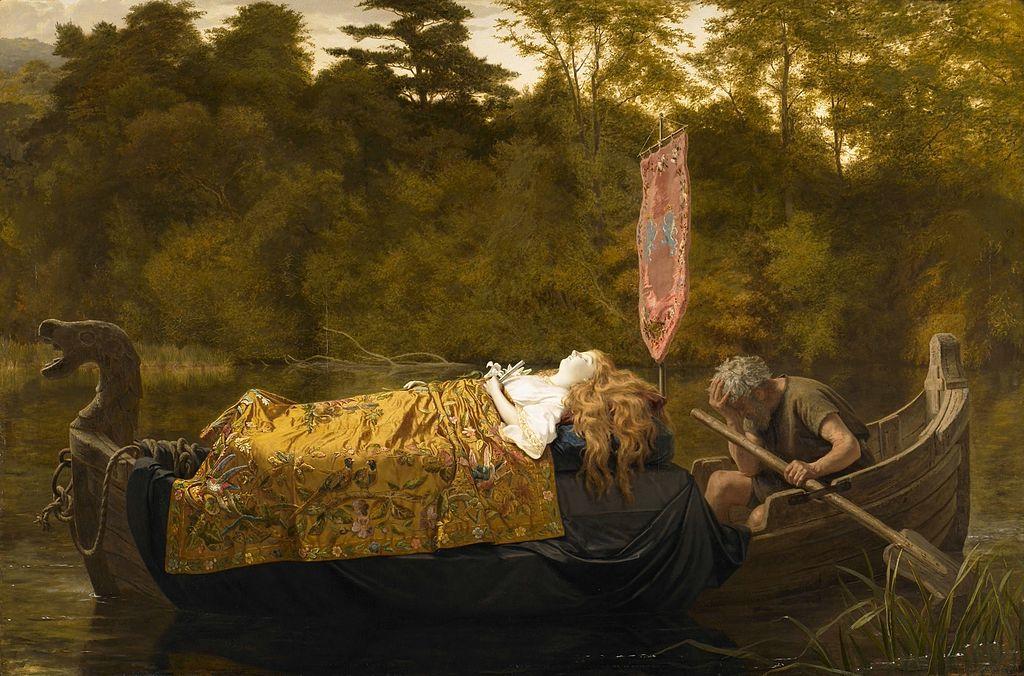

Elaine was painted by Sophie Anderson in 1870 while she resided in Italy. This painting was bought by the Walker Art Gallery in Liverpool becoming the first work by a female artist to be bought by a public institution.1 These public galleries would showcase art that propagated the ideals and messages that they wanted to instill in the public.2 Anderson’s works illustrate the social constraints on each gender. Here, Anderson shows the dead, heartbroken body of Elaine of Astolat, described in the stories of King Arthur and the Knights of the Round Table. This work embodies Anderson’s typical style of depicting women with an almost angelic glow. She emphasizes their purity and virtue through many elements of the painting.
It is thought that this work was inspired by a poem by Lord Tennyson.2 Anderson’s choice of inspiration in this poem is important and matches the innocent style that Anderson uses to depict women in all of her works. In the poem, Elaine of Astolat is one of the many women to fall in love with Sir Lancelot; however, he does not return her affections due to his love for Queen Guinevere. This causes Elaine of Astolat to die of a broken heart. This poem conforms with the typical Victorian gender roles where Sir Lancelot is the strong hero and Elaine of Astolat is a powerless damsel in distress. Additionally, the poem contrasts the virtue within Elaine and the sin of Sir Lancelot who is in love with his King’s wife. In the last line of the poem, “So groaned Sir Lancelot in remorseful pain, Not knowing he should die a holy man”.3 While Elaine is dead and displayed as holy, the poem concludes that Lancelot will have the opposite experience. Anderson depicts these gender norms within her piece as well.
Within the painting, Elaine gleams with innocent love and illuminates her surroundings, generating an angelic glow within the painting. In her hands, she holds a lily representing her purity and virtue. There is also a letter which is thought to declare her undying love for Sir Lancelot. Her body rests on the boat, presented for all to see her. This further shows her righteousness, because a woman who died in shame would be entirely covered and hidden from the public view. Her body is decorated and partially covered showing respect for her and her family’s status and honor. It appears that her body was thoughtfully laid onto the boat with a dark blanket underneath her and her hair brushed out. Her hair is down at her side and around her head. This might have come with Anderson’s attempt to be historically accurate since women of the Arthurian time would have had less complicated hair styles Additionally, her hair around her head suggests a halo which contributes to the angelic presentation of Elaine.
The background is a nature scene on a river. In the poem, they transport the body of Elaine of Astolat to King Arthur’s castle for Sir Lancelot to see. The scene is very peaceful and serene which at first glance can cause the viewer to think that Elaine of Astolat is just sleeping. I think that this further shows the expected gender role of a docile and passive woman. In comparison, one might envision scenes of men dying which are typically more heroic and gruesome. Even in death, Elaine is not revengeful or jealous of Sir Lancelot, but she simply cannot live without him. This painting and the story that inspired it perpetuate the gender roles present within Victorian Society.
There is a man in the painting which is uncommon in Anderson’s works. He is a servant mourning her innocent death and rowing the boat that carries her. His eyes look down and away from her body. This is important since it is indicative of a female artist. Many male artists would have directed the male gaze toward the female body, objectifying it. Rather, Anderson focuses on the female as a person with a story that does not include sex. This creates a moral teaching and ideal within her painting.
Elaine serves in role in the public sphere of reinforcing expectations of women and men. Sophie Anderson’s work was chosen to be displayed in this public sphere because of the morality that it teaches its viewers. By publicly showcasing this art in the Walker Art Gallery in Liverpool, they are informing people of their duties and how civilized society should behave.2 Additionally, the nature within this piece and the setting of a pre-industrialized time reminds the audience of a more moral and righteous time that they should strive to emulate within their daily lives.
Works Cited
(1) Nichols, E 2018, 'Sophie Anderson, a cosmopolitan Victorian Artist in the Midlands', Midlands Art Papers, no. 1. <https://www.birmingham.ac.uk/schools/lcahm/departments/historyofart/research/projects/map/includes/issue1/8-in-depth-sophie-anderson.aspx>
(2) Woodson-Boulton, ‘“Industry without Art is Brutality”: Aesthetic Ideology and Social Practice in Victorian Art Museums’, Journal of British Studies,46.1 (2007), p.52.
(3) Lord Tennyson, Alfred. "Lancelot And Elaine | Robbins Library Digital Projects". Lib.Rochester.Edu, 1859, https://d.lib.rochester.edu/camelot/text/tennyson-lancelot-and-elaine.