
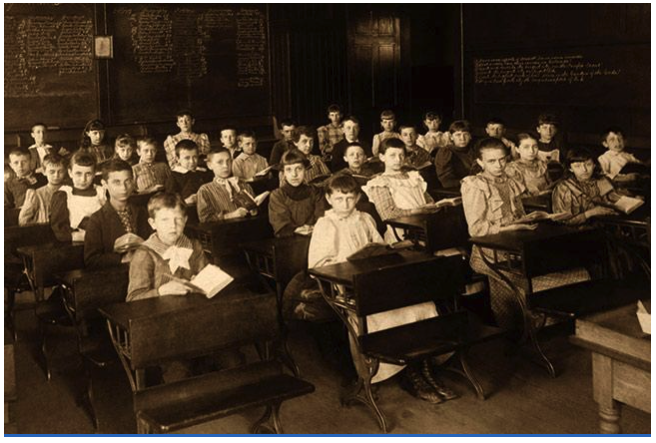
Entry (2/2): The passing of the Elementary Education Act (1870)
GROUP 2
https://www.bl.uk/collection-items/synopsis-of-the-forster-education-ac…
http://www.educationengland.org.uk/documents/acts/1870-elementary-education-act.htm
In terms of women’s education in the nineteenth century, the Elementary Education Act of 1870 in England opened up doors for young women, although there was still much work to be done. Also known as the Forster’s Education Act, it set a precedent for all children, both boys and girls, to be educated from the ages of five to twelve. Although the Forster’s Education Act was not created directly for women and young girls, it still benefits them. In the Victorian era, many women could not afford an education, and those who could afford it did not get a very well-rounded education that was equal to a male. An example of girls and boys not receiving an equal education can be found in George Eliot’s The Mill on the Floss through the characters of Maggie and Tom. Tom had the opportunity to get a very in-depth academic education so that he could get a well-paying job. Maggie, on the other hand, loved learning but was not afforded that same right because of her gender. Evidence of how women’s education and intelligence was viewed can be seen when Maggie’s father talks about her: “Too ‘cute for a woman, I’m afraid,’ continued Mr. Tulliver, turning his head dubiously first on one side and then on the other. ‘It’s no mischief much while she’s a little un, but an over ’cute woman’s no better nor a long tailed sheep - she’ll fetch none the bigger price for that''(Eliot, 15). Women were only taught the skills that would help them in the home, so any smart woman would never be recognized as such.
With the passing of the Forster’s Education Act, schools began to get more public funding, which improved them, although parents still had to pay for their child's education unless they could not afford to. It also brought about the idea of certain educational standards being met by children in order to complete school, as well as brought more supervision to the education system as a whole. Compulsory attendance was also emphasized. This act also put into effect the idea of non-denominational teaching, where people could opt out of a religious education. This caused a lot of controversy between the church and the government, the church feeling that they would lose power over schools. Many people at that time also feared mass education because they thought it would bring about indoctrination and rebellion. Before this act was passed, more than half of the children in England were not getting any education at all. Although we see this as the bare minimum effort for female education, it was a big step for the time.
Bibliography:
Eliot, George. The Mill on the Floss. Penguin Classes, 1979.
“Synopsis of the Forster Education Act 1870.” The British Library, The British Library, 1 May 2014, www.bl.uk/collection-items/synopsis-of-the-forster-education-act-1870.
The History of Education in England, www.educationengland.org.uk/documents/acts/1870-elementary-education-ac….