
Display Explanation:
For this exhibit of exhibitionists, the setup would be fairly simple. As museum attendees enter the lobby, there would be a bar on one side, and a place to buy snacks on the other side. Of course, the bar would have nothing but top shelf single malt scotches that can only be ordered neat. This choice would allow the museum to save money on ice, and pump the leftover funds into the snack bar. I’m thinking pulled pork nachos, maybe some street corn, scotch eggs; fun stuff like that. Popcorn and cotton candy. Once patrons have their booze and snacks, they can head into the exhibit. It would be a long hallway that is the length of a football field. Around every 33 yards, there would be a door leading one of the above paintings in the following order:
1) Kokoschka
2) Schiele
3) Klimt
Paintings would be attached to the walls at eye level using duct tape. As the patrons progress through the hallway by way of one of those conveyor belt things they have at airports for people who are too lazy to walk, the lighting would become increasingly warmer to signify the growing level of comfort of the subjects of the drawings, and the patrons become increasingly comfortable as a result. Everyone would be going at the same pace if the museum board decides to spring for the conveyor belt approach. If they’re really feeling like burning money, I would have cars from an antique wooden roller coaster installed where people ride through the exhibits. Sacklers have the money for this kind of thing.
The lighting would be of a similar style — the first room with the Kokoschka would be more on the dim and cool side with awful incandescent lights would be something cold and unwelcoming like they’d have in a hospital. Probably about 35 degrees in there, because why not. This is done to match the general vibe of the model in the first work — sort of hesitant or not entirely engaging with the artist.
As people plugged along down the conveyor belt, the Schiele would be marginally warmer in both lighting and temperature. The lights would be about 5000k, and the temp would be set at 69 degrees. These selections are made to make the viewers more comfortable and match the general feel of the model in the Schiele work.
Finally, the Klimt room would be very bright and almost uncomfortably warm. Straight up red lights inside, and the temperature would be set at 100 degrees. Again, this is to match the feel of the model in the drawing.
Hope there’s room in the budget for a lot of weird HVAC stuff. Finally, everything would be gold-plated; from the ceilings to the floors. Why the hell not? As patrons exited the exhibit, the conveyor belt would go to an edge where people are dropped off from roughly ten feet into a pool. They can cool off, splash around, and hang out before heading home for the day.
Installation Notes:
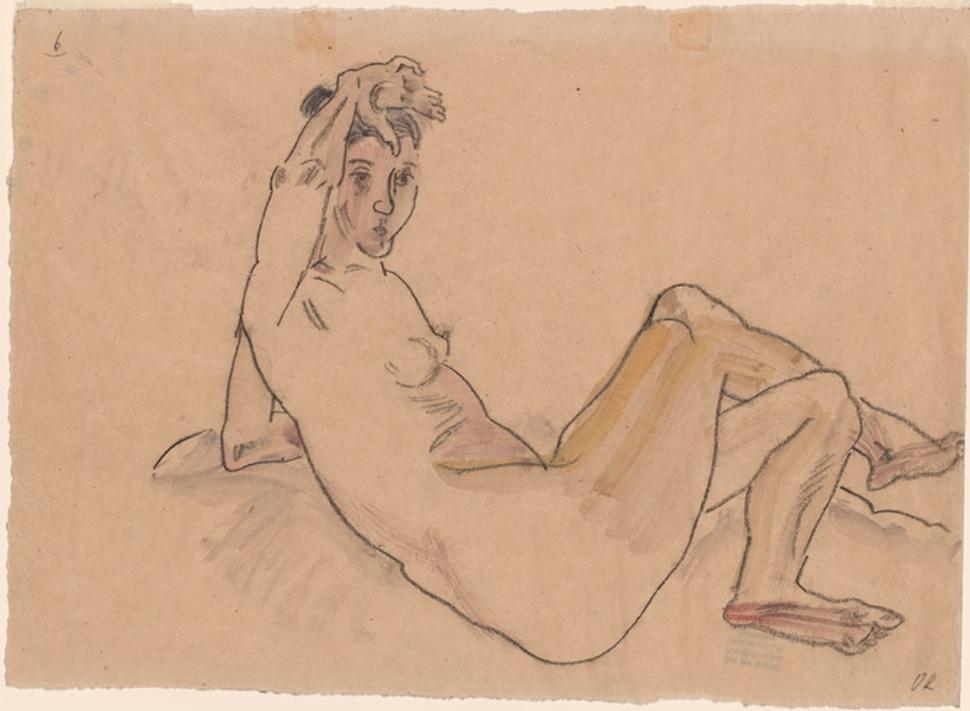
Reclining Female Nude — Oscar Kokoschka, 1911-1912
The first stop in this somewhat sticky exhibition is by Oscar Kokoschka and was created in 1911 or 1912. Same as Schiele and Klimt, old Oscar was an Austrian artist. This work was selected for how much it does not show of the model when contrasted with the other two works, and also to display the model not engaging with the artist or viewer. Klimt’s model had not a care in the world beyond enjoying herself as she thought of England while seeming to be indifferent to the artist. Schiele’s model almost beckoned or dared the viewer to look. But this one is a bit different. The legs of the model are crossed and she is facing away from the viewer. Though her breasts are exposed, they lack the level of detail shown in earlier artwork of the exhibit. She is aware of the artist, and almost seems annoyed by him; sort of like he interrupted her by entering a room and she rolled over to see what the racket was about. Similarly to the earlier works, there are few colors in this: purple, blue, yellow. A bit of red on the bottoms of the feet. This lends itself to a “colder” reading of the work when compared to the “flushed” nature of the first few. There is nothing on display, no arousal in this one. Just a person who likely was taking a pretty sweet nap and was interrupted. Though Schiele’s woman is similarly contorted in an unnatural position, this work seems to be one showcasing the discomfort (physical or otherwise) of the model. The lighting and temperature in this room would be reflective of the colors used in this work.
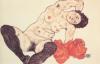
Sitting Girl — Egon Schiele, 1917
Up next is a work by a fellow Austrian who was inspired by Klimt’s works, and later became his mentee. Sitting Girl, by Egon Schiele, shows a woman posing beside a pile of red fabric. This is perhaps her dress. The red fabric ties in with her nipples, rouge on her cheeks, and painted lips. Compared to the first work by Klimt, this one by Schiele has several regions of one color where the viewer’s eye is drawn. The first, of course, is the fabric. But then, the eye of the viewer is free to wander between her black stockings, then up her chest more, catching some armpit hair, and finally, arriving at her hair. In comparison to the model in the final drawing, she is very aware of the artist being in front of her and drawing her in the moment. But, she isn’t doing anything — even the title just says she is “sitting.” This woman is proud of her body, and it could even be said that she is beckoning the viewer to look at all of her; she has nothing to hide — well, nothing except for her upper-left arm that’s concealed behind the red dress. Maybe she has a weirdly deformed hand or something, who knows. In any case, she is quite comfortable with her looks, and she sits in a way that shows the folds of skin on her stomach, which are captured by Schiele as the natural way that a body looks. There is no revisionism on the part of the artist here to “hide” anything that could be "considered" a flaw. The warmer temperature of this penultmate room would match the vibe of this drawing and model — more warm colors, more welcoming.
Frai bei der Selbstbefriedigung — Gustav Klimt, 1913
This 1913 account by additional Austrian artist Gustav Klimt was selected for me as the final installation artwork. In it, the viewer can see a woman who is clearly enjoying herself, and not much is left to the imagination. The model is relaxed; reclining and displaying herself in a very vulnerable position. Her head is backwards-tilted, throes of ecstasy en-route. She appears to be unabashed by Klimt drawing her in a private moment. The heavy and restrictive garments of the era (some sort of red dress, perhaps, and a pair of shoes) remain on her, and her bloomers are notable for not being removed, only pulled aside to expose herself to the artist. Her eyes are closed and not looking directly at the artist in the way of other models in my exhibit, lending itself to an almost voyeuristic tone. All that matters to her in that moment is her own enjoyment, and she seems to care very little about who may be an onlooker. Only three colors are present in the drawing: black, red, and white. Other drawings in my exhibit were chosen for having similar color palettes. There are no “heavy” areas of this drawing — i.e., there are no dark portions that draw the viewer’s eyes to one place on the paper or another. The lines are scribbled, and the onlooker is free to explore the work as the model explores herself. However, the focal point of the work is the action occurring. This final room would match the passion occuring in the work with its lighting and temperature.
Sources:
Klimt, Gustav. Frai bei der Selbstbefriedigung. 1913. https://en.wikipedia.org/wiki/Gustav_Klimt#/media/File:Klimt_Mulher_sen… Accessed 19 Feb. 2023.

Kokoschka, Oscar. Reclining Female Nude. ca. 1911-1912. https://www.themorgan.org/drawings/item/251019. Accessed 23 Feb. 2023.
Schiele, Egon. Sitting Girl. 1917. https://en.wikipedia.org/wiki/Egon_Schiele#/media/File:Egon_Schiele_-_W…. Accessed 19 Feb. 2023.
