
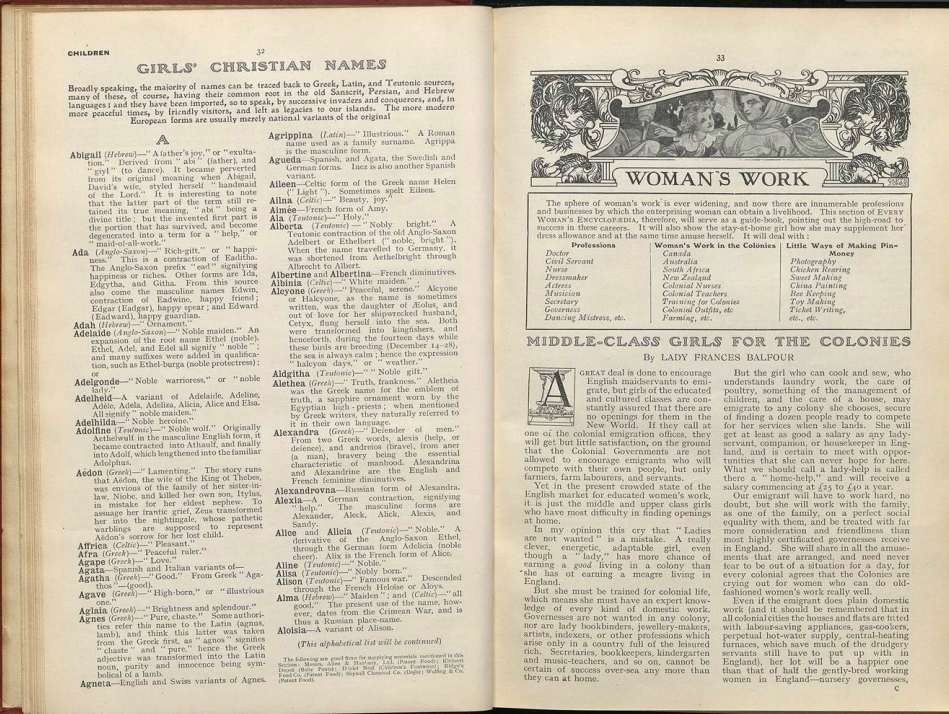
Character: Being a lady of the upper middle class, this was a common text found within our libraries that would serve as a guide for terminology and advice on management of a women’s role in society. Considering my political aspirations and backhanded skill for writing, I was hoping to see how I could immerse myself in the working society through the chapter “woman’s work”. Through my surprise though, I found it quite confusing that its chapter introduction began with a positive encouragement that women have the ability to seek careers such as “doctor, nurse, civil servant and etc”, yet it would be to “show the stay-at -home girl how she may supplement her dress allowance and at the same time amuse herself”(pg 33). Do they think that all we women care about is finding ways to buy more dresses? Imagine having to work past the gender barriers of becoming a doctor and yet with the sole purpose of amusing myself and expanding my allowance for dresses..quite a degrading opinion if you ask me. To make matters worse, the text stated that in order for women to truly make money, they should seek jobs in Great Britain’s colonies. Unfortunately, it seemed such was mostly directed toward english maidservants. It is believed that us women of higher class, don’t have the proper qualifications of a housewife. I tried to call the offices myself, and was “assured of no new openings in the new world”(pg 33). My determined personality finds difficulty in accepting a rejection right away,thus I took it upon myself to discover what these “qualifications” consisted of. To my disappointment, I found that girls who had domestic skills such as sewing and cooking would have of far greater value. It seems that there is a stereotype that an educated woman must have had maidservants and thus would lack skills in those areas. In reality, there should be a reevaluation of what is valued as “skills” and should be more towards the job than the living benefits she would give the host family.
Editor:The idea of upper middle class to upper class women in the workforce was a new concept with rooted misogynistic job qualifications. Culturally, it was viewed as a man’s responsibility to provide for his family whilst his wife cared for the home and the family. The text, “Every Woman’s encyclopedia” was proposed as as a guide to be used as “advice for women on the home, cooking, beauty, work, love, marriage, children, gardening, needlework, clothing, first aid and even hobbies such as Jiu jitsu for women” (under “additional information”). However, much of its focus was geared towards providing information on how women could better themselves as ladies often discouraging behaviors that may affect their image or chance at marriage. In the chapter, “Women’s Work”, various opinions regarding the best job options for women are listed and differentiated by rank. For the working women, domestic jobs were highly encouraged and praised as opportunities for good money. A single woman of the working class with experience in these jobs had a high chance of marriage and was valued within the colonies she served. On the other hand, work for the ladies of the higher classes presented much more difficulty, and such frustrations are seen in our character. Having worked hard in her education it would be disappointing for her not to be able to find a job, or like she mentioned be valued for her skills. If she were to want to get into Entrepreneurship , the text argued she was still expected to "spend a year or two in the colonies” as attempting to touch “capital” without experience was “fatal” (pg 34).Such dispirited many from setting foot in the workforce whilst others were stopped from their fear of failure and what such would do to their image.
Citation: 1912. (pg 32-35) Every [[Woman]]'s Encyclopaedia Vol.1. London, United Kingdom. Gender: Identity and Social ChangeAvailable through: Adam Matthew, Marlborough, Gender: Identity and Social Change, http://www.genderidentityandsocialchange.amdigital.co.uk.proxy-remote.g… [Accessed November 11, 2020].