
The idea of Hyde being an ape-like monster is greatly inspired by Stevenson in his words like that of, “ape-like fury,” and “A dismal screech, as of mere animal terror, rang from the cabinet.” These passages not only give the reader a sense of Hyde’s animalistic tendencies but gives ideas to adapters on how best to show the monstrosity of Hyde. Yet where do the connections between ape and monster come from and how did they get linked to the racist undertones of Hyde and his many depictions? One can look back to Darwin in which whose words are almost a blueprint for how Hyde looks and acts. Darwin states how humans can act in animalistic tendencies as, “Dickens, [1010] in speaking of an atrocious murderer who had just been caught and was surrounded by a furious mob, describes “the people as jumping up one behind another, snarling with their teeth, and making at him like wild beasts.” Everyone who has had much to do with young children must have seen how naturally they take to biting, when in a passion.” (Dickins)
What inspired these ideas of man and animalistic misconceptions of our past and how they relate to apes at that time for this one can look at what inspired this gallery passages in the book the Congo. The idea of murderous apes has been around for decades as explorers from all nations on earth attempted to explore the interior of the African continent they met with great difficulty. When they could not explore any further they left with stories from the local tribes, and these tall tales came many misconceptions about apes. Two experts from Crichton’s Congo that help this idea come across can be seen here, “There were stories of a vast forest and tiny men with tails; stories of mountains that spewed fire and turned sky black; stories of native village overwhelmed by monkeys, which would have congress with women; stories of great giants with hairy bodies and flat noses;” (Crichton, 57)This combats the idea of the violent lustful ape we see across the adaptations, and with the second quote comes with Crichton stating, “Elliot himself had helped eradicate one of the most famous misconceptions-the brutish stupidity of the gorilla. In the first descriptions, Savage and Wyman had written, “This Animal exhibit a degree of intelligence inferior to that of the Chimpanzee; this might be expected from its wider departure from the organization of the human subject.” Later observers saw the gorilla as “savage, morose, and brutal.” But now there was abundant evidence from field and laboratory studies that the gorilla was many ways brighter than the chimpanzee.” (Crichton, 264-265) Though this story is a fiction story he did do his research and these quote mirror what happen in real life and are the basis to see the lack of change I expect from adaptation and ape-like depictions.
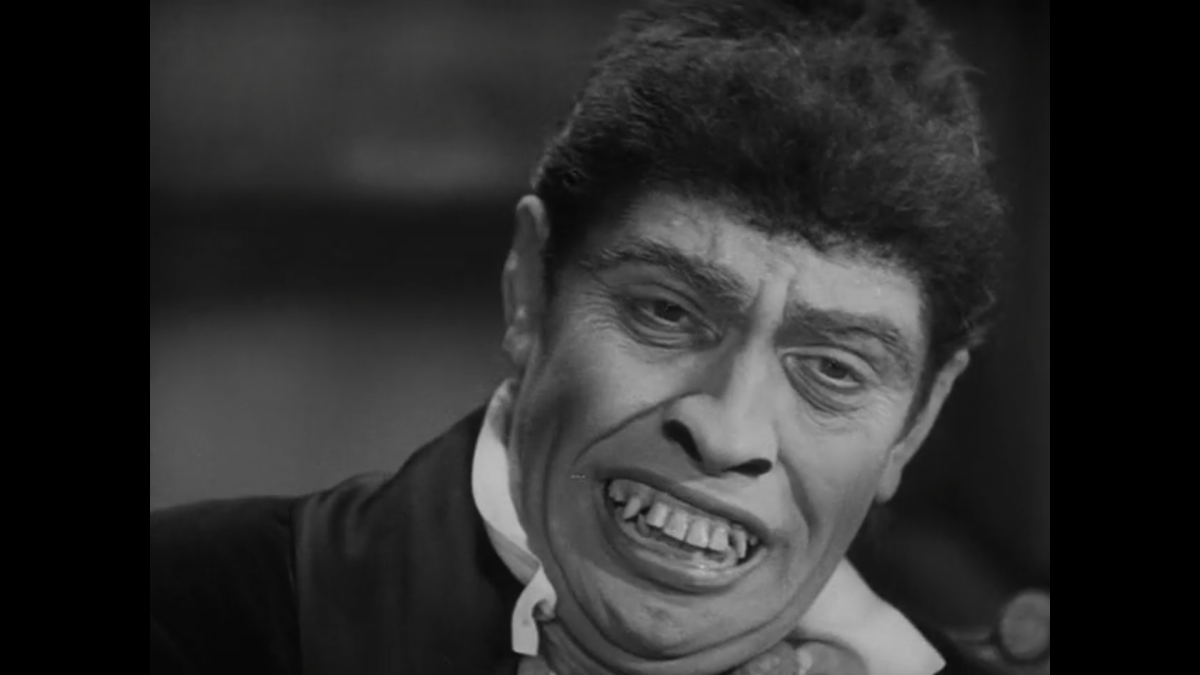
This scene is an extreme close-up of Hyde’s second transformation, and we can see the complete difference between Jekyll and Hyde. From this scene, we cannot see what is happening in the background, which hints at the view that the transformation here is incredibly important. For this gallery, it is important as it is an important depiction of Hyde as it shows his lustful hairy ape-like self. From his transformation, we can see Hyde’s physical traits match the depiction of an ape-man or people of lesser birth by Darwin. In chapter 10 of his article “The Expression of the Emotions in Man and Animals,” his description of the animals’ emotions shown by humans matches Hyde in his Transformation. A small excerpt that matches how Hyde looks here is, “The lips are sometimes protruded during rage in a manner, the meaning of which I do not understand unless it depends on our descent from some ape-like animal… The lips, however, are much more commonly retracted, the grinning or clenched teeth being thus exposed.” (Darwin) The way Darwin explains the ways that criminals or the mentally ill revert to a status of primal or atavistic being and mentality, and with Hyde’s ide self-being unleashed here we can see physically his ape-like features. As mentioned earlier Darwin has then grinning lips and clenched exposed teeth. We also hear him in films and act ape-like with growling and more animal noises. These all point to an almost false depiction of Gorillas and Apes, as where this story and usage of ape-like in a negative way we knew next to nothing about Apes like Gorillas.
Mamoulian, Rouben. Dr. Jekyll and Mr. Hyde. Paramount Pictures, 1931.
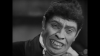
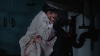
This depiction in the Nutty Professor is a great contrast to the original story of Jekyll and Hyde but the horror aspect of the originals comes out greatly in the first transformation scene here. In this frame of the movie, we as viewers can see many aspects that can be seen as a call back to not only the Mamoulian film in the 30s but to the greater depiction of ape-like men in media. We see in this scene and later that Professor Kelp’s teeth are uncovered and change into many different horrific ways that inspire disgust and fear in the viewer. That matches what Darwin perceives from teeth,” The appearance is as if the teeth were uncovered, ready for seizing or tearing an enemy, though there may be no intention of acting in this manner.” (Darwin) As well as the teeth we see that one of his arms has turned completely hairy down to the knuckles in a very chimp-like way. I see this as not only a callback but as an evolution of the ape-man because the special effects and his stature work together to make Kelp look almost Chimpanzee like in his fear-filled state. This idea of Ape man would go out of fashion with the time as did Hollywood but the idea of Hyde being more accurate to science wouldn’t.
Lewis Jerry et al. directors. The Nutty Professor. Jerry Lewis Enterprises 1963.
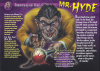
The next gallery image is a trading of the Monsters of the Mind collection of the Weird n’ Wild Creature trading card set that was sold from 2003-2010. The art used on this card is reminiscent of the Mamoulian film as just like in the film we see the increased hair and build of the character. Along with that, we see the hunched posture and barred teeth, and thin lips that work with Darwin’s depiction of the animalistic description of man and ape. Yet with this being 70 years later, I thought I would see some difference in how ape or ape-like men are portrayed with all the work put into equality, racism, and the study of the Great Apes but I think this points to two points. First that the image of Hyde as an ape-man was put into a common culture and will remain as a centerpiece of adaption when one looks back into the past of Hollywood. Second, this shows greatly the murderous urges Hyde had in the novel and seems like it was designed with help of Mamoulian character design and this passage in the “Strange Case of Dr. Jekyll and Hyde.” Stevenson’s quote that matches this is, “And next moment, with ape-like fury, he was trampling his victim underfoot and hailing down a storm of blows, under which the bones were audibly shattered and the body jumped upon the roadway. At the horror of these sights and sounds, the maid fainted.” (Ch. 4)
“Mr. Hyde.” Weird n' Wild Creatures Wiki, Fandom, https://weirdnwildcreatures.fandom.com/wiki/Mr._Hyde#Back_.
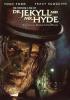
My idea coming into this gallery was not true, the idea that the ape depiction of Hyde would evolve with discoveries of Gorilla and Chimpanzee behavior is wrong, and it can be seen in no other place than in the 2006 adaptation by John Carl Buechler. This depiction doesn’t have the pronounced teeth or thin lips of other depictions and since I haven’t found a steaming version of the film, I haven’t seen the film. Yet from this cover art we can see that Tony Todd as an African American wasn’t using this role in a racist capacity as movies in the 30s would have. The actor not being a white man in colored face paint goes against this earlier idea of primitivism that we see in the Mamoulian film. This idea explains by Metzler, “Universal’s film adaptation appropriates and revises nineteenth-century constructions of scientific racism, speciation, and miscegenation as a means of entering into racially charged 1930s discourses of primitivism, which frequently hinged upon a persistent fear of foreign Others.” (Metzler, 31) With the change of not only physical features but the intent of not being racist but as the film shoots it is an accident from taking an experimental drug made for apes, that is why he is ape-like, and not for racist undertones.
Buechler, John. The Strange Case of Dr. Jekyll and Mr. Hyde. Rocky Mountain Pictures, 2006.
Citations:
Buechler, John. The Strange Case of Dr. Jekyll and Mr. Hyde. Rocky Mountain Pictures, 2006.
Crichton, Michael. Congo. HarperCollins, 2003.
“The Strange Case of Dr. Jekyll and Mr. Hyde FilmPoster.” Wikipedia, Wikimedia Foundation, 25 June 2019, https://en.wikipedia.org/wiki/The_Strange_Case_of_Dr._Jekyll_and_Mr._Hyde_%282006_film%29#/media/File:The_Strange_Case_of_Dr._Jekyll_and_Mr._Hyde_FilmPoster.jpeg.

Lewis Jerry et al. directors. The Nutty Professor. Jerry Lewis Enterprises 1963.
Mamoulian, Rouben. Dr. Jekyll and Mr. Hyde. Paramount Pictures, 1931.
Metzler, Jessica. “Lusty Ape-Men and Imperiled White Womanhood: Reading Race in a 1930s Poe Film Adaptation.” Adapting Poe, 2012, pp. 31–43.,
“Mr. Hyde.” Weird n' Wild Creatures Wiki, Fandom,https://weirdnwildcreatures.fandom.com/wiki/Mr._Hyde#Back_.
Stevenson, Robert Louis. Dr. Jekyll and Mr. Hyde. Longman, Green, & Co, 1886