
This timeline provides a sociohistorical context for Tom Wesselmann's 1961 Great American Nude #21.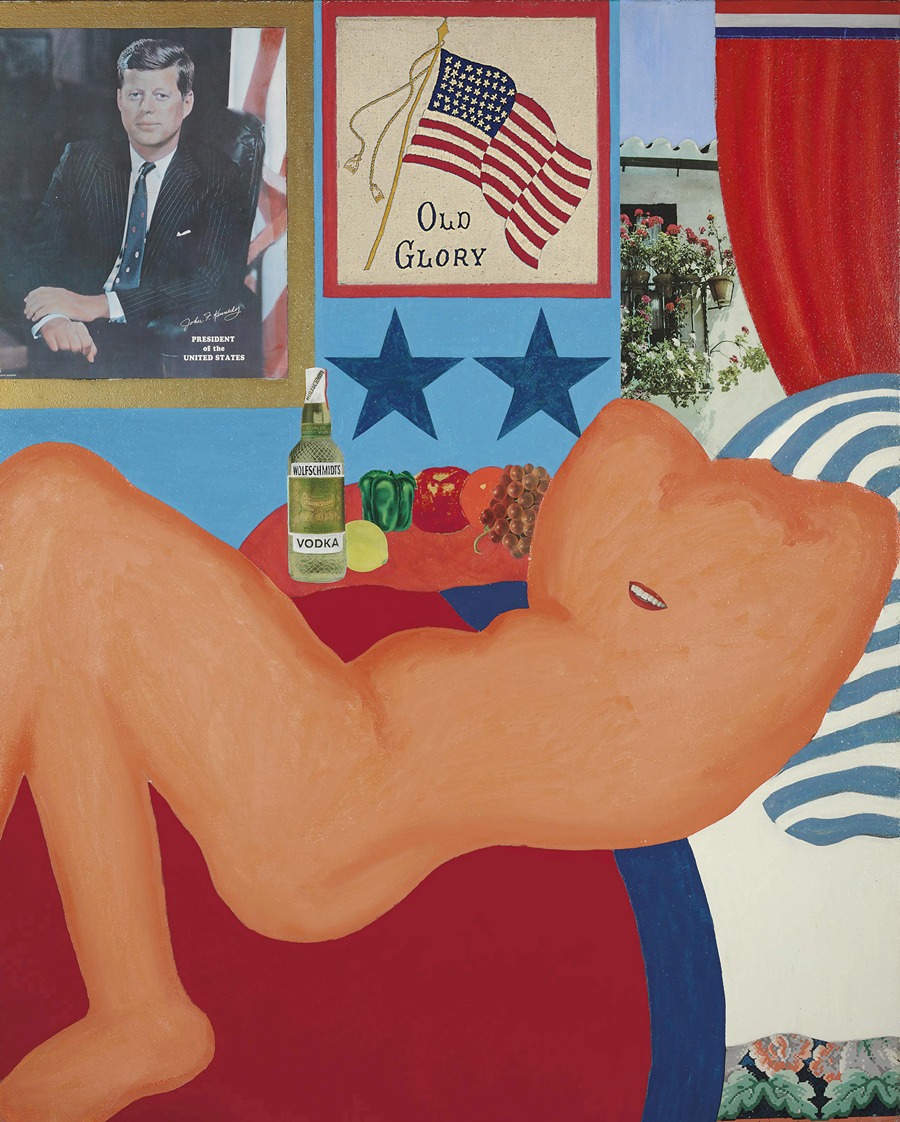
“Great American Nude # 21 by Tom Wesselmann.” Artvee, https://artvee.com/dl/great-american-nude-21
Timeline
Table of Events
| Date | Event | Created by |
|---|---|---|
| 1953 to 1965 | Neo-Dada MovementThe terminology Neo-Dada is often used in relation to modern artists and their works, and it utilizes similar methods to those of the Dada movement that occurred from 1916-1923. The first Dada appeared in Zurich during 1916 as an anti-art movement, and it was inspired by junk art that was created by Marcel Duchamp, a modernist sculpture of Picasso, Henri Laurens, and work in relation to propaganda done by Andre Breton. The movement was a strain of avant-garde art, and it utilized unorthodox methods and materials, popular imagery, and collaborative juxtapositions. It was further driven by an anti-establishment ethic. The Neo-Dada movement continued to influence a wide variety of 20th century artists, and also contemporary art movements, with Pop Art being one that sprouted from it. Art created within the Neo-Dada style rejected elitism that was often associated with Abstract Expressionist works, and it remained in favor of a more socialist type of art, which emphasized communities and our environment. The artists often worked alongside other similar artists, poets, musicians, dancers, and other groups that resulted in a new branch of aesthetics. This movement’s interest was revived during the 1950s in America and France. The “anything goes” attitude was embraced by artists, and unorthodox materials were used to protest high art traditions. For example, Duchamp’s collage art that was done alongside Kurt Schwitters and Georges Braque and the Surrealist artist’s efforts to turn the greatness of everyday life and its objects into a shared value were important parts of inspiration for them.
Works Cited: “Neo-Dada Art: History, Characteristics, Neo-Dadaists.” Www.visual-Arts-Cork.com, www.visual-arts-cork.com/history-of-art/neo-dada.htm. Accessed 2 Apr. 2023. “Neo-Dada.” Wikipedia, 29 Mar. 2023, en.wikipedia.org/wiki/Neo-Dada#/media/File:Robert_Rauschenberg. Accessed 2 Apr. 2023. |
Zane Clouser |
| circa. 1960 to circa. 1961 | Inspiring a New WaveArtists display artworks in downtown New York City: Andy Warhol, Tom Wesselman and Roy Lichtenstein started to create vernacular artwork from advertisements and other media. Post-War American culture had large emphasis on their produced artworks, and this eventually branched out into the Pop art movement. This movement collaged often, and its subject material usually shined from America’s vulgar commercial industries. It was often in touch with reproducible images and other symbols used in everyday life, which was opposite from the previous expressionists. One of their main goals was similar to those of Constructivists existing earlier within the twentieth century, with it being to accomplish a larger set of concerns through bringing them into focus while also combining the urgencies of everyday life and art. These artists redefined the expectations of contemporary painting, even those that were entirely radical. The exhibits gave birth to a new wave of artwork, and Wesselman shines the true meaning of Pop art within Great American Nude #21. We see many different everyday life symbols within this image, such as several pieces of glistening fruit and a bottle of vodka placed right behind the subject of the photo. He includes an image and/or poster of John F. Kennedy, who had just been elected. The viewer is also drawn to a needlepoint located in the United States flag image labeled “Old Glory.” Each aspect of the image creates a relationship that displays consumer culture during the time period while also celebrating the current state of taboo.
Works Cited: “Great American Nude # 21 by Tom Wesselmann.” Artvee, https://artvee.com/dl/great-american-nude-21 Accessed 19 Mar. 2023 “Tom Wesselmann (1931-2004).” Christies.com, Christie’s, 2020, www.christies.com/en/lot/lot-5437837 Accessed 19 Mar. 2023 "What You Need to Know: Pop Art", Sothebys.com, Kathleen White, 2018, https://www.sothebys.com/en/articles/7-things-you-need-to-know-pop-art Accessed 28 Mar. 2023 |
Zane Clouser |
| 20 Jan 1961 | John F. Kennedy ShinesJohn F. Kennedy was elected in January 1961, and immediately promised to “get this country moving again” to American citizens. He took his position during the Cold War, and during his inauguration, around one million people stood in harsh temperatures to view their new President. Kennedy was a war veteran, and he knew that it was important for him to propose acts of sacrifice to citizens. This inspired many individuals as he attacked the grim reality of nuclear warfare head on, refusing to shy away from a hard topic. Kennedy was able to offer a sense of security, but also idealism, which assured citizens of our nation’s strengths of the time. Great American Nude was crafted the year that J.F.K was elected, and Wesselman chose to include the president as he was very influential to citizens. Kennedy was also often referred to as handsome, further appealing to America’s libido during 1961. Due to his confidence and inspiration, he quickly became a major factor that represented the “Americana” that existed at the time. It is also known that the red lipstick used within this image is reoccurring throughout other artists works, such as Andy Warhol, during the time-period. This makes a connection to Marilyn Monroe’s use of sexual attraction to the known gaze of John Kennedy. The reason that I offered that background concerning those three events is because it helps me to explain what Great American Nude #21 was doing socially when Tom Wesselmann created it. The title itself embraces the era’s public spirit, and the painting consists of a pallet of bright reds, whites, and blues. Wesselmann included a familiar background, with the image taking place inside of a normal house in America, and he included a variety of fruits as well as a bottle of vodka. As mentioned earlier within the timeline, Wesselmann represented those products of mass consumption in a very realistic style, and this painting itself provided a view of the “familiar” privacy that exists in every American’s life. John F. Kennedy influenced the country when he was running to be and was eventually coined our president, and choosing to include him in a form of art that consists of other usage of everyday elements is the perfect example of Pop Art. The collaboration between Wesselmann, Warhol, and other Pop artists inspired a new wave of inspiration to flow through America, and this allowed many similar works to be created that displayed what it meant to be an American. The Neo-Dada Movement utilized unusual methods, popular imagery, collaborative juxtapositions, and an anti-establishment ethic that caused new forms of art to be created, with Pop Art sprouting from it. Wesselmann utilized a higher amount of abstraction but less definition in Great American Nude #21 and other paintings that he created during the time. This painting is considered to be the changing point of the countercultural movement, as his nudes were rendered from everyday life, which is opposed to the use of collages of still-life aspects. He chose to use his girlfriend, Claire Selley, as his model for these paintings, and he claims that she sparked his sexual inspiration. He chose to leave the model’s face undetailed so that viewers wouldn’t claim it’s a portrait. Wesselmann’s reasoning for the blank face yet defined lips is to allow the painting to be left up to interpretation of the viewers themselves, allowing for endless salacious potential to sprout from it. He was able to display emotions that were directly influenced by Post-War America Works Cited: “John F. Kennedy Inaugural Address: Jan. 20, 1961.” Www.cbsnews.com, www.cbsnews.com/news/john-f-kennedy-inaugural-address/. Accessed 2 April 2023 “The Inauguration of John F. Kennedy | JFK Library.” Jfklibrary.org, 2009, www.jfklibrary.org/visit-museum/exhibits/permanent-exhibits/the-inaugur… 2 April 2023 |
Zane Clouser |