
By Katelyn Swanson
As one can see in Thomson’s Seasons (1726-30) through his use of vivid descriptions of pastoral landscapes, there is a distinct connection between the arts and nature. Thomson uses specific elements such as "rolling hills" and "serene river" to reflect the classical paintings of the countryside. A home or other building’s landscape was just as important as the decorations inside the house, with many homes and buildings being designed around the landscape. However, there was a delicate balance in landscape between the garden and the wilderness.
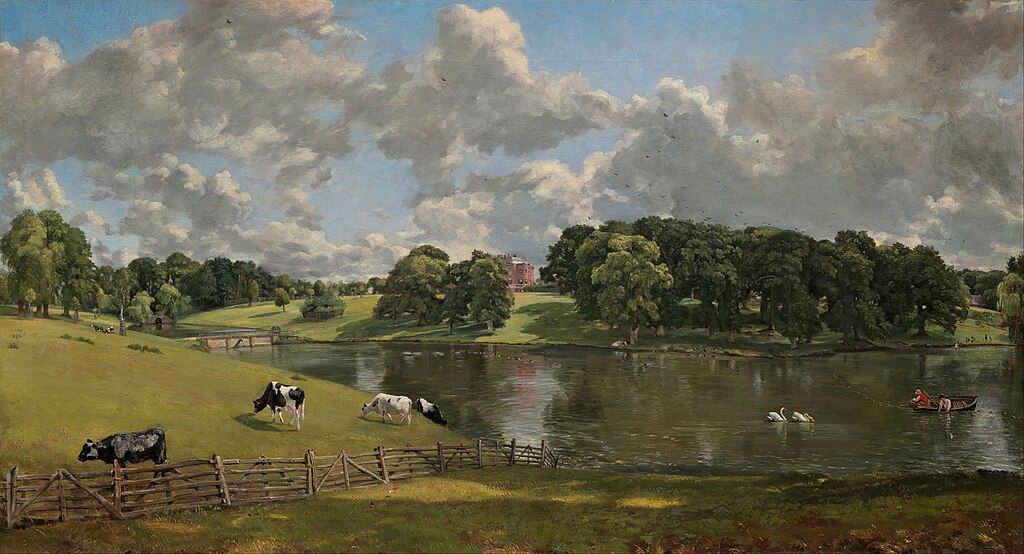
This can be seen in John Constable’s Wivenhoe Park, Essex (1816), through the careful placements of the subjects throughout the painting. One can separate the painting into three distinct zones, each showing a different component of locus amoenus. The first section is closest to the viewer in the foreground, and depicts several cows grazing in a lush grass field. This field clearly represents the “wilderness” in nature as well as the more “natural” elements. Moving towards the middle of the painting, one can see men fishing together in a boat. Here, Constable is beginning to blend the wilderness into the garden. The presence of the people within this section of the painting introduces the concept of human interference with nature, through the very direct way the men are interacting with nature. Finally, towards the background of the painting, the viewer can see a grand house sitting atop a slope, in which the “garden” aspect of locus amoenus is fully introduced. These scenes are a great example of the juxtaposition of the cultivated garden versus the unkempt wilderness. One can see the clear line that is drawn in Constable’s painting between these two extremes, similar to how one notices this line in Thomson’s writing.
In lines eleven through twenty-five of Thomson’s Spring, one can see how he complicates the concept of locus amoenus as “the pleasant place.” These lines describe the transition from winter to spring, in which Thomson describes winter as “surly” and as having “ravag’d” the land (3-4). This imagery contradicts his later description of spring as a softer season. How can nature be both harsh and soft and still fit into the concept of locus amoenus? Like Constable, Thomson is attempting to blur these lines between garden and wilderness. Nature is rough and harsh, but also soft and refreshing, and by providing a clear line drawn between the two, both Thomson and Constable are able to express that both of the concepts can exist at the same time while still conveying locus amoenus.