
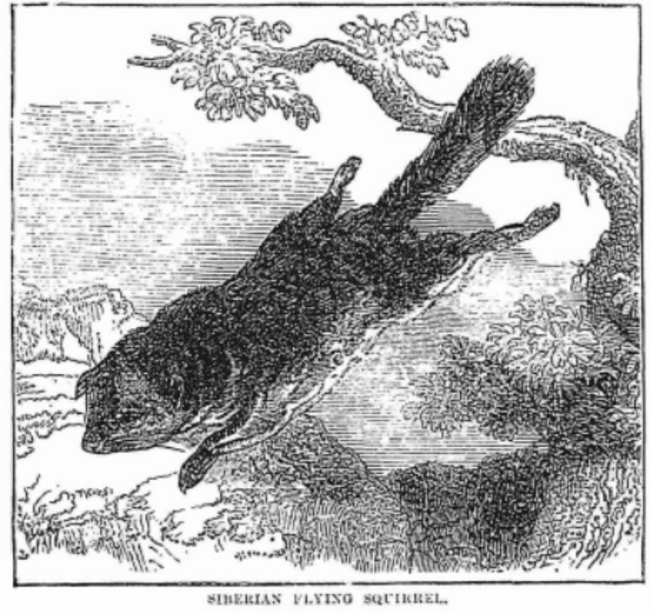
In 1896, Henry Schfrren published “Flight Without Wings” in The Boys Own Paper. The article studies the modes of flight that non-avian animals engage in. Pictured is the flight of the Siberian flying squirrel. Schfrren describes how this animal has a “flying membrane”: essentially, this is excess skin that protrudes from the creature’s elbow. In addition to this membrane, the Siberian flying squirrel has a flat tail which acts as a parachute. The creature glides, rather than flies.
The article emerges in an era fixated with empirical knowledge. Flight and conquership of the skies was a fascination of the Victorians. Along with the pictured squirrel, Schfrren studies the flying dragon/lizard, fish, and lemur. He discusses the different breeds of each animal, their habitats, their diets, and their physiques. Knowledge, in this period, is a commodity: Schfrren’s article is representative of the era’s fascination with scientific inquiry.
While most flying devices or creatures emerging in this period consist of wings–or, they are mechanical models of wings–the flying squirrel or fish defy the norm. Schfrren differentiates the different meanings of flight: “Flight, in the strict meaning of the word, belongs to bats, birds, and insects. It is used here in the sense of ‘passage through the air’” (Schffren 13). The flight of humans must be considered as “passage through the air.” In Craik’s The Lame Little Prince, Prince Dolor laments that he cannot travel great distances like avian animals: “Prince Dolor looked at [the swallows] as one after the other they glided past him. . . “Oh, I wish I were going with you, you lovely creatures! I’m getting so tired of this dull plain, and the dreary and lonely tower” (Craik, Chapter V). While Dolor does not participate in conventional flight, for he is without literal wings, he certainly “passes through the air.” This passage, however, is not necessitated by natural evolution (like that of the Siberian squirrel), but rather, it is a power bestowed upon him to increase the quality of his life.
Craik’s text rejects overtly scientific models of flying, but rather, she opts for magic. This creative choice could be interpreted as Craik’s way of sidestepping the objectification that is inherent in the medicalization of disability. Prince Dolor is able to function without the ability to fly: he is not an “exceptional case” where his disability implies that he must have extraordinary capabilities in his other faculties–but rather, flight is a magical, artificial, ability. Unlike the subjects of Schffren’s study, Craik’s The Lame Little Prince explores ability in a way that eludes total objectification of the individual.
Image Citation:
Artist Unknown. "The Siberian Squirrel." 1896, National Library of Scotland, Scotland, UK.
Article Citation:
Schfrren, Henry, F. Z. S.,. "Flight Without Wings." Chums: An Illustrated Paper for Boys, vol. IV, no. 174, 8 Jan. 1896, pp. 317+. Nineteenth Century UK Periodicals, link-gale-com.ledproxy2.uwindsor.ca/apps/doc/DX1901975305/NCUK?u=wind05901&sid=bookmark-NCUK&xid=93ed676a