
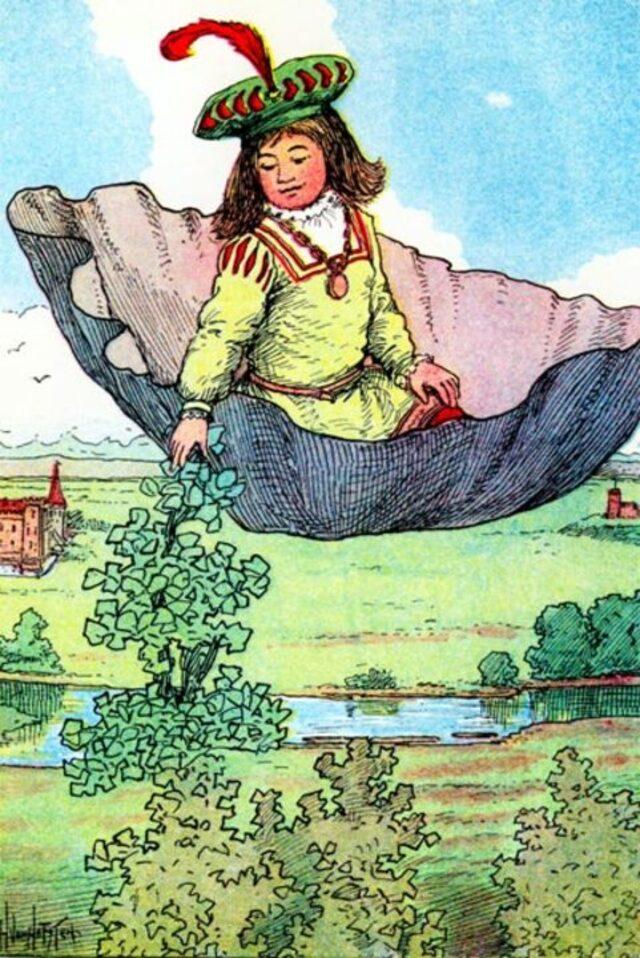
This illustration of Prince Dolor by Hugo von Hofsten, as well as several other illustrations of Dolor’s flight, depicts Dolor flying on a cloak that resembles a magic carpet. The function and appearance of the cloak are even similar to a magic carpet, as Dolor’s godmother instructs him to “set [himself] in the middle of [it]” (COVE, Chapter IV), the cloak rolls itself up and unfolds like a carpet (Chapter V), and Dolor states that to the nurse, the cloak would look like “a mere bundle” (Chapter V). The magic carpet or “cloak” that Dolor flies thus evidences the notion of Orientalism in The Little Lame Prince. Kennedy outlines three origins for Orientalism in Victorian England (Kennedy). First was the fascination with The Thousand and One Nights, a collection of largely Middle Eastern and Indian stories whose origin is uncertain (“The Thousand and One Nights”). It became extremely popular in English society through the translation of Edward Lane produced between 1838 and 1840 (Abdessamad). Lane’s text served as a guidebook to Egyptian customs and society for the English (Abdessamad). Second, Romantic visions of the Orient as represented in the works of Coleridge, Percy Shelley, Byron, Gordon, and other Romantics intrigued the Victorians (Kennedy). Third, Victorian interest in Orientalism can be traced back to Thomas de Quincey’s Confessions of an English Opium Eater, which domesticized the image of the “Oriental” opium addiction and the Chinese opium den. This would later become a notable trope in the fiction of Dickens, Wilde, and Kipling, for example. Therefore, it is clear that Craik could have been subject to Orientalist influences when envisioning the travelling cloak. In fact, Craik explicitly incorporated Orientalism into her other work, notably her 1851 story The Half-Caste where the protagonist Zillah is the daughter of an English merchant and an Indian princess (Mascarenhas). Zillah reads Arabian Nights, the English version of The Thousand and One Nights, thus demonstrating Craik’s familiarity with the story and its Orientalist tropes (Mascarenhas). In The Little Lame Prince, Dolor relies on the travelling cloak and its Oriental connotations for mobility and to compensate for his disability. Craik therefore frames disability not just as something to be overcome through prosthetics but something that requires an exotic, foreign solution. She thus represents the imperialist trend of Victorian England relying on the resources and knowledge of colonized cultures for cures to perceived issues or deficiencies, like quinine from South American bark to cure malaria (Ratangee). Through the Oriental connotations of the travelling cloak, Craik ultimately links Dolor’s flight to imperialist exploration, where his cloak allows him to travel vast distances much like the European travelers that brought the stories of The Thousand and One Nights to England.
Image citation: “PRINCE DOLOR MADE A SNATCH AT THE TOPMOST TWIG OF THE TALLEST TREE.” Project Gutenberg, 27 Dec. 2007, www.gutenberg.org/cache/epub/24053/pg24053-images.html.