
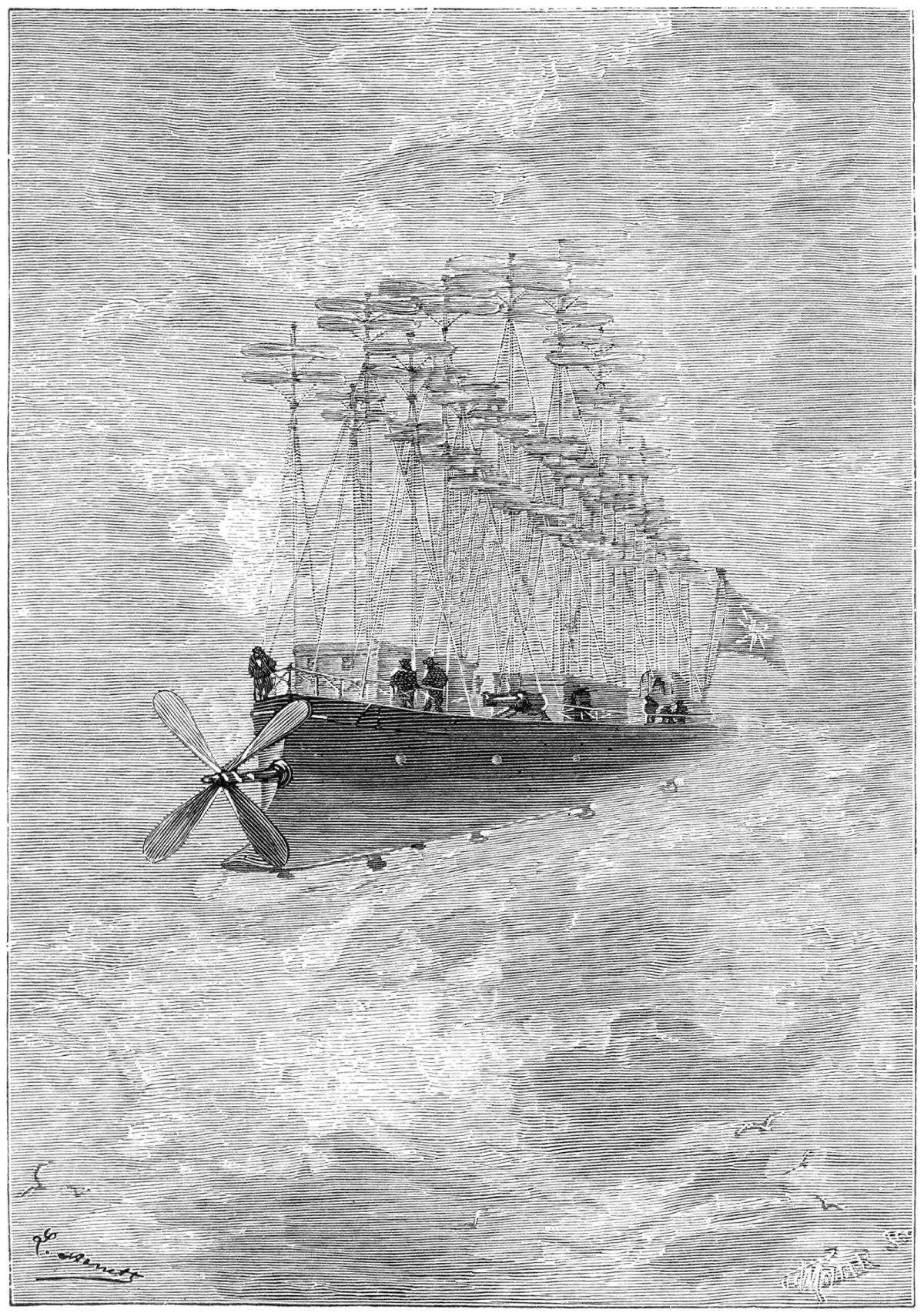
This illustration by Leon Benett is titled “The Clipper of the Clouds” from Jules Verne’s science fiction piece, Robur the Conqueror. The novel was published periodically in Boys Own Paper: this section, “On Board the Albatross” was published on December 11th, 1886. The Albatross, or, the “Clipper of the Clouds” is the name of the fictional ship that was built to conquer the skies. The flying ship was inspired by the flight of birds; however, Robur, the creator of the ship, had difficulties accommodating the weight of the locomotive. Ultimately, he decides on a ship-like platform. To move the Albatross horizontally, Robur equips the platform with propellers on each end. To move the flying-ship vertically, Robur installs helicopter-like rotors.
The Victorian era brought about a surge of adventure fiction, geared at young boys. The Boys Own Paper was a British periodical that began publishing children’s works in 1879. As Elizabeth Penner argues in “‘The Squire of Boyhood’: G. A. Hutchison and the Boy’s Own Paper,” this periodical is informed by Christian ideology and it promoted stories of heroism and masculinity. Jules Verne’s science fiction contributed to this cultivated image of masculinity and implicated it with sentiments of imperial conquest.
The mode of flying offered in Verne’s text can be compared with Prince Dolor’s cloak in Craik’s The Lame Little Prince. When he is given a magic cloak from his godmother, Prince Dolor is able to fly: “[T]he cloak gave a sudden bound forward, and presently he found himself high in the air” (Craik, Chapter V). Verne’s text opens with a quote from the French astronomer Camille Flammarion: “‘When will men cease to crawl in the depths to live in the azure quiet of the sky?’” (Verne 4). Craik’s work evokes a similar sentiment of increased mobility–however, it is more individualistic.
Flammarion speaks of “crawling” in a metaphorical sense to emphasize man’s “crippling” lack of knowledge. The Lame Little Prince uses flight as a mode of increasing mobility for the disabled individual. Prince Dolor’s movements are physically limited: “He sprang out of bed, – not to his feet, alas! [B]ut to his poor little weak knees, and crawled on them from room to room” (Craik, Chapter IX). Flight, in both texts, works to satisfy intellectual curiosity. Robur and his Albatross are vehicles of empire, while Prince Dolor’s flight enriches his individual quality of life, for he is able to see a world outside of his tower.
Image Citation:
Benett, Leon. "The Clipper of the Clouds." 1886, National Library of Scotland, Scotland, UK.
Excerpted from Periodical:
Verne, Jules. "The Clipper of the Clouds." The Boys' Own Paper, vol. IX, no. 413, 11 Dec. 1886, pp. 164+. Nineteenth Century UK Periodicals, link-gale-com.ledproxy2.uwindsor.ca/apps/doc/DX1901386711/NCUK?u=wind05901&sid=bookmark-NCUK&xid=3e5e6193.