
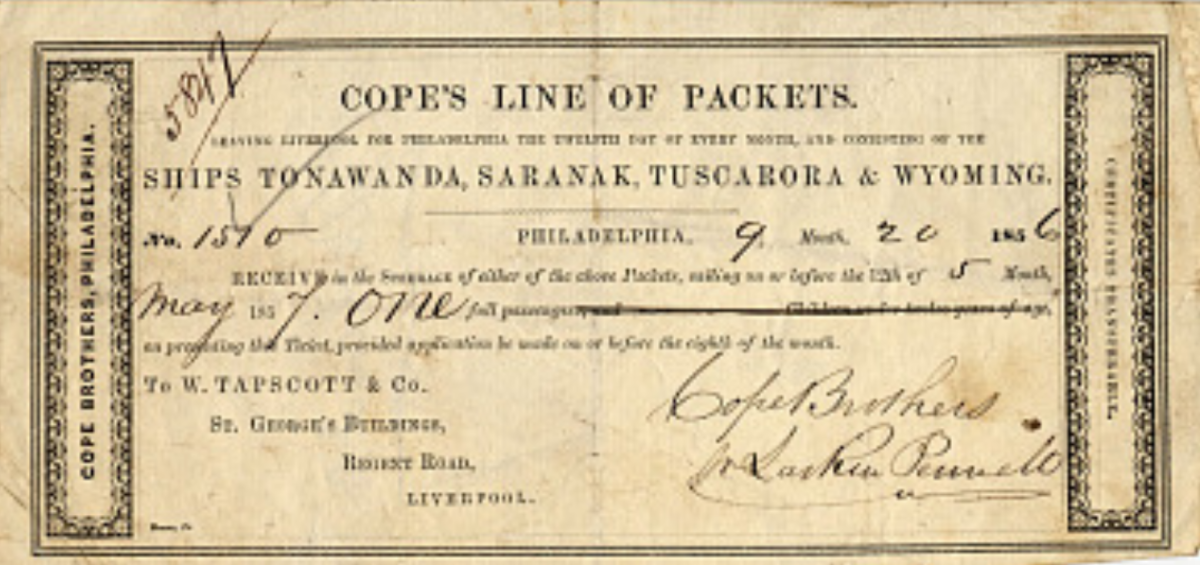
Frank's Commentary: My ticket to Africa cost around £6, but The Woodcut paid for that expense. I am more than excited to embark on this journey, as I believe it to be the start of my new life. With this ticket, I am off to a new world, one in which I will be able to establish myself in a much stronger way than that of which I have a home. I can not wait to work on my engravings for the paper, and I am sure those back home will enjoy it as much as I do. I have never been to another continent, and am not sure what to prepare myself for. It is a warring time in Africa, and the Boer’s do not seem to be backing down. I am a little worried about this aspect of my trip, but nothing is going to keep me away from chasing the opportunity I was so luckily offered! I believe this is the best way I can prepare myself for the future I have once I return home to Lucy. After my job in Africa, I will be well established in my field, I should be able to find a good job back home. I will be able to provide for her and our family (which I hope to have), and I will tell them stories of the amazing sights I saw and places I went. I can not wait to tell Lucy about all the exciting experiences I am a part of. Hopefully she will find my letters well, and write back full of joy. She is the one I am most excited to return to, I hope I can find a gift there for her to cherish!
Editorial Commentary: The price of a ticket from England to the United States of America was around $7, so it makes sense that this ticket going to Africa would be similar in price when converted to GBP (Gjenvick-Gjønvik). This ride, which appears to have been just like any other boat at the time, would have likely been cramped with many other people, as well as quite long and very boring (Pritchard). Frank was likely faced with swaying seas and difficult nights in which the waves constantly shook him, as these boats were not nearly as well developed as the ones we have today. Frank mentions the company that has hired him, a print company by the name of The Woodcut. British newspapers, like The Woodcut, were a staple of the 1890s due to their plethora of information and relatively cheap price (King). There were dozens of different press circulations around the country, each discussing different topics or similar topics in different ways. In his journal, Mr. Frank discusses his business with the paper, for which he is an artist. Engraving for newspapers consisted of carving out a wooden block in the image that was chosen. The difficulty in this came in the fact that the engraving had to be crafted inversely to the expected final product. After the engraving was finished, it would be inked over and stamped onto the paper, creating an image for all to see (Princeton). This process was very tedious, but Mr. Frank appeared to have had a passion for his art, and if he was requested to go overseas to engrave for the paper, he must have been good at his job.
References
Gjenvick-Gjønvik Archives - GG Archives. (2023). Cost of a European trip - 1910. Ocean Travel, Military, and Immigration Archival Collections. https://www.ggarchives.com/OceanTravel/TravelGuide/04-CostOfEuropeanTrip.html
King, E. (2007). British newspapers 1860-1900 (Ed King). Scholarly Resources for Learning and Research | Gale. https://www.gale.com/intl/essays/ed-king-british-newspapers-1860-1900
Pritchard, R. (2021, July 12). Shipboard: The 19th century emigrant experience. State Library of NSW. https://www.sl.nsw.gov.au/stories/shipboard-19th-century-emigrant-experience
Smithsonian. (2021, April 28). [Photograph]. National Museum of American History. https://ids.si.edu/ids/deliveryService?max=800&id=https%3A%2F%2Famericanhistory.si.edu%2Fsites%2Fdefault%2Ffiles%2F3034.jpg

The Trustees of Princeton University. (2015, October 18). How wood engravings were made. Graphic Arts. https://graphicarts.princeton.edu/2015/10/18/how-wood-engravings-were-made-for-19th-century-american-illustrated-newspapers/