

Educator and educational philosopher Friedrich Froebel (1782-1852) founded the first German kindergarten -- the "Institution for the Care of Children's and Adolescents's Desire to Explore" -- in 1837.
With his "play theory", Froebel sought to educate children through each child's own "self-activity" (Hailmann 5), by incorporating "play and means of employment... which nourish and strengthen, develop and form the life of the child (Froebel 18). Play, in Froebel's conception, focuses on the basic perceptions and sensory experiences of the child, incorporating all of the senses: feeling, touching, hearing, and speaking, which are activated and encouraged to interact with increasing synergy as the child moves from infancy, to toddlerhood, and into the school years (Froebel 20).
Froebel designed his seven "Spielgaben" or "Play Gifts" to support his play theory, and to encourage play and engagement in early childhood development. Froebel provided detailed instructions on the correct use of each gift, as well as a series of nursery rhymes and songs specific to each gift. The Play Gifts are provided sequentially, moving from simple to complex toys as the child develops new skills while promoting the child's exploration of connections and oppositions, unity and symmetry, as they exist in nature (Training and resources - Froebel's Gifts").
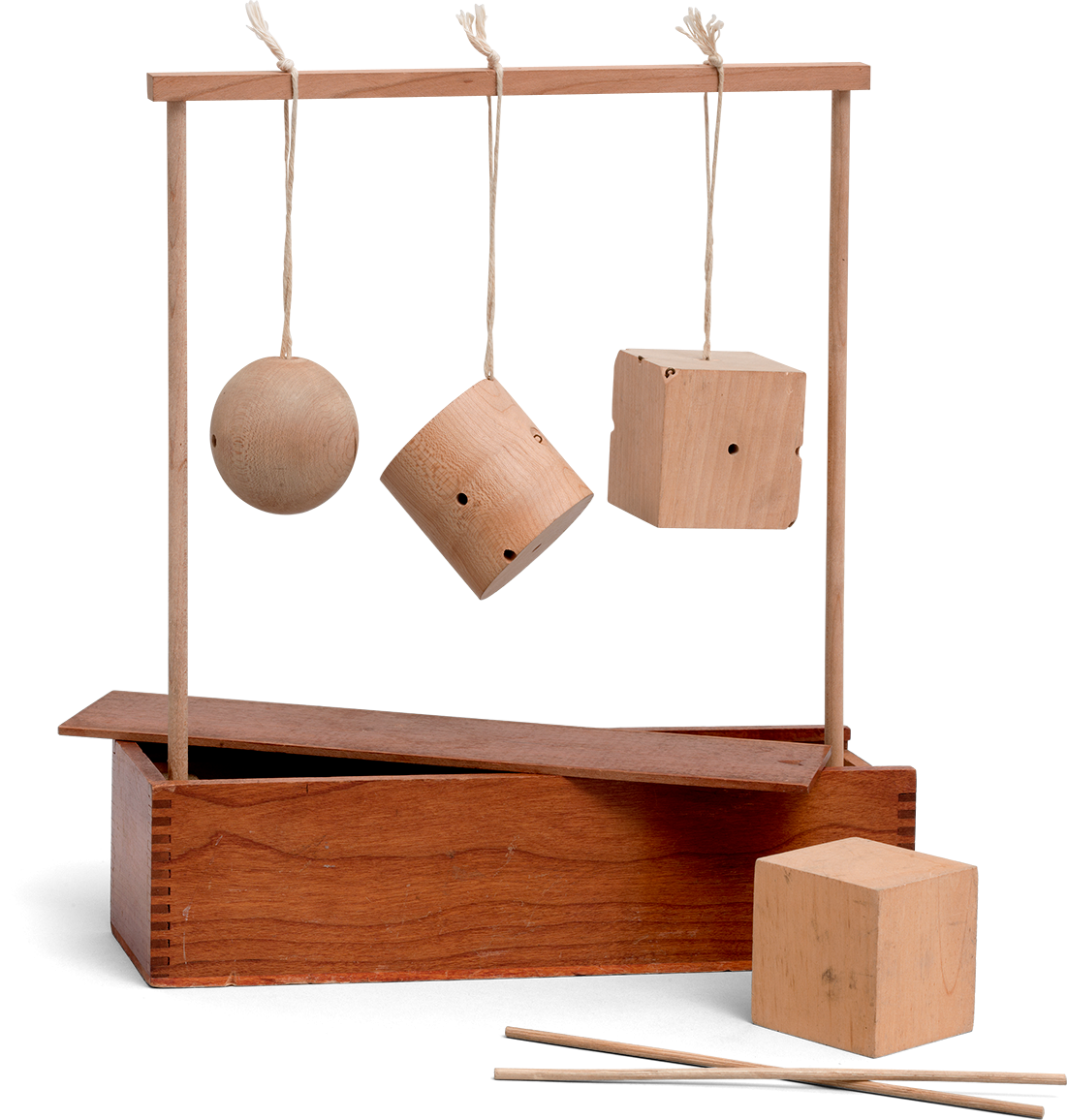
Pictured here is Gift No. 2, which is comprised of a set of three hard, naturally coloured three-dimensional shapes. The shapes in Gift No. 2 include a sphere (Gift No. 1), a cylinder, and a cube. Each shape hangs from a wooden dowel using a string. According to Froebel, the sphere in Gift No. 1 and Gift No. 2 represents "the material expression of pure movement" (70), while the cube represents "the material expression of complete rest" (70). The inherent opposition in the two toys is meant to encourage the developing child to explore connections between opposites and contrasts that occur within the natural world (73). The movement of the shapes hanging from the dowel are meant to encourage experimentation with motion, movement, physics, and geometry.
Froebel encouraged parents, nurses, and educators to incorporate songs, rhymes, and questions along with the use of his toys. While playing with Gift No. 2, Froebel encouraged educators to repeat the rhyme: "I turn and wind, and, as I go, / The sphere in form I always show" (74).
Sources:
Froebel, Friedrich. Education of Man. Translated and annotated by W.M. Hailmann, New York, D. Appleton and Company, 1887.
Froebel, Friedrich. Pedagogies of the Kindergarten, or His Ideas Concerning the Play and Playthings of the Child. Translated by Josephine Jarvis, New York, D. Appleton and Company, 1895.
Froebel Trust. "Froebel's Gifts." Froebel Trust, www.froebel.org.uk/training-and-resources/froebels-gifts. Accessed 8 Apr. 2025.
Froebel-Kan Co., Ltd. Gift No. 2. 1992. Victoria and Albert Museum, collections.vam.ac.uk/item/O1124116/gift-no-2-learning-toy-friedrich-froebel/. Accessed 10 Apr. 2025.