
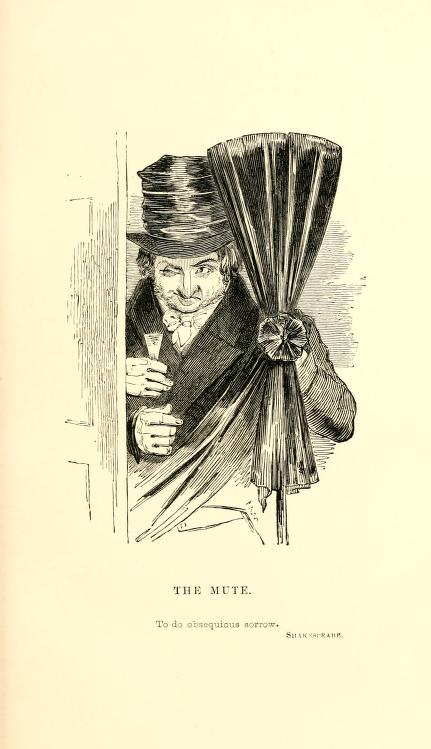
"'There's an expression of melancholy in his face, my dear,' resumed Mr. Sowerberry, "which is very interesting. He would make a delightful mute, my love'" (Dickens 57).
In this passage and in the lines that follow, Mr. Sowerberry proposes to his wife that they make Oliver Twist work for them as a funeral mute for children's funerals. While Twist may be one of the most famous examples of mutes in literature, child mutes were actually less common with the job usually being taken by adult men. Popular in the 1700s and declining towards the end of the 1800s, the mute profession entailed "stand[ing] vigil outside the door of the deceased, then accompany[ing] the coffin, wearing dark clothes, looking solemn and usually carrying a long stick (called a wand) covered in black crape" (Byrne). They typically operated on an irregular job-by-job basis, but still stood out as part of an funeral industry that increased in extravagance the further it moved into the Victorian era. Dickens himself actually held great distaste for mutes and the elaborate funerals they symbolized which led him to use them as vehicles in many of his works (e.g. Martin Chuzzlewit) to mock the industry and the barriers it presented to the lower classes (Admin). Dickens' critique of them contributed to their decline in popularity as did the perpetually shifting Victorian ideas about funeral proceedings, status, and representations of wealth in death. By the 1890s into the early 1900s, mutes as a funeral staple were a thing of the past (Byrne).
Works Cited
Admin. "The History of the Victorian Mute." Austin's, 18th Jan. 2016, https://www.austins.co.uk/blog/index.php/the-history-of-the-victorian-mute/.
Byrne, Eugene. "Q&A: What are the Origins of the 'Mutes' that Attended Victorian Funerals?" HistoryExtra, 26th April 2012, https://www.historyextra.com/period/victorian/qa-what-are-the-origins-of-the-mutes-that-attended-victorian-funerals/.
Dickens, Charles. Oliver Twist. 1961. Signet Classics, 2005.
Image Citation
Meadows, Joseph Kenny. Heads of the People, or, Portraits of the English. Henry G. Bohn, 1864. Internet Archive, https://archive.org/details/headsofpeopleorp02mead/page/n7/mode/2up.