
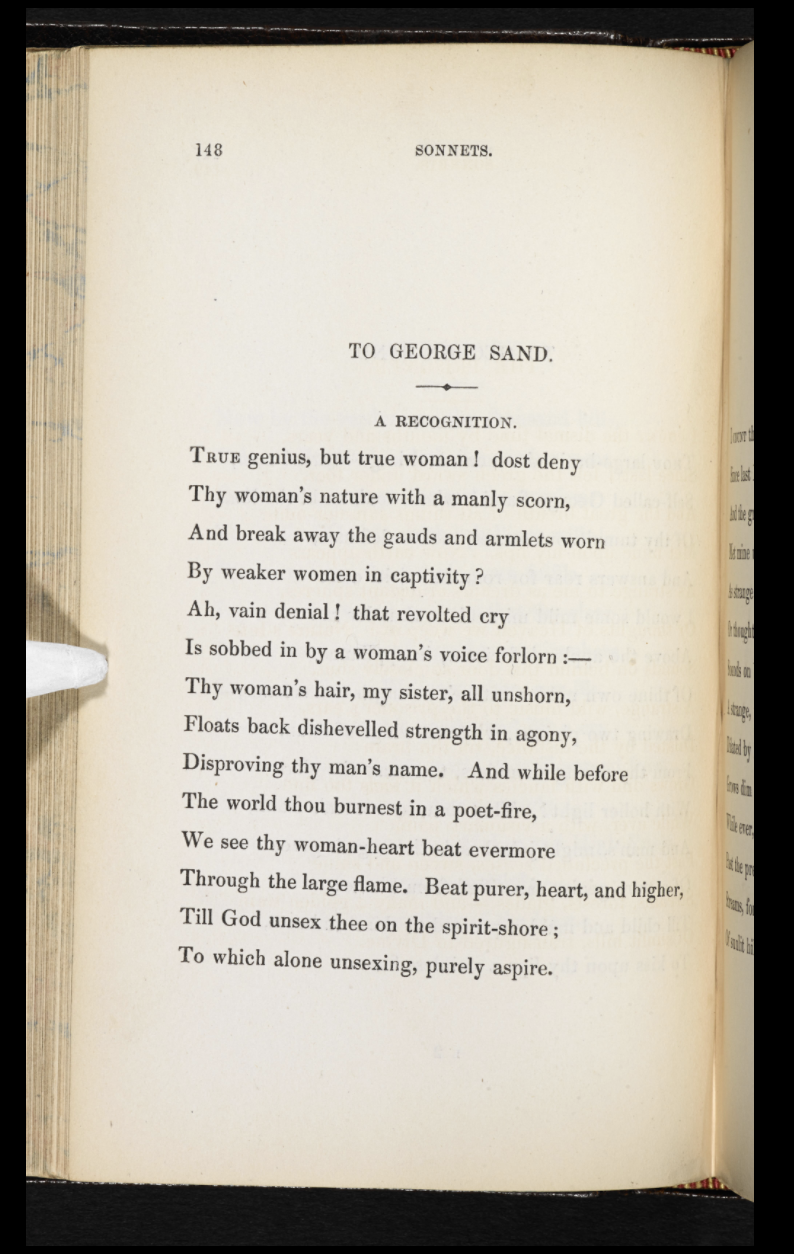
Everyday, the articles, poems, and letters I have collected remind me of what my duty is and how to overcome the many obstacles being a woman has brought me. I have kept Elizabeth Barrett Browning’s “To George Sand: A Recognition,” by my bedside for many years now as a reminder to be a bold and fearless woman despite what society tells me to do. As a woman, I am faced with these trying times of inequality and discrimination. I have learned that I must continue to keep my head up and continue working for equality. George Sand was actually a French female novelist who took the name of a male writer and Browning praises her for her bravery. This poem inspires me to continue advocating for women’s rights during these times. Sand refused to take on the role of a traditional mother and wife in the home and instead took on the role of a novelist set on destroying gender roles. I too have refused to be the traditional mother and wife society pressures me to be and as a progressive woman, it is my duty to address the issues women face in this patriarchal society. As an empowered British woman, I rely on no man to bring about a successful life. It is my duty to fight for the rights of women and change the image of the modern woman. I am not who people think I am. I deserve the same opportunities as men. Why should I be ridiculed for my actions when I am just living up to my full potential?
Editorial Commentary: In Elizabeth Barrett Browning’s “To George Sand: A Recognition,” she writes in praise of the French female novelist who took the name George Sand in order to get her works published and address the issues women faced in a male dominated society (“Elizabeth Barrett Browning and the Woman Question”). To Charlotte, this poem is more than just words on a page, but is the reason she is who she is and the reason she has been so successful in her fight for equality. In “To George Sand: A Recognition,” Browning characterizes Sand as a representation of the “True genius, but true woman” (line 1). Sand’s ability to withstand societal pressures and forge on as a female writer shows the unwavering determination and persistence she had in order to obtain equality for women. Browning’s poem reveals the many characteristics that defined these daring women at the time and the bravery it took to question Victorian gender roles. Charlotte has many of these characteristics, thus this is why she keeps the poem by her bedside. However, Browning’s praise for George Sand was just the beginning of the discussion of women’s rights and oppression. It was through progressive women, novelists, and social reformers similar to those of Charlotte that women were able to transform society and make their mark in society, whether during their lifetime or after. It is clear that the 19th century was in many ways a movement towards gender equality. Nonetheless, this transition could not have been done without the brave women who protested against male supremacy and fought for more opportunities in the home and workplace. Ultimately, male patriarchy ruled Victorian times and society, but women were able to fight for more opportunities and equality through ways never thought possible.
Citation: “Elizabeth Barrett Browning and the Woman Question.” The British Library, The British Library, 12 Feb. 2014, www.bl.uk/romantics-and-victorians/articles/elizabeth-barrett-browning-….