
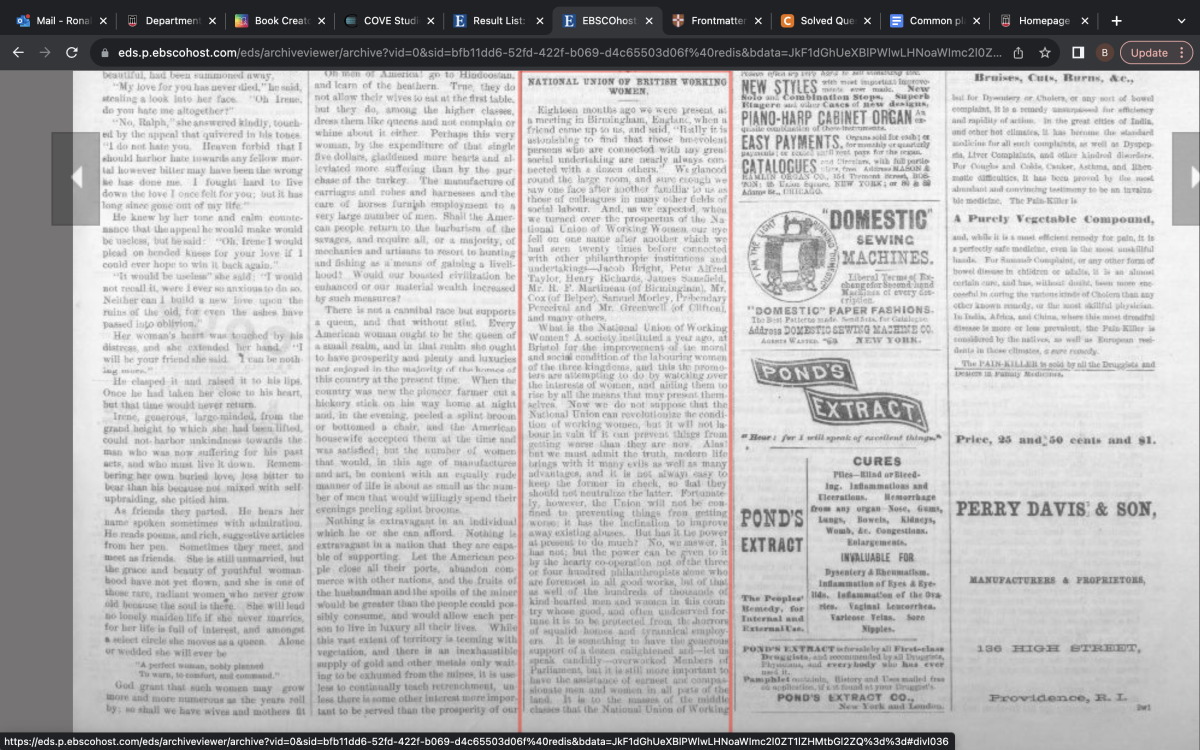

I stumbled across this in the weekly newspaper from America, and chose to include this article in my scrapbook because I feel it was published to support myself, sisters, and people like us in the workforce. I love to collect all articles in the weekly newspaper in Britain that I feel empower women, especially those in my circumstances. Yet, seeing support come all the way from America is touching. One of my cousins that moved to America a few years ago came by our estate to visit and she brought along the paper because I had wrote to her about our shop. Seeing how others struggle the same way I do helps me not feel so alone. I feel that if I can learn more about the movement for women to be a part of the workforce and be treated as equally as men, then I can do my part in the progression. Whenever we lost our source of income from our father, we had to turn to a small business. The business was the only option that would keep our family together with a stable enough income to survive. The article states that the common working class person, man or woman, is the difference between the rise or fall of the Union. Parliament and high class aristocracy will help, but our support, coming from the masses, means the most to the Union. I feel that saving this article will constantly remind me of my duty to support those who are living with the same daily social responsibilities as myself and family. I hope to use my experiences in the photography shop to share with others the struggles I’ve overcome as a woman in the workforce. Maybe one day, I can be featured in an article like this to hopefully give useful insight to the many other women who are trying to make a living on their own.
Gertrude Lorieme, a female photographer from 1800th century England chose to include this article from a Women’s newspaper in her scrapbook. The article was perceived very personally to her not only because it was an exotic, foreign newspaper, but because it was trying to rouse support for a national Women’s labour union. It claimed that the working class, like Gertrude, were the ones who could make the Union succeed. The “New Woman” was referred to as the women that acted differently from female Victorian etiquette and norms. The “Old Woman” is a woman who maintained traditional English-woman values and gender traits. Gertrude was showing characteristics of the New Woman because she was supporting a movement to integrate women into the workforce while working in a trade herself. Gertrude probably felt if she kept the article, she would be playing her part in a movement bigger than herself. At this point in history, women who worked were mostly “regarded as a problem”(Neff, 23). So not only were women not expected to work, but when they did, they had a hard time getting employed or getting business due to the nature of Sexism in Victorian society. Gertrude and her sisters are an example of the lack of equality and work availability in the Victorian era due to sexist ideologies and norms. They are successful in their business, but they had a harder time because they were women. The progressive citizens of England and “New Woman”, like Gertrude in this situation, seek to empower the working women of England who are making a living themselves rather than just living off of the wealth acquired by their husbands or fathers, while helping those that don’t have any inheritance find better and more equal jobs.
Works Cited
Radcliffe, Helen. “National Union of British Working Women.” Women’s Journal, 1876.
Neff, Wanda F. Victorian Working Women. Frank Cass and Co. LTD , 1966.