
November 30th, 1875
As I sit by the window in my new cozy parlor, all I can think about is my newfound eternal happiness. There have been so many wonderful moments in my life since becoming a newlywed. Just yesterday, my beloved Charles and I exchanged our vows in front of all of our relatives. This was truly the most joyful day of my life. The ceremony was absolutely splendid, all of my dearest friends got to celebrate my love. We had the most beautiful flowers, table settings, and hymns.
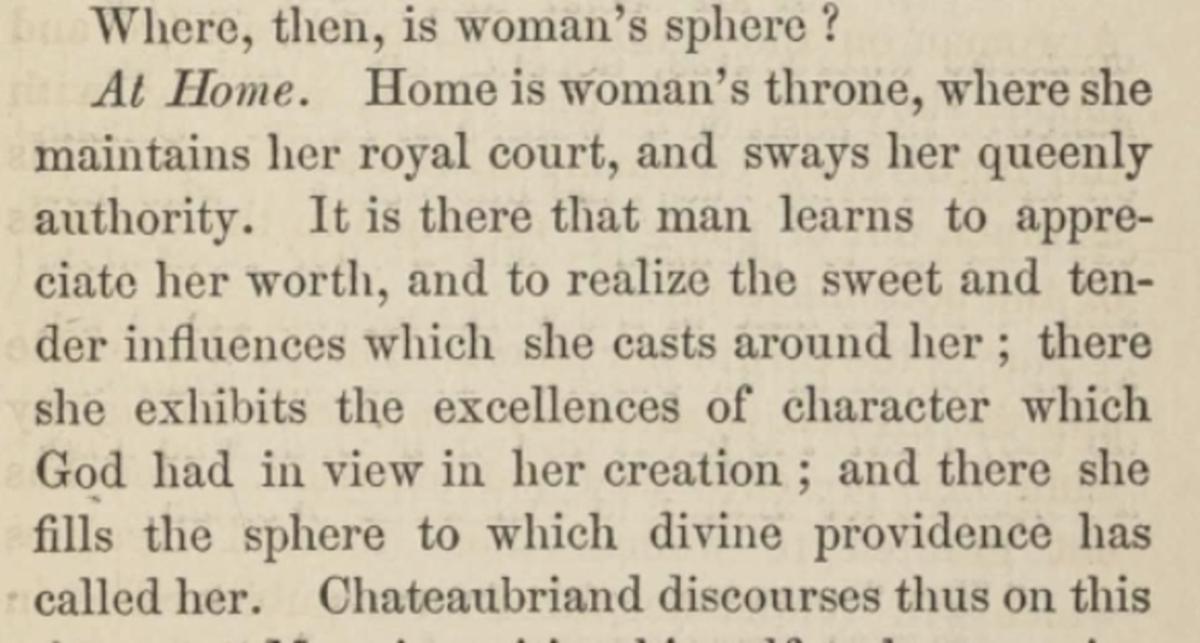
But the undoubtedly best part of the evening was the gift that my dear husband bestowed upon me this morning. A beautiful book, its title, “The Young Woman’s Friend; or, the Duties, Trials, Loves, and Hopes of Woman. Designed for the Young Woman, the Young Wife, and the Mother,” warms my soul as I turn its pages. I can just picture it, reading these wise words in the glow of the morning sun. Using the wisdom contained merely within these printed words to serve my husband as he deserves. I will tend to our beautiful home as it is my “throne”, it is my sacred duty to be the heart of my home, to tend to my husband's needs, and to create a space of peace and love. I plan to embrace the teachings of this book as it is my deepest aspiration.
This book describes the honorary art that is homemaking, teaching me how to create a haven where my husband can relax after a long day. I will learn how to be a mother, daughter, daughter-in-law, and most notably, a wife. As I read each and every word of this book, I will feel nothing but gratitude for my wonderful beloved husband. The gift that Charles has given me is not just a book, but it is a guide to living our life together as a life filled with love, respect, and fulfillment of our roles in this partnership. I am so pleased and blessed that my place in this life is tending to our home and nurturing our love.
- Adelaide
Editorial Commentary-
The entry from November 30th, 1875, provides insights into the life and perspective held by Victorian-era women. Adelaide reflects on her recent marriage and the gift from her husband with utmost happiness and is excited to start her role as a housewife. This entry offers a glimpse into the social norms, values and aspirations held by women in the late 19th century. Adelaide’s words come from a sense of pure happiness and contentment about her marriage. She describes her wedding ceremony and all the beautiful aspects of it and she highlights the significance of this time of family and social gatherings on important occasions. Adelaide’s main topic of her entry is the book she received as a gift from her husband. The book is a book dedicated to teaching young women about their life as a wife, mother, and daughter, as well as all the duties that come with this. The title of the book “The Young Woman’s Friend; or, the Duties, Trials, Loves, and Hopes of Woman. Designed for the Young Woman, the Young Wife, and the Mother,” itself shows the societal expectations of women during the Victorian era. During this time, “The women were expected to marry, have children, and keep a nice household. Those were the only acceptable roles for women during that era,” (Barrett 6) Adelaide exemplifies this as she feels this is her purpose and is excited to get to do it. Adelaide describes the book as emphasizing on the importance of homemaking and the roles associated with being a traditional woman. Adelaide’s gratitude and willingness to accept these teachings reflects greatly on her dedication to her husband and her beliefs on the ideals of Victorian womanhood. According to Langland, Victorian women were the “Angel in the House”, as they are the hearth and leader over the household (Langland 290-291). Adelaide demonstrates that she sees her role as being a wife and homemaker as her sacred duty.
Barrett, Kara L. “Victorian Women and Their Working Roles.” State University College at Buffalo, 2013.
Eddy, Daniel C. “Chapter 1.” The Young Woman’s Friend: Or, the Duties, Trials, Loves, and Hopes of Woman Designed for the Young Woman, the Young Wife, and the Mother, W. Scott, London, 1886, p. 23.
Langland, Elizabeth. “Nobody’s Angels: Domestic Ideology and Middle-Class Women in the Victorian Novel.” PMLA, vol. 107, no. 2, 1992, pp. 290–304. JSTOR, https://doi.org/10.2307/462641. Accessed 11 Oct. 2023.