
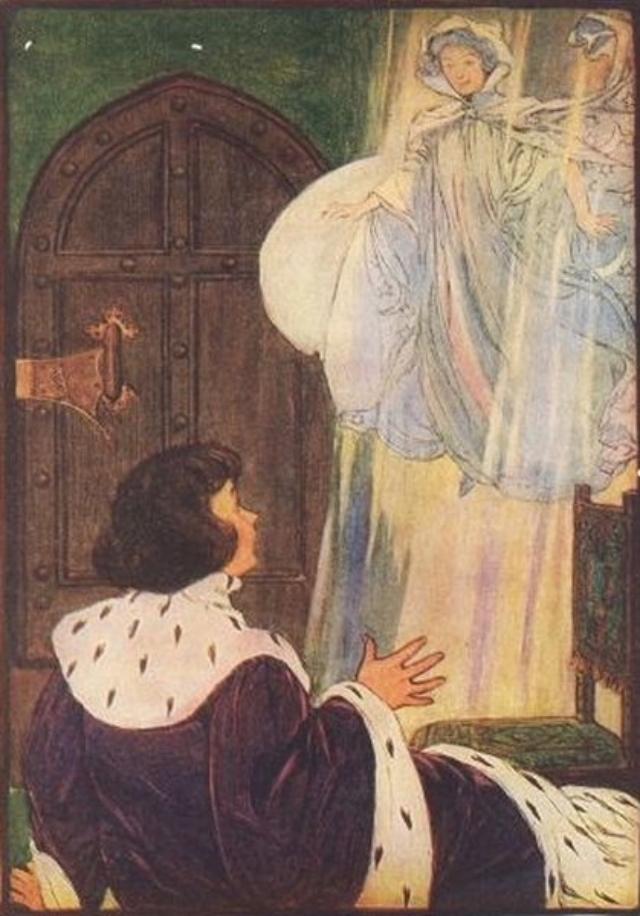
This photograph comes from a Hope Dunlop illustrated edition of the Little Lame Prince, demonstrating Prince Dolor astonished to see his godmother; the figure who will bestow him with magical tools. Prince Dolor is isolated in Hopeless Tower due to the social stigma surrounding his disability, and utilizes his imagination to create companionship, as a child would with an imaginary friend. Prince Dolor’s growth is directly linked to the tools his godmother gifts him, like the flying cloak or the silver ears, objects that can be viewed as fantastical. Though these magical prosthetic devices, he starts to experiment with imaginative play, as seen when he utilizes the cloak to explore the outside sphere, possibly an aspect of his imaginative play, aiding him to reach the stage of “normality” that the bildungsroman concludes with (Hingston 372). Like the cloak is a physical manifestation of his imagination, the godmother, a magical being, illustrated with a sheath of light surrounding her, could also be a figment of his imagination. Hingston posits that readings of the godmother have assumed that she might be a representation of imagination and creativity, manifested due to Prince Dolor’s forced isolation and, as a product of isolation, his subdued potential (373-74). These mediums aid him in overcoming his physical limitations or rather refusing them as a deterrence to his rightful place on the throne of Nomansland. Imaginative play, symbolized by the gifts and the power of imagination as a support for his disability, manifests in his godmother as a character, as she is his caretaking figure, whom he could have manifested for support.
Works Cited
Craik, Dinah Maria Mulock. The Little Lame Prince and His Travelling Cloak. 1875.
Dunlop, Hope. Prince Dolor on his bed appearing astonished at the sight of his godmother. 1909, https://www.gutenberg.org/files/45975/45975-h/45975-h.htm.
Hingston, Kylee-Anne. “Prostheses and Narrative Perspective in Dinah Mulock Craik’s The Little Lame Prince.” Women’s Writing, vol. 20, no. 3, 2013, pp. 370–386. Taylor & Francis Online, https://doi.org/10.1080/09699082.2013.801125.