
The Amish religion is filled with stark conservative views involving technology and attire, and their beliefs around schooling and the public are no different. Since they first settled in Pennsylvania in the late 1700s, they have been steadfast in removing their children from school at age 14 to begin training on their farms or in the construction trade. States such as Indiana and Ohio did not agree and started fining Amish fathers for refusing their children to attend state-recognized schools until age 18. The Amish began keeping their children in separate schools and away from public education. By the mid-1950s, 41 new one-room parochial schoolhouses were erected across Pennsylvania by the Amish and other Anabaptist religions. The Commonwealth ‘s Department of Education was slightly more lenient than other states and started offering an alternative schooling program which adhered to the Amish religion but kept the Commonwealth’s age requirement intact. In Wisconsin, however, the Yoder, Miller, and Yutzy families withdrew 37 Amish children from public school, costing the state roughly $18,000 in tax revenue. All three fathers were prosecuted under Wisconsin law. Ball and Skelly, a civil rights law firm out of Harrisburg picked up the case and successfully argued for the Amish in front of the Wisconsin Supreme Court. The State of Wisconsin appealed to the United States Supreme Court which heard testimony from experts including Dr. Donald A. Erikson, an anthropology professor from Chicago, who argued that the Amish “learn by doing, and ( … ) they have little unemployment, delinquency, or divorce.” In 1972, the Court ruled that the Wisconsin law violated the Free Exercise Clause of the First Amendment to our Constitution, because its requirement that attendance past the eighth grade “interfered with the right of Amish parents to direct the religious upbringing of their children.” In short, the right of Amish parents to their freedom of religion outweighs the State’s interest in educating their children, and all states must stop forcing children of this religion to attend public-ran schools after age 14.
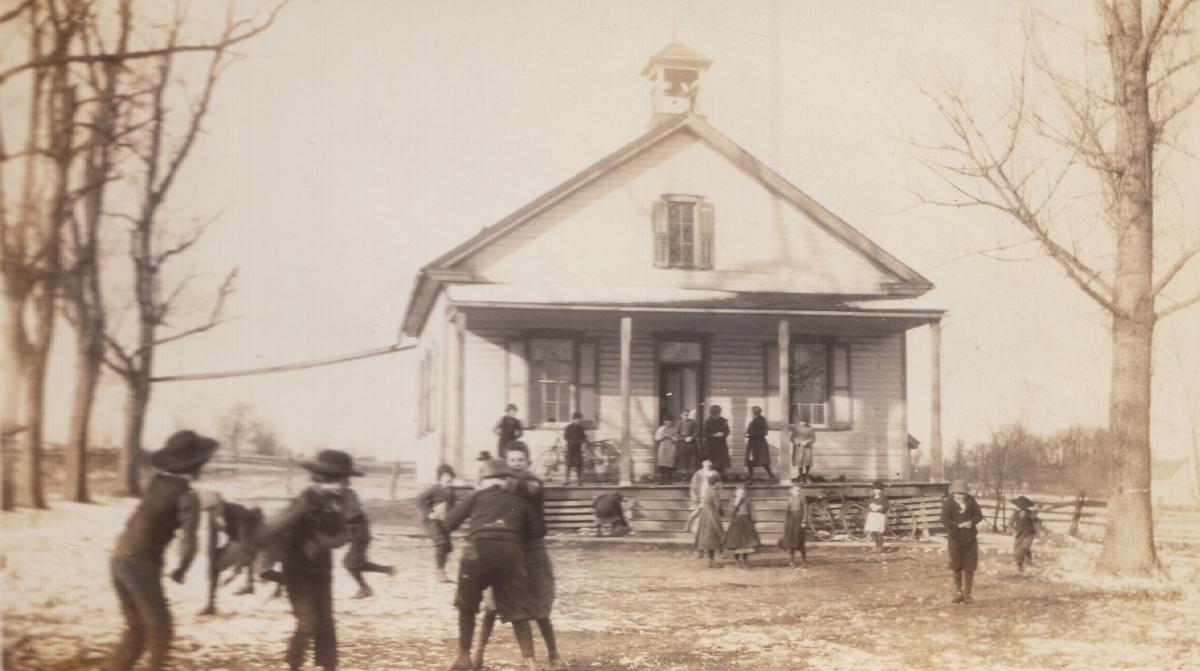
1. This image captured in 1923 from the Landis Valley Museum and featured on PBS.org features both Amish and English children playing in front of the Millcreek School, a traditional one-room schoolhouse in Stormstown, Pennsylvania. The photo was taken at a time when Amish students attended public schools with non-Amish children. Because the Amish of that time considered photography to be a violation of the Second Commandment, which prohibits the making of “graven images”, it was difficult to find pictures from that era, because most Amish would object to getting their photo taken.
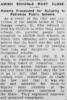
2. This article from the PA News Archives was featured in The Star newspaper, Reynoldsville, Pennsylvania on October 12, 1904. Prior to the landmark decision of Wisconsin v. Yoder in 1972, Amish fathers were prosecuted for refusing to allow their children to attend public school, not only in Pennsylvania, but also in states including Ohio, Iowa, and Wisconsin. As evidenced in the article by the words “peculiar people”, non-Amish individuals, even those with prominent upbringing and education, were ignorant of the Amish religion and its followers.
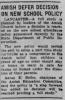
3. & 4. These articles were taken from the PA Power Archives Digital Library and were both run in the Wilkes-Barre Sunday Independent in 1953 and 1955. They represent a time when the Commonwealth was still steadfast in requiring Amish children to attend school until age 18, but as we start to see here, the Department of Education is becoming open to new ideas which adhere to its requirements but also allow the Amish to maintain their religious beliefs.
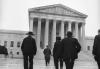
5. This image was taken by Capitol Hill photographer, John Duricka, in 1971, and captures Amish men walking into the U.S. Supreme Court during the landmark case of Wisconsin v. Yoder, 406 U.S. 205 (1972). The case was sparked after three Amish families in Wisconsin were prosecuted under Wisconsin law for refusing to send their children to public high school. It is important to note that Harrisburg attorneys, William B. Ball and Joseph Skelly, successfully argued the case on behalf of the Amish men, which allows Amish children to attend parochial schools in order to protect their religious beliefs.
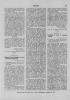
6. This memorandum was taken from the PA Power Library’s Digital Library and was contained in Volume 3, No. 4 of the PA Bulletin in 1973. As written by Pennsylvania Attorney General Israel Packel to the Secretary of the Department of Education, this memorandum is still advising the Department to mandate children to attend school until age 18. The AG is arguing that because the Commonwealth created the Amish Operated School Program, which is described in images three and four, it will not violate the recent Yoder decision by compelling Amish children to continue schooling until age 18.