
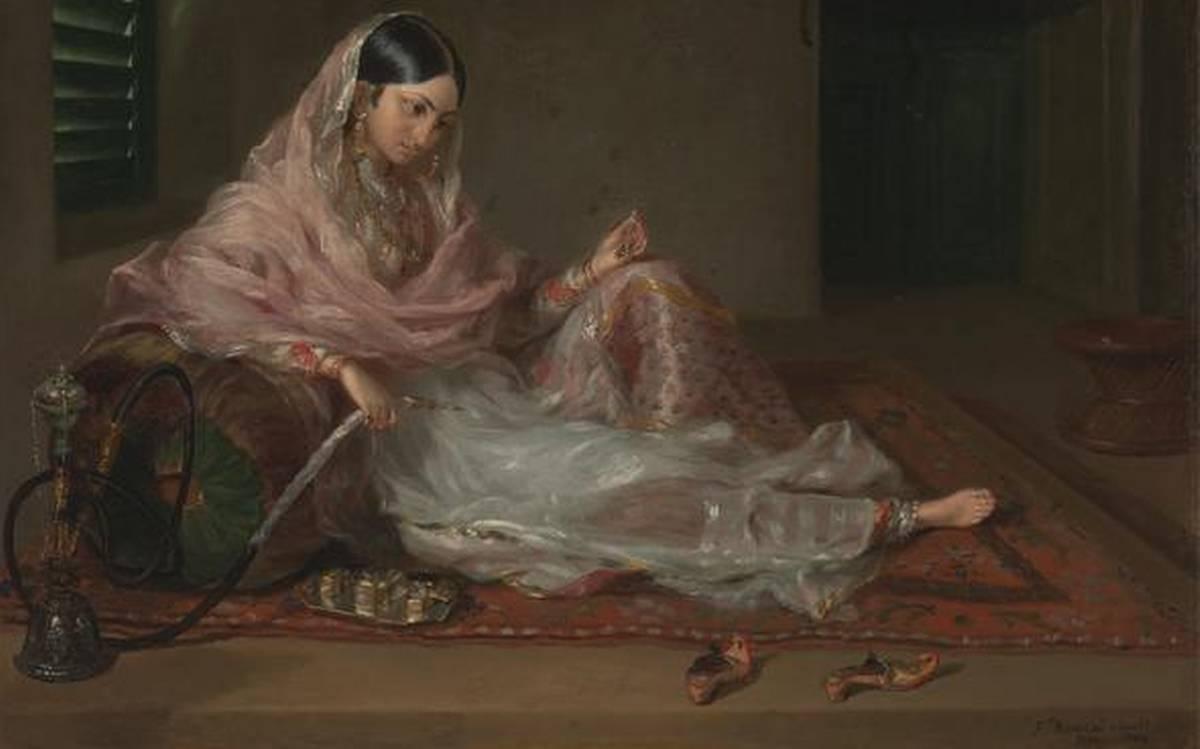
Hookah, also known as Shisha, is a water pipe used to smoke tobacco. The history of the hookah is strong in Indian culture and dates back to the late 16th century. Smoking the hookah was practiced by both Indian men and women alike. Hookah originated as a way of reducing potential harm from smoking but eventually became ingrained in the culture as a social marker. In fact, English women who lived in India during the colonial period used to smoke hookah as a form of “fashion.” It maintained its prevalence in society throughout the 1800s, and is mentioned in many historical texts from this time. One text published in 1867 titled India And Its Native Princes: Travels In Central India And In The Presidencies Of Bombay And Bengal 1864-1865 spoke of hookah almost exclusively when the author/narrator is in the presence of aristocracy or nobility. The hookah pipe itself demonstrated wealth as some surpassed 3 feet in height and had hand-carved intricacies and embellishments with precious stones.
Sen mentions hookah only once in her text, at a moment where she is feeling very inferior. She is ordered to prepare the hookah for Kalicharan’s Grandma after first travelling to East Bengal, but does not know how to do so correctly. She ultimately packs the tobacco in so tightly that no smoke was able to come from it. The Grandmother makes her do it again (pg 89). Sen in this moment is doing the work of a servant, as many noble men and women would not prepare the hookah themselves. Hookah was a sign of nobility and affluence in Indian society, Sen’s unfamiliarity with it emphasizes the lower place in society that she holds despite the Brahmo caste she was born into.
Sources:
Ray, Cecily S. "The Hookah – the Indian Waterpipe." Current Science 96, no. 10 (2009): 1319-323. Accessed February 28, 2021. http://www.jstor.org/stable/24105369.
Rousselet, Louis. “India and Its Native Princes. Travels in Central India and in the Presidencies of Bombay and Bengal : Rousselet, Louis, 1845-1929” Internet Archive. London Bickers, January 1, 1882. https://archive.org/details/indiaitsnativepr00rousuoft.