
This edition of the Rubáiyát was written by Carolyn Wells and illustrated by May Wilson Preston. Carolyn Wells was a prolific American writer renowned for her wide-ranging body of work, which includes poetry, children’s literature, parodies, and mystery novels. In the early phase of her literary career, roughly the first decade, Wells focused primarily on poetry, humor, and writing for children. The Rubáiyát of Bridge is a product of this early period and exemplifies her flair for light verse and clever parody. The book offers a humorous take on the then-popular card game bridge, combining the format and rhythm of Omar Khayyám’s Rubáiyát with playful commentary on the social dynamics of card playing.
Later in her career, Wells shifted her focus to the mystery genre after being inspired by a detective novel she encountered. From that point onward, she became a dedicated mystery writer, producing an extensive number of detective stories and novels. She continued writing in this genre until her death in 1942, eventually becoming a significant figure in early 20th-century American mystery fiction.
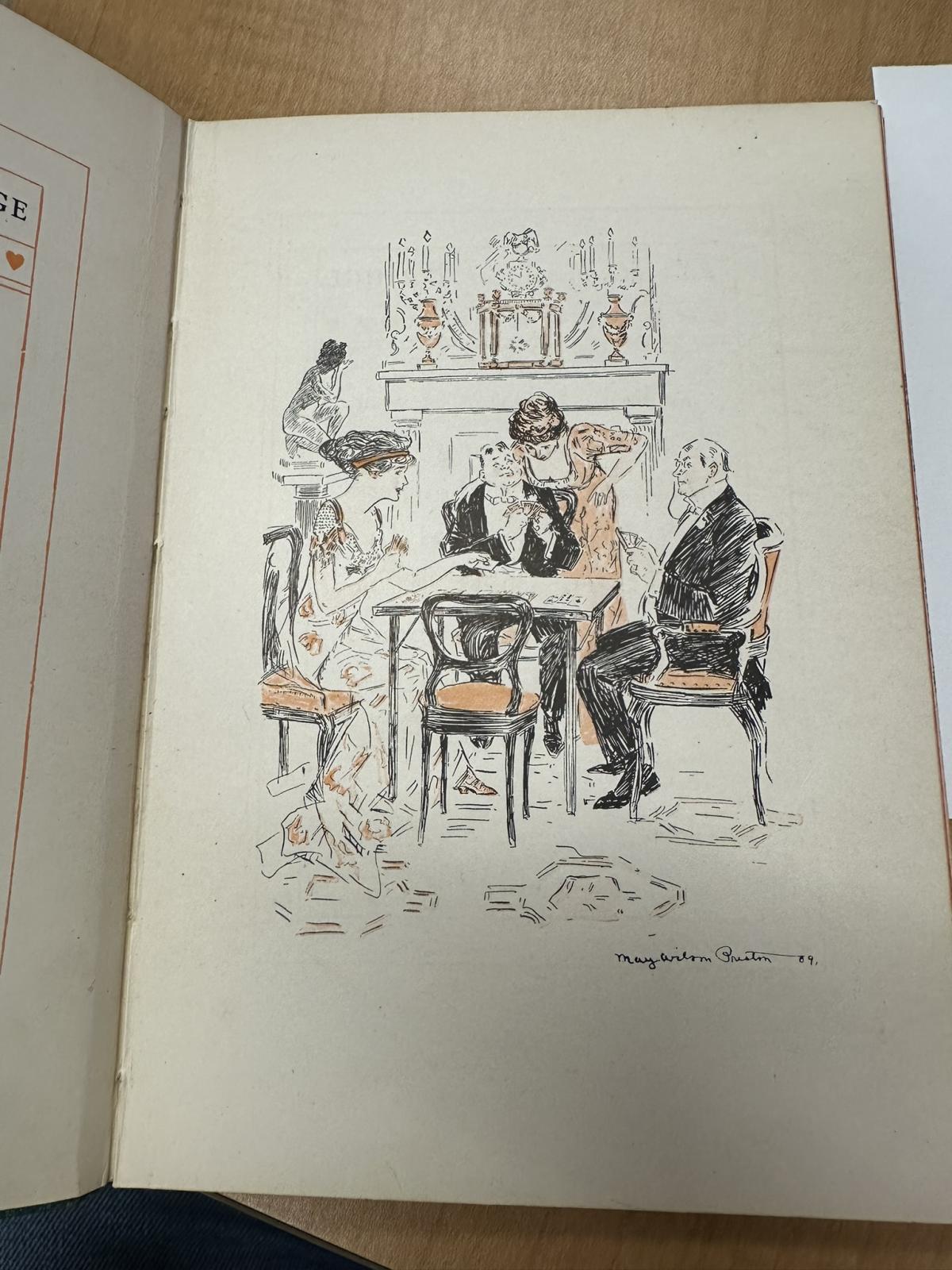
The illustrations for The Rubáiyát of Bridge were provided by May Wilson Preston, a distinguished American illustrator and artist. These illustrations are known for their vibrant color, expressive characters, and socially attuned nature. This is clear in The Rubáiyát of Bridge as we see the illustrations bring to life the game of Bridge. In Figure one we can see some men and women clustered around a table playing Bridge. We can see their furrowed brows concentrating on the game at hand. This illustration demonstrates Wilson Preston's colorful and social nature of her illustrations.
Early in her life, May Wilson Preston demonstrated a strong commitment to advancing the role of women in the arts, both through her work and her advocacy. Shortly after finishing high school, she became one of the founding members of the Women’s Art Club in New York City. This organization provided a critical platform for women artists to exhibit their work, build networks, and gain visibility in a male-dominated art world. Over time, the group evolved into the National Association of Women Artists (NAWA).
Wilson Preston launched her professional career by contributing illustrations to prominent periodicals such as Harper’s Bazaar. In 1903, she married fellow artist James M. Preston, and the two occasionally collaborated on illustration projects, including co-illustrating magazine stories. Throughout her career, May Wilson Preston became especially known for her work with Harper & Brothers, where her illustrations graced numerous publications. This is where Wilson Preston did her illustrations of The Rubáiyát of Bridge. The Rubáiyát of Bridge was published by Harper & Brothers publishing company in 1909. Harper & Brothers was founded in New York City in 1817 by James and John Harper, the company originally operated as J. & J. Harper before officially becoming Harper & Brothers in 1833. By the early 20th century, when The Rubáiyát of Bridge was released, the company had already established a reputation for producing both high-quality literature and popular works. Wilson Preston joined Harper & Brothers and began illustrating for many of their published works.
Widely regarded as one of the leading female illustrators from the early 1900s through the 1940s, Wilson Preston made significant strides in a male-dominated industry. She was the first woman admitted to the prestigious Society of Illustrators and remained one of the few women in the organization for many years. Her contributions to the field not only elevated the visibility of women illustrators but also paved the way for future generations of female artists.
Sources:
Wells, Carolyn. "Carolyn Wells." Poetry Foundation, Poetry Foundation, https://www.poetryfoundation.org/poets/carolyn-wells.
"May Wilson Preston." Encyclopaedia Britannica, Encyclopaedia Britannica, https://www.britannica.com/biography/May-Wilson-Preston.
"Harper Brothers." Encyclopaedia Britannica, Encyclopaedia Britannica, https://www.britannica.com/topic/Harper-brothers.