
The first edition of Rubáiyát by Omar Khayyám, translated by Edward FitzGerald, has a remarkable story that begins in a London bookshop. First published in 1859, this now-famous text was initially just one of many small publications produced by a bold and ambitious bookseller. Its eventual cultural significance owes much to the man who believed in it from the start: Bernard Quaritch. The story of this edition is about more than poetry, it is also about friendship and craftsmanship. The journey of Rubáiyát shows how even the quietest beginnings can lead to lasting literary impact when supported by vision and care.
Bernard Quaritch opened his bookshop in 1847 and quickly earned a reputation for dealing in rare and valuable books. His customers included prominent names such as Prince Louis Lucien Bonaparte, Prime Ministers William Ewart Gladstone and Benjamin Disraeli, and the Earl of Crawford and Balcarres, owner of the Bibliotheca Lindesiana. William Morris, the influential designer and writer, was also one of Quaritch’s important clients. Through these high-profile connections and his skill in identifying valuable works, Quaritch became a major figure in the world of book collecting and literary publishing.
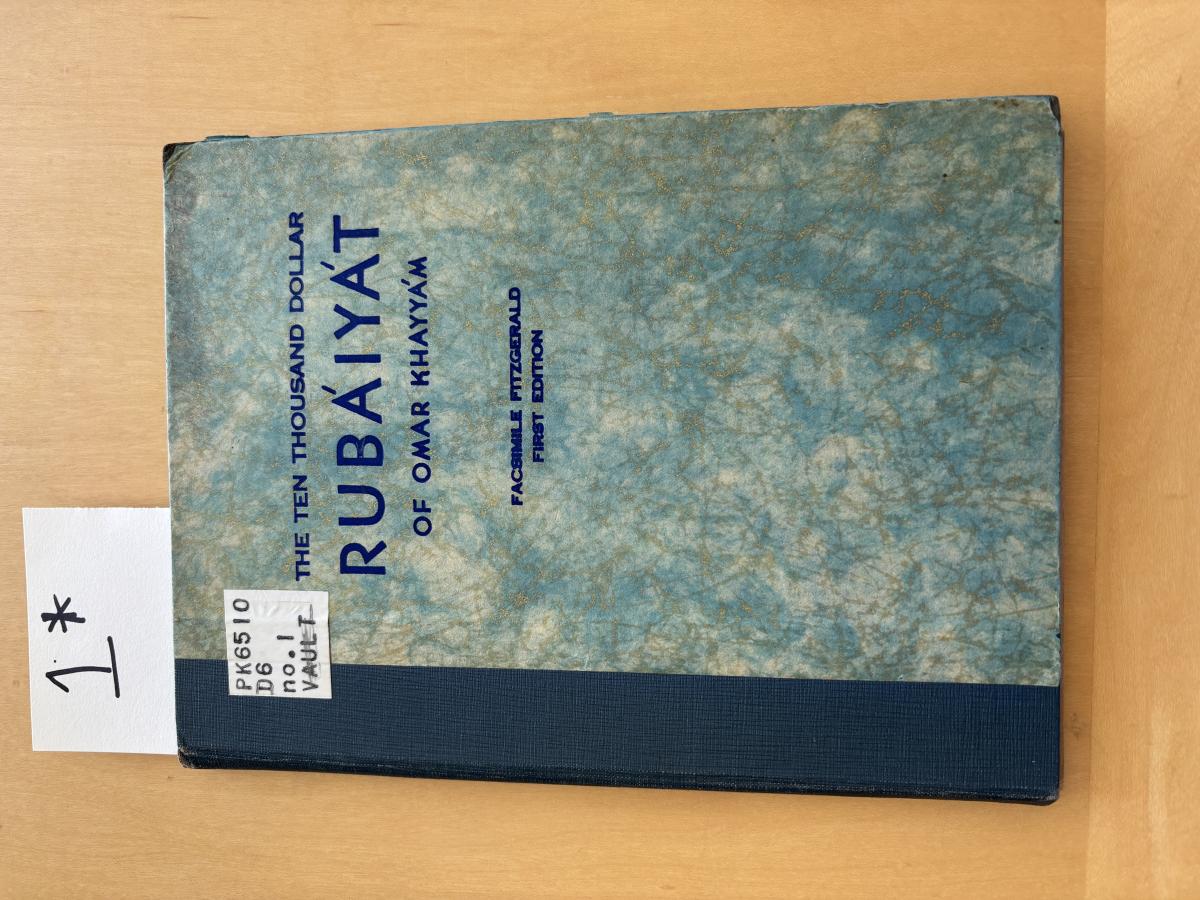
One of Quaritch’s earliest and most loyal customers was Edward FitzGerald. Their regular conversations at the shop eventually grew into a close friendship. This connection proved essential when FitzGerald completed his translation of a series of Persian quatrains, which became the Rubáiyát of Omar Khayyám. Edward FitzGerald’s connection to the shop was more than casual; as noted, “Edward FitzGerald, who frequented the shop from the first, was to become an intimate friend and it was Quaritch who first published FitzGerald’s translation of Rubáiyát of Omar Khayyám in 1859” (Bernard Quaritch, 2016). This first edition was simple in design, but later versions became visually striking. “These books were described as being very decorative and alluring with gilt edges, beautiful bindings, and lovely engravings to delight and impress the recipient” (Birzer, 2013). The facsimile edition pictured reflects this tradition, with its marbled blue-green paper cover, elegant lettering, and careful reproduction of the original’s charm (Figure 1). Even as a reproduction, it captures the beauty that helped elevate Rubáiyát into the cultural imagination.
The relationship between FitzGerald and Quaritch was key to the existence of Rubáiyát. Without Quaritch’s willingness to publish the work, FitzGerald’s translation might have remained unknown. Though it was not a major success at first, the book slowly gained attention among literary circles. Over time, it became one of the most widely published and quoted poetic works in English, all beginning with a quiet release supported by a trusted bookseller. It is a testament to how literary taste and timing, paired with belief in an author’s voice, can eventually shift the course of cultural history.
Today, the first edition of Rubáiyát is not only a literary treasure but also a symbol of the importance of vision and support in the world of publishing. Its striking appearance, intimate origin, and lasting legacy continue to captivate collectors and readers. The facsimile serves as a reminder of its elegant past and the hands that helped shape it. Thanks to the collaboration between FitzGerald and Quaritch, a small book of translated poetry became a lasting masterpiece that still resonates over 160 years later.
Bernard Quaritch Ltd - Rare books, manuscripts & photographs. (2016, March 18). https://www.quaritch.com/about/our-history/
Birzer, Bernadette (2013) "Exploring 19th Century Gift Books in a Special Collection: A Collection Analysis," https://aquila.usm.edu/slisconnecting/vol2/iss2/8