
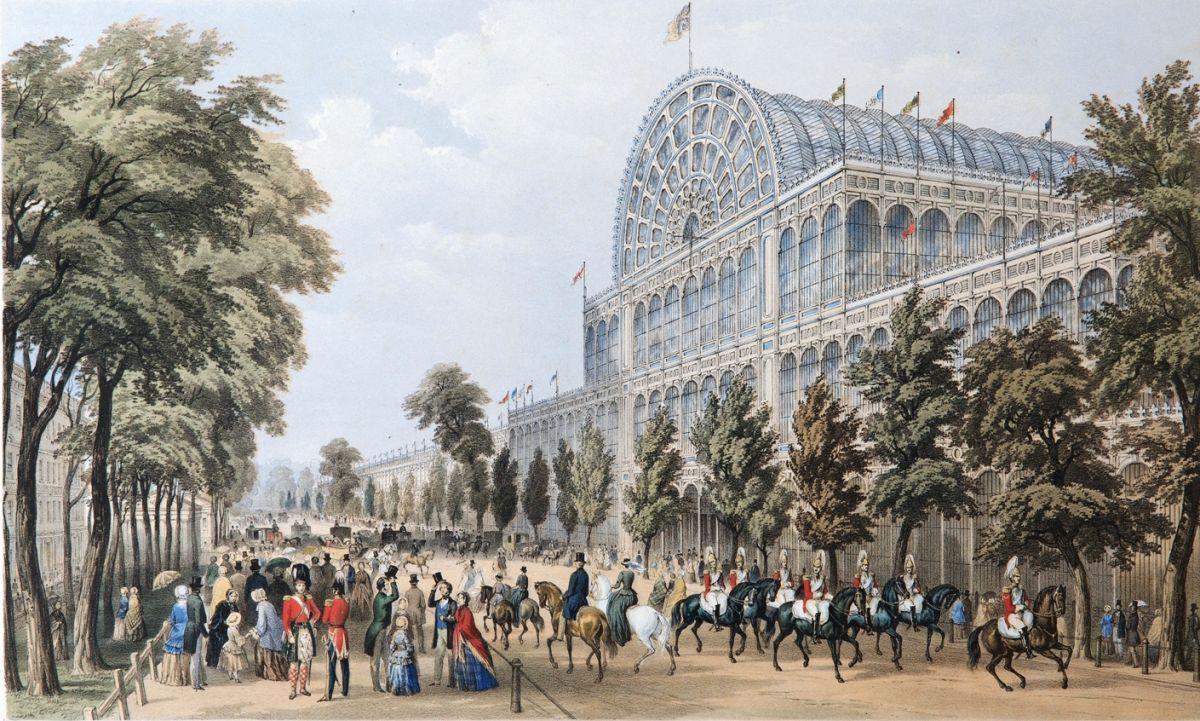
This is a drawing of Hyde Park featuring the Crystal Palace, which was erected in the 1850s for the Great Exhibition.
In the final passage of Chapter 1, Mill recalls the first moment his father acknowledged that he was different from others. Mill notes, “I remember the very place in Hyde Park where…he told me that I should find, as I got acquainted with new people, that I had been taught many things which youths of my age did not commonly know” (Mill 24). The physical setting of Hyde Park is important to this realization, not least because the park was a totally public place, open every day of the year to people from all walks of life. Thus, at the same time as Mill reveals his special knowledge to the reader, he also situates himself in a position of commonality.
Established as a royal hunting grounds in the 1500s, by the 19th century, Hyde Park was increasingly known as a place for public gathering. A number of national celebrations were held there throughout the 1800s, including the Great Exhibition, which showcased works of industry from the age and was attended by over six million people.
Moreover, in 1866, the Reform League marched through Hyde Park, resulting in conflict with the police force, which Mill notes later in his autobiography, writing, “the Tory Government brought in a bill to prevent public meetings in the Parks, I not only spoke strongly in opposition to it, but formed one of a number of advanced Liberals, who…succeeded in defeating the Bill” (Mill 155-156). Despite only attending one Reform League meeting and disagreeing on a number of their central tenants, Mill continues to align himself with the interest of the public through his stance towards the park. In fact, this work led to the establishment of Speaker’s Corner in Hyde Park, which exists to this day as a place where anyone can go to say whatever they would like.
Sources:
- https://www.regencyhistory.net/2018/01/hyde-park-in-regency-london.html
- https://www.royalparks.org.uk/parks/hyde-park/about-hyde-park/landscape-history
- https://www.royalparks.org.uk/parks/hyde-park/about-hyde-park/history-and-architecture
- https://www.historic-uk.com/HistoryUK/HistoryofEngland/Great-Exhibition-of-1851/#:~:text=The%20Great%20Exhibition%20of%201851%20ran%20from%20May%20to%20October,points%20of%20the%20nineteenth%20century.