

The purpose of my gallery is to demonstrate how racial stereotyping has transition through adaptations of a specific work. In an era where the discussion of racism and stereotypes about certain groups can come off as sensitive for most, I find it important to address these issues to further construct how society should respond to them. Indeed, showing these pictures could be hard for the easily offended but denying their existence only adds to the problem of how racism still affects society. I would like to be clear that my intentions are not to cancel the movies, books, or people associated with these images rather use their likeness as means to talk about the racial stereotypes that came with the associated property.
I wanted to focus on various adaptations of Strange Case of Dr. Jekyll and Mr. Hyde from Robert Louis Stevenson where the character of Mr. Hyde has been portrayed as a racial stereotype against African Americans on the grounds to mock or perpetrate violent characterization. The first image shown is that of Fredric March portraying the character of Hyde from 1931 film adaptation of Dr. Jekyll and Mr. Hyde. Next comes from an illustration drawn by Edmund Joseph Sullivan for another publication of the original Stevenson text. Then, the third picture originates from a Looney Tunes cartoon starring Sylvester the Cat and Tweedy Bird titled Hyde and Go Tweet. Finally, the picture to conclude the gallery is that of Eddie Murphy from his star vehicle 1996 The Nutty Professor, which was a remake to the 1963 Jerry Lewis comedy of the same. Each of these pictures will be reference with two sources related to the topic of racial stereotyping. One comes from Jessica Metzler’s article “Lusty Ape-Men and Imperiled White Womanhood” while the other is that of Charles Darwin’s The Expression of the Emotion in Man and Animals. I hope everyone will enjoy my display and that it will provide discussions on how to look at stereotypes in a new manner.
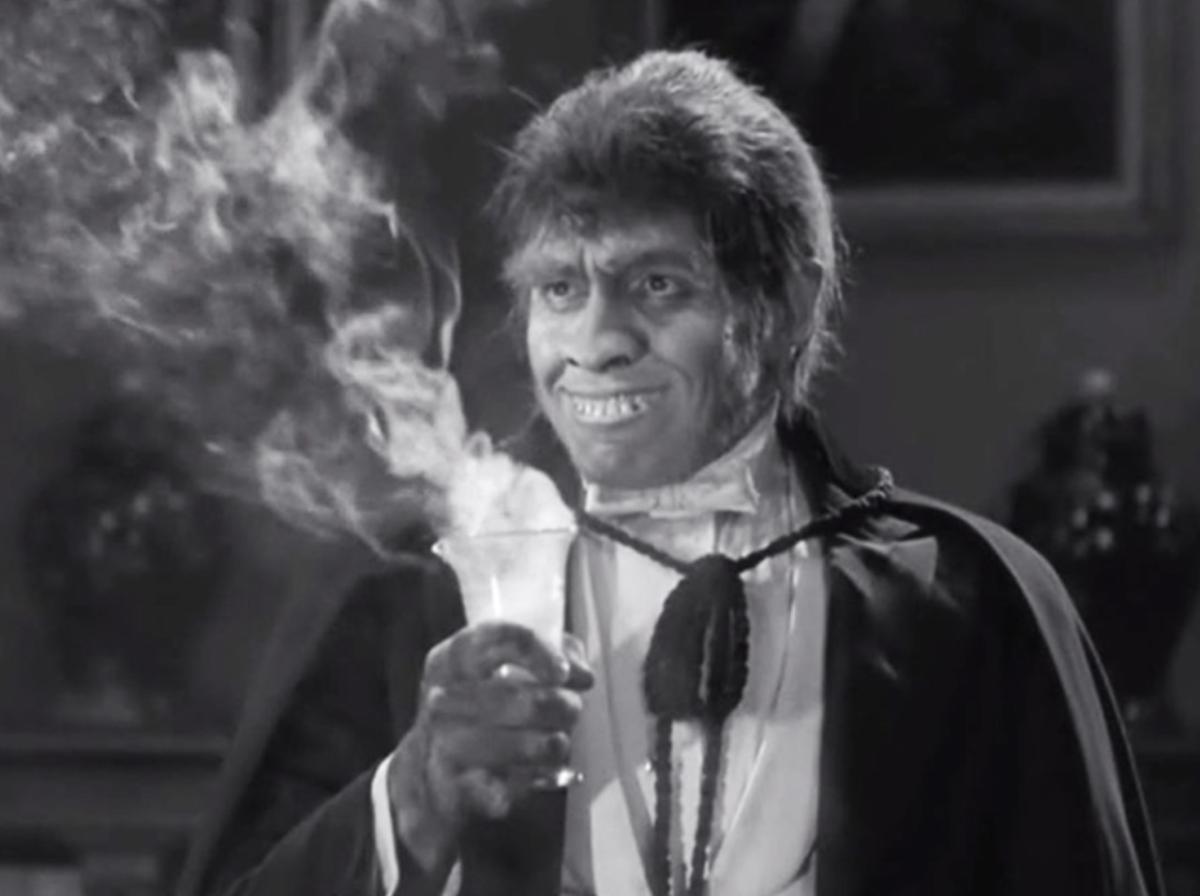
Dr. Jekyll and Mr. Hyde. Directed by Rouben Mamoulian, Paramount Pictures, 1931, (1:17:04).
When Mr. Hyde arrives to Lanyon’s home to retrieve a box of the formula that would turn him back into Jekyll, the other doctor holds him at gunpoint until made aware of the safety of his friend. Despite this order, Hyde goes ahead mixing the formula together warning Lanyon about what he could witness in the screenshot. Notable about the shot comes from the low-key lighting where the formula bottle emits light onto Hyde’s face more clearly. The light from the bottle reveals an otherwise hideous looking creature with bushy eyebrows, jagged teeth, and flat nose. Another detail about Hyde within the frame is his arm holding the bottle which looks quite hairy. An audience who had seen the character back when the film came out would have thought Mr. Hyde to be some form of ape-like human. However, Jessica Metzler wrote about in “Lusty Ape-Men and Imperiled White Womanhood” that around the 1930s as the film came out, Hollywood pictures “displayed a fascination with racialized representations of apes” (34).
Indeed, Hyde perpetrates a racial stereotype about African Americans garnering more ground from white people. The film takes that stand with Hyde beginning to take over Jekyll’s body. But the frame makes that more apparent with the two vases behind Hyde in the shot. From Hyde’s left, the vase seems faded out from the steam coming out of the bottle and lighter in comparison with the vase from the right, which looks noticeably darker. Jekyll could act as the vase from the left about to fade away over the control of Hyde represented with the right vase. In an era of segregation and Jim Crow laws implemented by Whites over fear of African Americans, neither Hyde’s appearance nor actions does much for positive portrayal towards the latter.
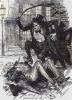
Sullivan, Edmund Joseph. Mr. Hyde assassins Sir Danvers Carew. 1927. Strange Case of Dr. Jekyll and Mr. Hyde, by Robert Louis Stevenson, 1886, p. 21.
Edmund Joseph Sullivan’s illustration depicts the murder of Sir Danvers Carew from Mr. Hyde, which the original text from Robert Louise Stevenson had never fully shown. What appears striking about the depiction comes from the juxtaposition of Hyde attacking from above to Carew laying down below him. Hyde is depicted throwing an entire rage onto Carew with his right hand whacking the gentleman with a cane while his right arm stomps over the poor man’s body. His left hand is clawed expressing the sense of anger towards Carew as he murders the fellow away. On his face, Hyde expresses a sneer from his mouth while he looks down viciously at his victim. Charles Darwin noted in The Expression of the Emotions in Man and Animals how sneering of the mouth “protruded during rage in a manner, the meaning of which I do not understand, unless it depends on our descent from some-like animal” (155). The depiction of Hyde mirrors that of the ape-man stereotype commonly associated against African Americans. Behind Hyde, his shadow illuminates on the brick wall making him seem like an ape on a rampage. It makes it even worse with Sir Danvers Carew, who is drawn as white with his head tilted backwards and chess up after being attacked by Hyde.
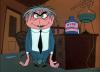
Hyde and Go Tweet. Directed by Friz Freleng, Warner Bros. Pictures, 1960, (0:55).
In this Looney Tunes cartoon, the characters of Dr. Jekyll and Mr. Hyde are adapted into the zany setting of the titular animated series. Following the opening credits, Dr. Jekyll arrives to his office where he drinks a bottle that quickly transforms him into Mr. Hyde. There is not any reason given to why Jekyll drinks the bottle for the occasion other than that this is another adaptation of the story. In the screenshot, the framing juxtaposes the bottle labeled “Hyde Formula” from the right of Mr. Hyde to make a clear connection that the bottle led to the transformation.
At initial glance, the depiction of Hyde does not come across as anything racially sensitive. However, looking carefully shows some level of the ape-man stereotype commonly found in characterizations. His arms lag onto the floor like that of an ape with his knuckles touching the ground similarly to how the primate walks. Although his skin color looks pink indicating that he is white, its arguable that the depiction is meant to parody the ape-man trope associated with blacks. Furthermore, Jessica Meltzer notes in “Lusty Ape-Men and Imperiled White Womanhood” how primitive discussion around African Americans “linked black Americans with both animals and “less evolved” African Others” (33). Hyde displays being “less evolved” from Jekyll through his unintelligence that the viewer laughs out. His silly grin revealing gapped teeth and crazed cross eyes are cartoonishly exaggerated for comedic purpose. Instead of parodying the stereotype on a commentary level, the cartoon uses the stereotype as means of mocking at it.
The Nutty Professor. Directed by Tom Shadyac, Universal Pictures, 1996, (0:37:20).
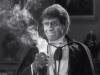
When Sherman Klump drinks the formula to turn him from an overweight to thin, he embodies the character of Buddy Love in a remake to the sixties Nutty Professor which was already an adaptation of Dr. Jekyll and Mr. Hyde. During a montage that introduces the character of Buddy, who goes about experiencing the first time being trim down in weight, Love finds himself outdoors eating with various unhealthy food. In the image provided, the camera incorporates a close-up shot of Buddy as he shouts about his recent loss of weight. The close-up shot provides enough about Buddy personality wise; he comes across as very loud and obnoxious. His mouth is full of a piece of burger while he rambles about himself giving the audience the impression to feel disgusted by his eating habits.
Where Buddy comes off as a stereotype is how he perpetrates the idea of African Americans being loud. In “Lusty Ape-Men and Imperiled White Womanhood,” Jessica Metzler reported how following the thirties there was discussion on blacks being seen “as uncivilized, superstitious, libidinal, and id driven” (36). This can be true of Buddy who seems uncivilized by not respecting his surroundings acting as the id of Sherman that disrupts the public. His annoyance and talkative attitude are meant to be made fun of as in the background behind Love, two women out of focus from the shot appear to be staring at him. The woman from the left is shown to be enjoying his antics humorously, an indication for the audience to join as well. Like the public from the film, the audience laughs at Buddy for his stereotypical loudness that gets associated commonly with his skin color.
Work Cited
Darwin, Charles. The Expression of the Emotions in Man and Animals. London: John Murray, 1872).
Metzler, Jessica. “Lusty Ape-men and Imperiled White Womanhood: Reading Race in a 1930s Poe Film Adaptation.” Adapting Poe: Re-Imaginings in Popular Culture, ed. Dennis R. Perry and Carl H. Sederholm. New York: Palgrave-Macmillan, 2012, pp. 31-43.