
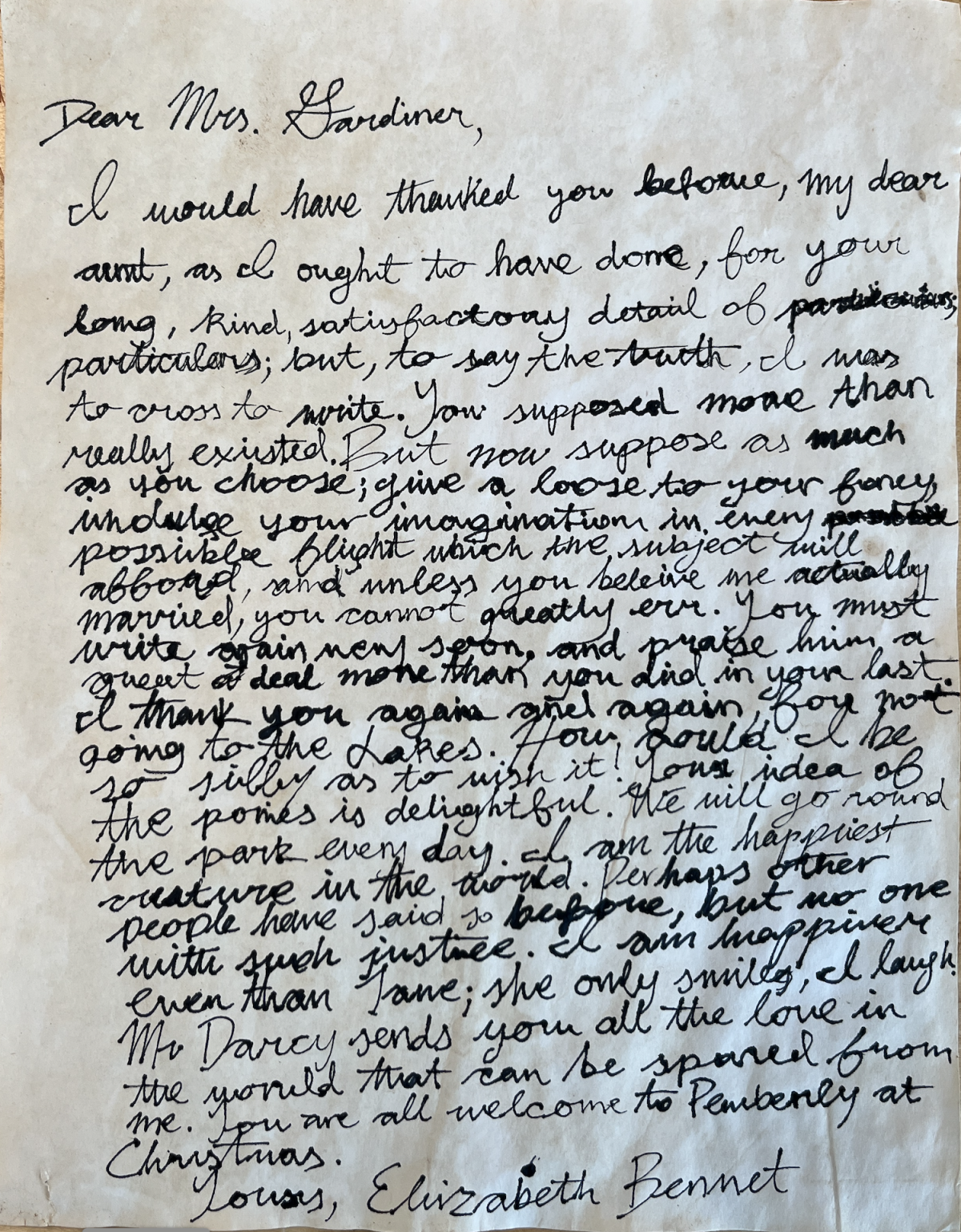



Elizabeth Bennet's letter to her aunt, Mrs. Gardiner, in Pride and Prejudice (1813) reflects the role that letter writing played in the Regency era by being the main form of communicating news. Additionally, Elizabeth's letter emphasizes how letters were used to express affections during the Regency era. Despite the rough beginning of Elizabeth Bennet and Mr. Darcy’s relationship, they find a happy and joyful ending together. This letter successfully highlights Elizabeth’s happiness and success in marrying for love. This joy is clearly depicted as Elizabeth proclaims to be the “happiest creature in the world.” Elizabeth even goes so far as to compare her happiness to that of Jane, noting, “she only smiles, I laugh.” This difference is important as Elizabeth and Jane have a strong sisterly bond throughout the novel, where Elizabeth views any success of Jane's as a success for herself, too. Therefore, the written comparison to Jane’s happiness continues to highlight the extent of Elizabeth’s happiness. This letter is also special, as in contrast to other Jane Austen novels, Pride and Prejudice (1813) is the only one where the reader gets to hear of the heroine’s happiness directly from her. This virtual display case focuses on the depictions of Elizabeth's happiness, as well as Mr. Darcy and her family, as a result of Mr. Darcy and Elizabeth's marriage. The first image shows the recreated letter from Elizabeth Bennet to Mrs. Gardiner. The second image shows the process of recreating this letter, and the third shows the folded letter. The fourth image depicts Elizabeth and her father, Mr. Bennet, notably happy at the end of the 2005 film adaptation of Pride and Prejudice. Lastly, the fifth image illustrates Mr. Darcy and Elizabeth in the 1995 TV Series adaptation of Pride and Prejudice, as well as in the 2005 movie adaptation. All these images work together to depict the joy and happiness felt by everyone at the end of Pride and Prejudice.
Recreation of Elizabeth Bennet’s Letter to her Aunt, Mrs. Gardiner, in Pride and Prejudice (1813), Photo taken by Kara Duffy, October 2025. While recreating this letter, I realized how significant it is to show the reader how joyful Elizabeth is with her engagement to Mr. Darcy. This joy is especially apparent when Elizabeth compares herself to Jane by saying that “she only smiles, I laugh.” The Bennet sisters are consistently compared to each other throughout the novel; however, in contrast to past comparisons, Elizabeth compares herself with Jane in a positive manner to show how truly happy both are. Through our course we have learned how important letter writing is to show affection between the sender and receiver. While the letter does illustrate affection between Elizabeth and the receiver, Mrs. Gardiner, Elizabeth also uses the letter to emphasize her strong affections for Mr. Darcy. The continuous outpour of gratitude and love within this letter made it fun to write.
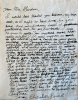
Process of Creating a Letter from Pride and Prejudice, Photograph by Catherine Golden, October 2025. The second image illustrates me in the process of writing the letter Elizabeth Bennet sends to Mrs. Gardiner. To recreate this letter, I used the dip pens from the Idea Lab and tea-stained paper from Dr. Golden. To make the letter more authentic, I used black ink with the dip pens. As I did not feel very confident about writing in cursive, I also had a scrap paper next to the tea-stained paper. I first practiced on the scrap paper to get a feel for how to use the dip pen and how much ink to use. After practicing for a little, I started writing my letter, which in the end took me longer than expected. Even after practicing, I had a few words that were illegible that I then crossed out.
Folded Letter from Pride and Prejudice, Photograph by Catherine Golden, October 2025. The third picture above depicts another version of the final recreated product. After I was done copying the words, I folded the letter using the technique that Dr. Golden told us was used during the Regency era. This folding technique keeps the letter together and almost creates an envelope out of the tea-stained paper. After folding the letter, I melted green wax and used a tree stamp to seal the letter. I chose the color green as I believe it reflects Elizabeth's down-to-earth character as well as her love of walking through nature and not caring about getting muddy. I chose the tree stamp with the same thinking, as it matches the color green and portrays Elizabeth's character.
Elizabeth Bennet and Mr. Bennet in the 2005 Movie Adaptation of Pride and Prejudice. By having the recipient of the letter be Mrs. Gardiner, Austen also emphasizes how big of a role Elizabeth’s family has played during her developing relationship with Mr. Darcy. The fourth image shows Elizabeth and her father after he approves her marriage with Mr. Darcy in the 2005 movie adaptation of Pride and Prejudice. The illustrated joy on both of their faces mirrors the feelings Elizabeth expresses within her letter. This moment and the letter parallel each other, as both illustrate the role that the Bennet family played in bringing Elizabeth and Mr. Darcy together. Mr. Bennet plays a role, as he explicitly allows Mr. Darcy and Elizabeth to marry. However, Mrs. Gardiner also plays a large role. Elizabeth sends the letter to thank her aunt and tell her how grateful she is that they did not go the “the Lakes.” Going to Pemberley allows Elizabeth to interact with Mr. Darcy after rejecting his first marriage proposal and actively pushes them together again. Therefore, by highlighting the family's involvement, Austen shows how everyone is happy due to Elizabeth and Mr. Darcy's marriage, not just the two of them.
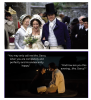
Elizabeth Bennet and Mr. Darcy in the 1995 PBS Version and the 2005 Movie Adaptation of Pride and Prejudice. The fifth image is a collage of the ending scenes in the 1995 PBS version and the 2005 movie adaptation of Pride and Prejudice. These two images work together to successfully illustrate the utter happiness and joy Elizabeth writes about in her letter. The image on top is from the 1995 adaptation and perfectly depicts the line in the letter where Elizabeth compares herself to Jane and writes "she only smiles, I laugh." This image successfully depicts this line, as Elizabeth is pictured laughing in her wedding dress. Even Mr. Darcy, who is famously stoic throughout the novel, is smiling in this image. The image on the bottom is an additional end scene from the 2005 movie adaptation after Elizabeth and Mr. Darcy are married. I have added captions to the image to show what Elizabeth and Mr. Darcy are saying to each other. As seen in the image, Mr. Darcy is "completely and perfectly and incandescently happy," because he calls Elizabeth "Mrs. Darcy." Even though the letter is from Elizabeth's perspective, Mr. Darcy is referenced as he "sends [Mrs. Gardiner] all the love in the world," which does insinuate him being very happy. Therefore, both images highlight not only the happiness of Elizabeth but also Mr. Darcy. Furthermore, in contrast to other Jane Austen novels, the happiness shining through in this letter makes the ending feel not as rushed and the relationship between Elizabeth and Mr. Darcy appear more genuine.